



LAS VEGAS – After the Celtics selected Dillon Mitchell with the 40th overall pick, Vice President of Basketball Operations Mike Zarren jumped on a Zoom call with reporters to discuss the newest addition.
One of the first questions centered around Mitchell’s jump shot and how much room for growth the Celtics believed it had.
“He can be successful, even when he’s not shooting the ball. But he’ll get better at his shot,” Zarren said. “We don’t have any doubt about that. If you watch enough, you’ll see he’s got the ability to get better there. So, like any young player, there are things to work on. That’s one for him, but we’re really excited about Dillon.”
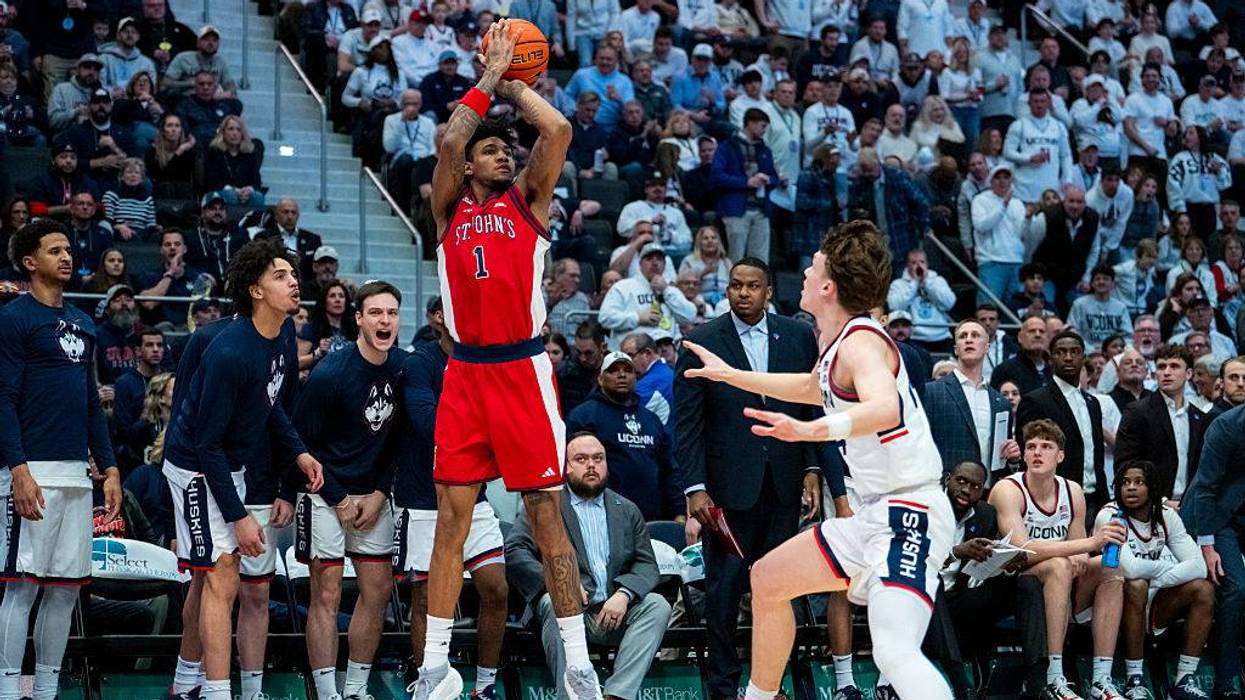
Mitchell shot just 1-of-15 from three-point range last season and 11-of-57 (19.3%) across his collegiate career. Through three Summer League games, he’s made three of his eight attempts (37.5%), slightly above the NBA’s league-average mark of 36.0% over the last two seasons.
Are we ready to declare his jump shot fixed after eight attempts?
Of course not.
But for a player widely viewed as a non-shooter entering the NBA Draft, it’s an encouraging start.
“Just the work that we’ve been putting in, especially with Coach Craig [Luschenat]. Just working on the jump shot and being confident. Confident in it,” Mitchell said. “Just going out there and playing confident, and especially hearing their confidence in me to just shoot the ball, and I know they’re going to crash and everything like that. So, just the confidence they instill in us.”
Mitchell has been working closely with Craig Luschenat, the head of Boston’s player development team, who also works extensively with Payton Pritchard (career 39.4% three-point shooter), Sam Hauser (career 41.2%) and Baylor Scheierman (career 37.8%). That trio shot a combined 38.9% from three last season.
Although Mitchell and Luschenat have made some minor tweaks to his shot, the biggest difference has been the confidence Luschenat and the rest of the Celtics’ coaching staff have instilled in the 22-year-old.
“Just having confidence in [my shot]. Everybody on the bench has confidence in me shooting the ball,” Mitchell said. “There wasn’t a lot we were able to do before Summer League — but as far as just confidence and tweaking the little things, and after Summer League, when we have a lot of time, and I get back to Boston, we’ll definitely work on it a lot more.”
Dillon Mitchell on the progress in his jump shot:
“Just having confidence in it. Everybody on the bench has confidence in me shooting the ball… After Summer League, when we have a lot of time and I get back to Boston, we'll definitely work on it a lot more.” pic.twitter.com/H1wJCrdHaw
— Justin Turpin (@JustinmTurpin) July 14, 2026
Mitchell isn’t the only rookie already showing progress in an area the Celtics identified for improvement.
Chris Cenac Jr. has shown early progress as a rim protector.
After blocking just 18 shots in 37 games in his lone season at Houston, Cenac has recorded nine blocks in three Summer League games.
It has been a point of emphasis from the organization.
“That’s something that they’ve been preaching to me since I’ve gotten here that I need to do,” Cenac said. “I’m a player that’s going to do whatever it takes and do whatever the organization needs me to do, so that’s something I’m emphasizing in my game while I’m on the court.”
Chris Cenac Jr. on recording 9 blocks in 3 Summer League games after totaling just 18 in 37 games during his lone season at Houston:
“That’s something they’ve been preaching to me since I got here that I need to do.” pic.twitter.com/YDeo72BxeW
— Justin Turpin (@JustinmTurpin) July 14, 2026
The Celtics knew the rookies would defend. They knew they would rebound. And they knew they would bring nonstop energy and relentless effort. Those traits were a big reason Boston drafted them.
Now, it’s about building on the foundation that made them draft picks in the first place. And under the guidance of arguably the NBA’s best player development staff, those early steps are already taking shape.
“Everything is very disciplined, and it’s looking at the little things and not trying to look at the big picture of things,” Mitchell said. “Taking it one day at a time. Nobody’s expecting any of us to just become a whole different player the next day, but just one day at a time, getting better, working on things, and trying to get 1% better every day.”