


As the number of COVID-19 cases continues to double overnight across the globe, the number of confirmed cases among U.S. Forces Korea affiliated personnel is on a downward trend. What did USFK do to control its outbreak of the disease — and are other installations doing enough of the same?
Gen. Abe Abrams, commander of USFK, appeared via teleconference at a press briefing at the Pentagon to discuss what actions USFK took against coronavirus — and how early they took those actions.
On Jan. 27, as the outbreak in China began to gain international attention, USFK implemented 24/7 operations in preparation of the virus with a full operations staff and an operations center providing comprehensive updates on the evolving situation daily.
By Feb.1, when 12 cases had been confirmed in Northern Korea, USFK developed communication plans for information sharing with communities, established quarantine facilities, planned life support for those facilities, and checked medical supplies.
Early in the process, USFK closed Department of Defense schools, limited travel outside of Korea, and canceled formations and training events larger than 20 individuals.
By Feb. 20, there were 104 confirmed cases in South Korea — 57 of which were in the city of Daegu within close proximity to four different U.S. Army installations. Soon after, an active-duty USFK soldier was diagnosed as the first-ever active-duty Department of Defense affiliated coronavirus case.
"With a cluster of four Army installations based around Daegu...the proximity of the virus to our installations was virtually, literally at our doorstep," Abrams said.
USFK acted accordingly.
The command limited off-post activities to official business only, implemented telework, reduced the workforce, and limited visitor access. As a result, the number of individuals moving on and off the installations was reduced by 60 percent.
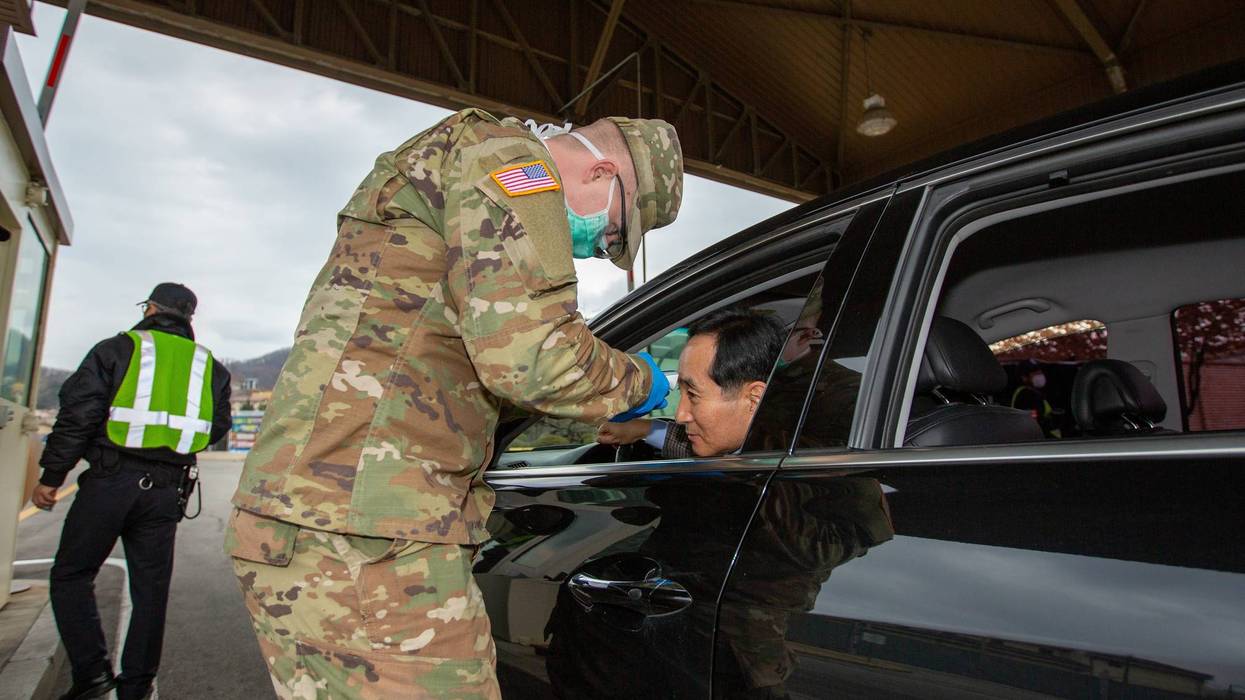
Those individuals who were traveling on and off the installations were asked detailed medical and travel screening questions. They were subject to temperature checks and many were turned away or sent to hospitals for testing.
Outside of professional operations, USFK also prohibited personnel from bars, clubs, large social gatherings, eat-in dining, and movie theaters. The use of public transportation was highly discouraged.
Essentially, USFK set up a "protective bubble around our installation," Abrams described.
Now, USFK has nine confirmed cases of coronavirus — the first active-duty case, two active-duty dependents, and six Korean national employees and contracts. All nine live off-post.
"Out of a population of 58,000 people that touches US Forces Korea daily, that's a pretty low number," Abrams said. "We've seen a downward trend for the last two weeks. So far we've tested more than 145 USFK affiliated individuals either through the (Korea Centers for Disease Control and Prevention) or our own capabilities."
Each time a USFK individual tests positive, Abrams says they conduct a COVID-19 "battle drill" — the individual is placed in a negative pressure room, contact tracing is conducted, individuals who crossed paths with the diagnosed person are quarantined, teams disinfect any area the diagnosed person visited, and an interactive map is updated so the entire USFK community can see where this diagnosed person traveled.
"We've approached it similarly to how we act in combat," Abrams said. "This is not an administrative task, this is not a medical task, and this is not a routine event - it's an operation. We are conducting 24/7 round the clock operations and have been since 27 January."
So how do the coronavirus prevention efforts stateside compare to those within USFK?
Installations remain open, National Guard and Reserves training schedules —which necessitate a significant amount of travel — have not been altered, and tours of the Pentagon for foreign officials continue.
National Guard members still have to travel for drill amid coronavirus concerns
These types of changes, however, may be forthcoming.
"We have not made a formal action, but broad guidance has gone out anticipating a formal decision," Esper said at a briefing at the Pentagon Thursday. "I don't think I've probably changed my schedule so far, but that's where we're heading towards, as a matter of precaution, to protect the troops....But as you go through this, you've got to make sure that you get it right, you answer all the questions that likely come from people at the far end who have to implement it."
Despite the quickly escalating number of coronavirus cases across the country, Esper remains confident that the virus is not a threat to national security.
"I'm confident that we'll be able to do what we need to do to maintain the nation's security," Esper said. "We have a young, healthy, fit, robust demographic in the United States military. On top of that, the commanders are making prudent decisions with regard to day-to-day operations, with regard to exercises, so forth and so on."
"COVID-19 still has a lot of unknowns," Abrams said. "We're dealing with a fast and fluid virus that has an immediate impact on everyone as you all in the states are experiencing now. Currently South Korean trends are trending downward and looking good. 113 cases nationwide today. We had an operationalized approach to combatting coronavirus from the very beginning."
There are now 6 active duty service members with COVID-19
As of yesterday, there were six confirmed COVID-19 cases among active-duty personnel.
—
Want to get more connected to the stories and resources Connecting Vets has to offer? Click here to sign up for our weekly newsletter.