


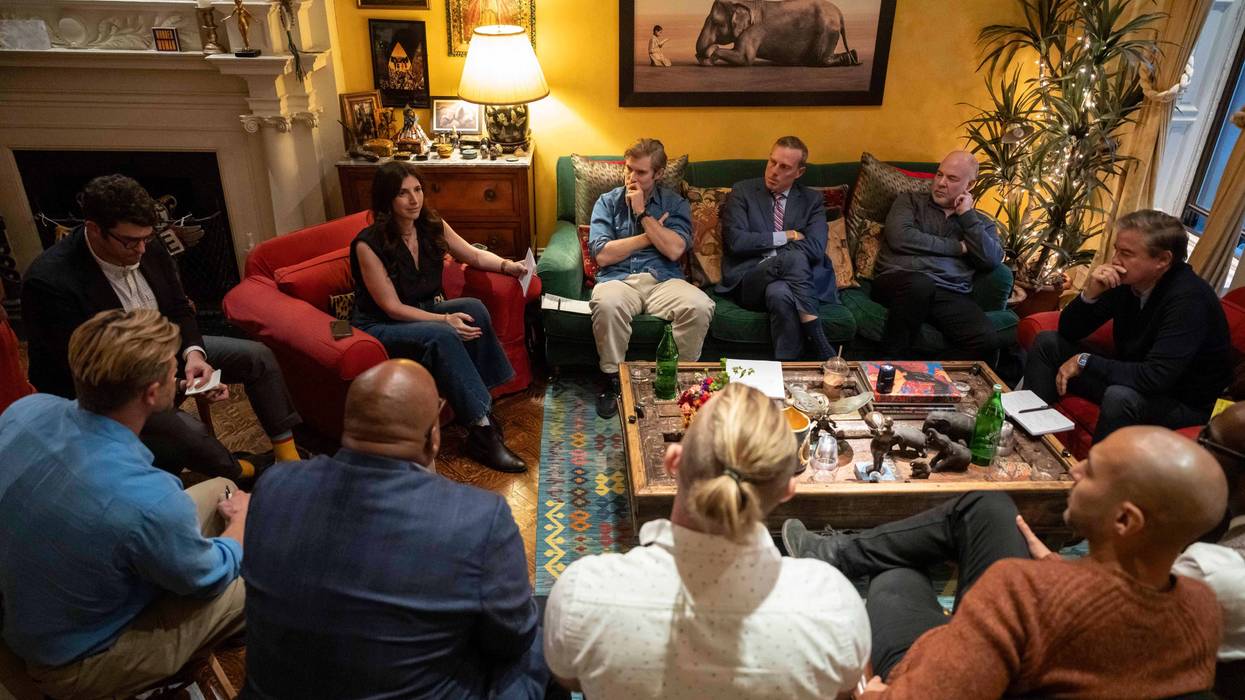

NEW YORK (AP) — For more than half a century, Gloria Steinem welcomed guests into her inviting, art-filled Manhattan living room, gathering women from all walks of life to discuss issues of vital importance in health, education, business, politics and beyond.
It was her long-held dream that these “talking circles” continue after she was gone — and, two months after her death, they’re indeed going strong. Last week, though, marked a first that close associates say would have particularly delighted the feminist trailblazer: a men-only circle, focused on male well-being.
“I know Gloria would have loved this,” exclaimed Jill Heller of Gloria’s Foundation, which is working on preserving the home as a permanent center, as she welcomed the men. “Wherever she is, I hope she’s tap-dancing,” she added — a wry reference to one of Steinem’s lesser-known talents.
Then the circle's facilitator, Janna Meyrowitz Turner, explained the genesis of the idea to bring the guests — advocates, academics and others working with men and boys — into one room.
“If she were here, Gloria would tell you that men’s liberation and men’s well-being have always been a part of feminism,” said Meyrowitz Turner, CEO of Antenna Up, a media and events platform that aims to build trust between men and women. “She would say that healthier men means healthier women.”
The circle, she noted, had been planned with Steinem's enthusiastic support before her death in September at age 92. Originally scheduled for the summer, the event had been postponed due to travel schedules.
“We’ll forgive her for not getting to this one,” Meyrowitz Turner said, to chuckles. “Gloria owes us nothing.”
One man was thanked for ‘bringing tears’ into the room
Hundreds of admirers will bid farewell to Steinem this week at a New York memorial service expected to feature luminaries from political figures to pop stars to poets, all there to remember, to laugh — and of course, to cry.
But there were tears, too, on a much smaller scale at the talking circle last Tuesday, with 12 men detailing the paths that had brought them to this moment in a feminist icon’s living room.
When Brendan Kwiatkowski-Hartman’s turn came to speak, he soon found he was overcome. The sociologist, who specializes in the emotional life of teen boys, was describing his journey away from a religious childhood in which he was taught to believe that feminism was “anti-Christianity.”
“I knew nothing about Gloria Steinem other than as a bogeyman,” he said.
In college, he met a professor who was a Christian feminist, and his views began to shift. Now, seated in the home of Steinem herself, he said: “Feminism has given me a mirror to see myself better.”
He began to choke up as he said it, drawing thanks from another circle member for “bringing tears into this space.”
“You've done one of the bravest things in this conversation,” said Johnny Cole, an advocate who also works with men and boys. One thing young men really need, he said, is “to see more men crying, and willing to do it in front of men.”
Like many in the room, Cole spoke of the need for self-esteem among men. “You can’t enact change … if you don’t have self-esteem,” he said.
Educator and author Jackson Katz, meanwhile, urged those assembled to remember that “We wouldn't be here without women's leadership.” Katz had written in Ms. Magazine, upon Steinem's death, about how she had changed men’s lives, too.
“This didn’t come out of nowhere,” he told the group about their conversation. “The driving energy is women’s leadership.”
Steinem first moved into her home in the late '60s, with a roommate
Steinem first made her home in the Upper East Side brownstone in 1967, Heller explained to the room. Then, it was a one-floor rental; she and her roommate fashioned a loft bed space in the living room, which remains.
“That’s the OG bed,” said Heller, pointing upward; whichever roommate came home first got the bed. Two decades later, Steinem bought the floor below, where the foundation now works. It also has space on the third floor, and the hope is that eventually the foundation can occupy the entire building.
Ms. Magazine, co-founded by Steinem in the early ’70s, had its early meetings in the living room, where many groups and initiatives were also born. The talking circles began almost from the start, and still usually take place a few times a week. Exactly one week after Steinem died, women gathered to discuss leadership and style in a circle hosted by the Argent fashion label.
Steinem explained the circles' meaning in an interview with this reporter earlier this year, six months before her death.
“There's a continuing series of meetings going on in my living room, sometimes initiated by me, sometimes initiated by other people,” she said, adding that she also usually had a guest or two staying in the spare bedroom.
“We are communal animals, you know,” Steinem said. “We don’t generate the famous oxytocin, the chemical that allows us to empathize with each other, unless we’re physically together. It’s why solitary confinement is the worst punishment everywhere in the world. We do need to be together.”
The home, including Steinem’s own bedroom down the hall from the living room and past a small kitchen, is filled with mementos from her constant travels. Every surface seems to contain an expression of her personality. Her fireplace bears a banner that says “Hope.” On the mantel above sits a colorful matchbox emblazoned with the words “Wonder Woman” — a character Steinem had particular fondness for and even placed on Ms. Magazine's cover.
The men were urged to be a support system for each other
As the speakers took turns last Tuesday, each man recounted why he was there and what he hoped to accomplish.
Nate Glasser, an internist and pediatrician at the University of Chicago, told of how, during his residency, “the curriculum was telling us almost explicitly not to pay attention to the interior lives of men.”
His own colleagues, he said, “miss that boys have interior lives. That is what brings me here.”
CJ Goulding spoke about his work with a group called Boyz N The Wood, providing healing spaces in nature. “We are a part of something bigger when we're in nature,” he said.
Rawle Andrews Jr., executive director of the American Psychiatric Association Foundation, injected a note of humor when he quipped that some women on his team had asked him: “Why do YOU get to go to Gloria’s house? Take us!”
There were more laughs when two of the men, sitting on a small piece of furniture, thought they’d broken it. “The first time we get men in the room!!” joked Meyrowitz Turner, in mock horror. Heller assured everyone the damage had been there previously.
Meyrowitz Turner closed out the session by urging the men to serve as a support system for each other — as women more often do. “This work can be really lonely,” she said. The men, in turn, thanked her for “nudging” them to answer her emails.
Heller returned at the end with a tearful note of thanks.
“This is just what Gloria envisioned for this space,” she said, noting that Steinem had hoped she could “just go to sleep, and the work would go on.”
And she invited them all back.
“Consider it your living room, too,” she said.