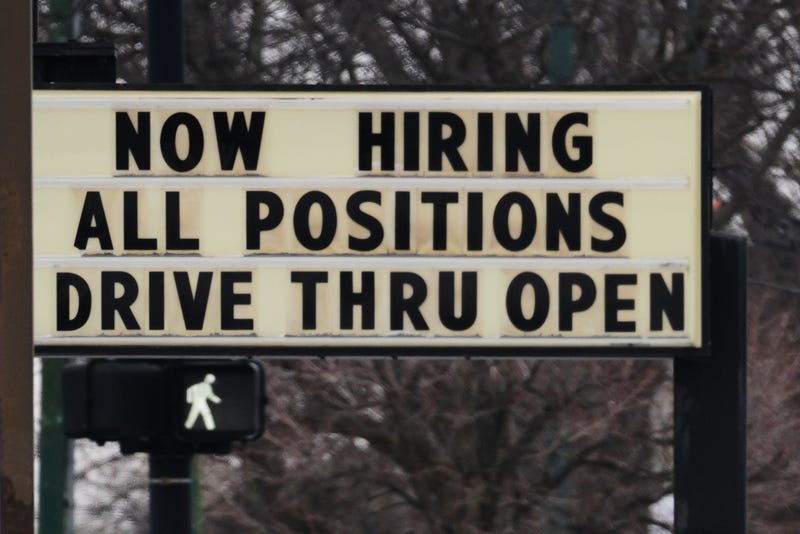
WASHINGTON (AP) — U.S. employers added a surprisingly strong 130,000 jobs last month, but government revisions cut 2024-2025 U.S. payrolls by hundreds of thousands.
The unemployment rate fell to 4.3%, the Labor Department said Wednesday.
The report included major revisions that reduced the number of jobs created last year to just 181,000, a third of the previously reported 584,000 and the weakest since the pandemic year of 2020.
The job market has been sluggish for months even though the economy is registering solid growth.
But the January numbers came in stronger than the 75,000 economists had expected. Healthcare accounted for nearly 82,000, or more than 60%, of last month's new jobs. Factories added 5,000, snapping a streak of 13 straight months of job losses. The federal government shed 34,000 jobs.
Average hourly wages rose a solid 0.4% from December to January.
The unemployment rate fell from 4.4% in December as the number of employed Americans rose and the number of unemployed fell.
“The surprisingly strong job gains in January were driven mainly by health care and social assistance,” Heather Long, chief economist at Navy Federal Credit Union, wrote in a commentary. "But it is enough to stabilize the job market and send the unemployment rate slightly lower. This is still a largely frozen job market, but it is stabilizing. That’s an encouraging sign to start the year, especially after the hiring recession in 2025.”
Weak hiring over the past year reflects the lingering impact of high interest rates, billionaire Elon Musk’s purge last year of the federal workforce and uncertainty arising from President Donald Trump’s erratic trade policies, which have left businesses less willing to hire.
Dreary numbers had been coming in ahead of Wednesday’s report. Employers posted just 6.5 million job openings in December, fewest in more than five years.
Payroll processor ADP reported last week that private employers added 22,000 jobs in January, far fewer than economists had forecast. And the outplacement firm Challenger, Gray & Christmas reported that companies slashed more than 108,000 jobs last month, the most since October and the worst January for job cuts since 2009.
Several well-known companies announced layoffs last month. UPS is cutting 30,000 jobs. Chemicals giant Dow, shifting to more automation and artificial intelligence, is cutting 4,500 jobs. And Amazon is slashing 16,000 corporate jobs, its second round of mass layoffs in three months.
The sluggish job market doesn’t match the economy’s performance.
From July to September, America’s gross domestic product – its output of goods and services – galloped ahead at a 4.4% annual pace, fastest in two years. Consumer spending was strong, and growth got a boost from rising exports and tumbling imports. And that came on top of solid 3.8% growth from April through June.
Economists are puzzling out whether job creation will eventually accelerate to catch up to strong growth, perhaps as President Donald Trump’s tax cuts translate into big tax refunds that consumers start spending this year. But there are other possibilities. GDP growth could slow and fall into line with a weak labor market or advances in AI and automation could mean that the economy can roar ahead without creating many jobs.
The jobs report Wednesday could lead the Federal Reserve to further delay any new cuts in its key interest rate. Some Fed officials have specifically argued that last year’s weak hiring is evidence that borrowing costs are too high and are weighing on growth and discouraging companies from expanding. But a pickup in hiring, if sustained, undercuts that view.
Fed officials signaled in December that they expect to reduce their key rate once more this year, while Wall Street investors expect two reductions, according to futures pricing. Yet many analysts now expect a first cut won’t happen until June or later. The odds of a rate cut in April fell sharply after the jobs report, according to futures markets, from 36% on Tuesday to just below 19% Wednesday, CME Fedwatch said.
Wednesday's report included the government's annual benchmark revisions, meant to take into account the more-accurate jobs numbers that employers report to state unemployment agencies. They cut 898,000 jobs from payrolls in the year ending March 2025.
More revisions, many meant to reflect more accurate information about the number of businesses that opened and closed, trimmed the tally of jobs created from April through December last year to 120,000 (or 13,000 a month) from an originally reported 251,000 (or 28,000).
Despite recent high-profile layoffs, the unemployment rate has looked better than the hiring numbers.
That is partly because President Donald Trump’s immigration crackdown has reduced the number of foreign-born people competing for work.
As a result, the number of new jobs that the economy needs to create to keep the unemployment rate from rising – the “break-even’’ point -- has tumbled. In 2023, when immigrants were pouring into the United States, it reached a high of 250,000, according to economist Anton Cheremukhin of the Federal Reserve Bank of Dallas. By mid-2025, he found, it was down to 30,000. Researchers at the Brookings Institution believe it could now be as low as 20,000 and headed lower.
The combination of weak hiring but low unemployment means that most American workers are enjoying job security. But those who are looking for jobs – especially young people who can be competing at the entry level with AI and automation – often struggle to land one.
_____
AP Economics Writer Chris Rugaber contributed to this report.