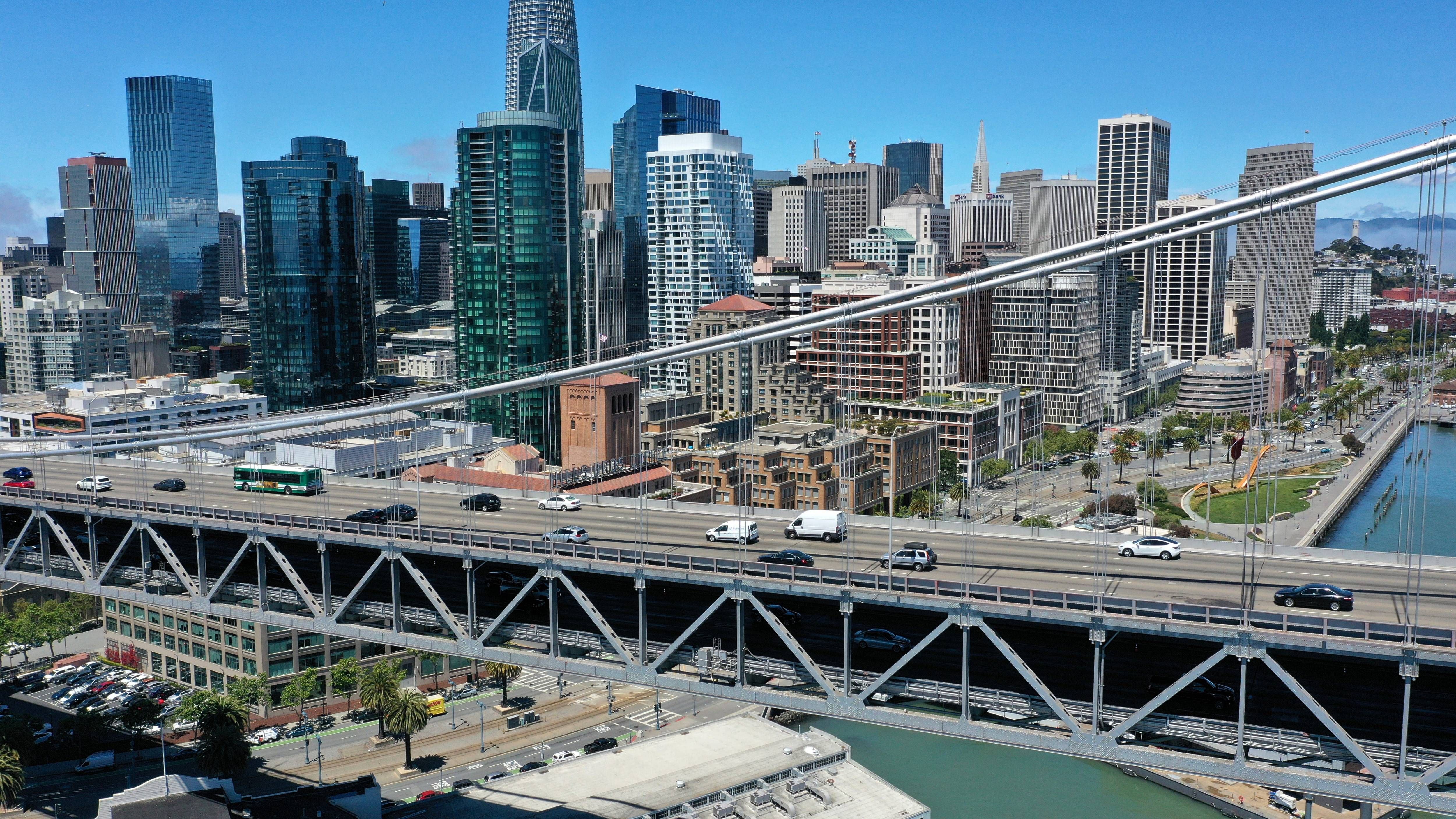



Bay Area traffic could’ve been worse last year, at least according to one study.
The "2021 Urban Mobility Report" unsurprisingly found that drivers in San Francisco and Oakland spent, on average, about as many hours in traffic delays in 2020 as their counterparts in Los Angeles.
The surprise? Drivers in both areas spent 10 fewer hours in traffic delays (46) than those in New York City and Newark, New Jersey (56).
David Scrhank, Senior Research Scientist at the Texas A&M Transportation Institute and one of the study’s authors, told KCBS Radio’s Patti Reising on Wednesday that truck traffic played a big role.
"(There was) a lot of trucking activity in the New York metro area," Scrhank explained. "Both … serving the port, but also delivering. Now, instead of delivering to businesses during the day, we’re delivering to homes. So (there were) a lot of new routes, a lot of new trucks being added to that mix."
Traffic delays in San Francisco and Oakland decreased by about 57 hours per person in 2020, and by 49 hours in San Jose.
The latter change was the largest of any "large" area, or one in which 1 million to 3 million people live. San Francisco and Oakland, meanwhile, had the third-largest, which was about 14 hours above average in areas with 3 million or more people.
Drivers in Boston (50) and Houston (49) also averaged more hours in traffic than drivers in San Francisco and Oakland, which was not the case in either city in 2019.
That year, San Francisco and Oakland drivers spent more hours in delays than all but two “very large” metropolitan areas: Los Angeles and Washington.
While the country grappled with the COVID-19 pandemic in 2020, Schrank and his colleagues determined there was about a 50% year-over-year reduction in traffic delays. But will that persist as coronavirus-related restrictions are lifted and workers return to offices?
That’ll depend on the amount of companies that continue with remote work, whether part-time or permanently. Still, Schrank said a few organizations doing so could go a long way in reducing traffic congestion.
"The question will be how many of those persist into the future, and how big is that impact," he said. "We've seen that just a 5% or 10% reduction in traffic, which is probably what you're seeing out your window right now, still has delays lower than it normally is."