


HONOLULU (AP) — Thousands were without power Monday after Tropical Storm Lala uprooted trees from downtown Honolulu to the Big Island, where intense flash-flooding and strong winds isolated already-remote communities.
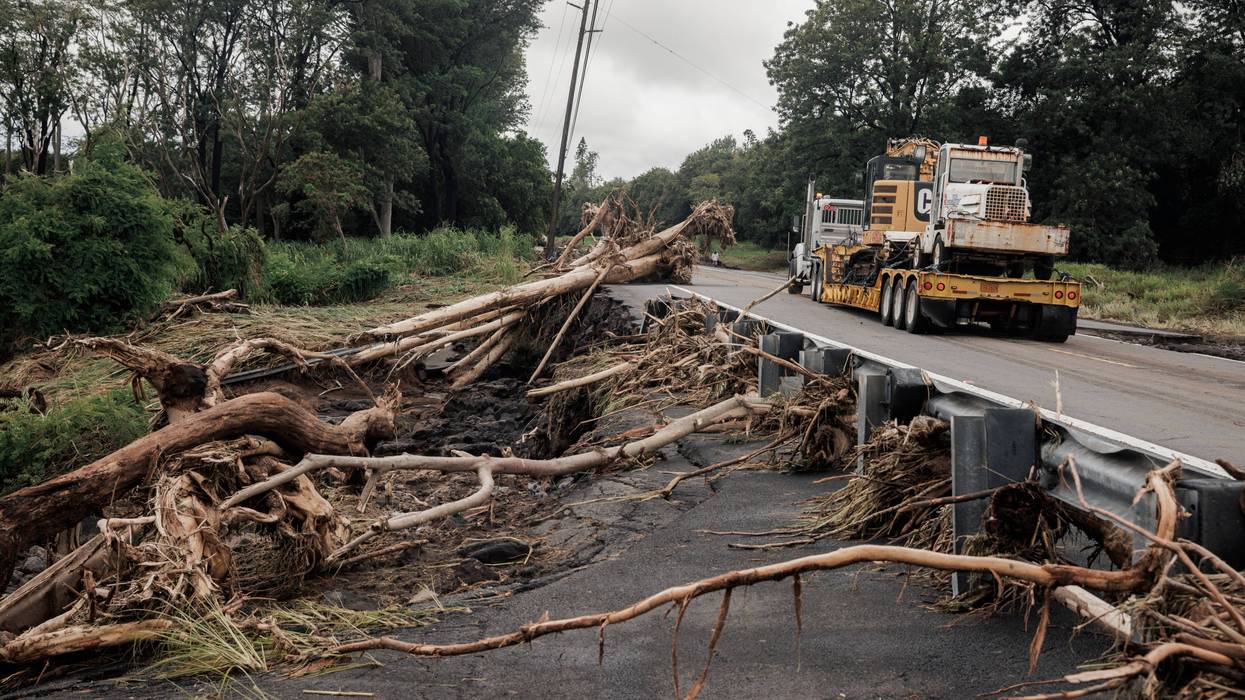
In the hard-hit southern end of the Big Island, communities were isolated as they were cut off from communication and roads were blocked by debris. Floodwaters disturbed some grave sites.
Officials announced one fatality blamed on the storm — a 90-year-old woman who had been reported missing in Naalehu and then found dead on Monday. Additional details about the death weren't immediately available.
Lala weakened from a hurricane to a tropical storm Sunday after lashing the state without making landfall. Intense rainfall and flooding caused a muddy mess as the storm moved past Hawaii’s main islands.
Destructive flooding
The flooding proved to be more destructive than the wind, said Gov. Josh Green, who flew over and walked through the south part of the island Monday.
“It’s the flood and the mud and the rock the poured through Naalehu, Pahala, Waiohinu,” he said. “These communities have a lot of cleanup to do and they’re going to need a lot of support.”
The storm was projected to continue moving westward and was forecast to become a hurricane again at sea and far from land by Wednesday.
Public schools statewide, some private schools and state offices were closed Monday. Schools and county offices on the Big Island will remain closed Tuesday. Cleanup efforts began in earnest with crews repairing bridges and clearing fallen trees.
The Hawaiian Electric utility said nearly 104,000 customers were without power as of Monday afternoon. The passing storm’s strong winds took down trees, utility poles and transmission towers. The Big Island’s power transmission system suffered “extensive damage,” the utility said.
The 911 emergency service number was temporarily out of service on the Big Island because hurricane impacts were affecting radio and telephone communications, the Hawaii Police Department said, but was back up by the afternoon.
Cut-off communities and damaged cemeteries
“My district is in shambles,” said state Rep. Jeanné Kapela, who represents the Kau district on the southern end of the island. Her voice quivered with emotion as she described communities trapped by collapsed and debris-blocked roads, including the small community of Punaluu, home to about 100 households and popular among tourists for its black-sand beach.
Two cemeteries in Naalehu were “washed out,” she said.
Kapela was working to get satellite internet connections near communities without power and cellular service.
“Most people when you think of Hawaii, you think of Lahaina or you think of Waikiki,” she said of some of the state's most popular tourist destinations. “You don’t necessarily think of the southern point of the United States, but at the end of the day, we are the southernmost point in the United States. That’s the community that got hit. And it’s probably one of the most rural communities in the entire country.”
The governor said he was hopeful the area would become accessible within days, and not weeks or longer.
"Please respect those people who were deceased and buried in the cemetery there where there was some dispersal of the ‘iwi kupuna’, Green said, using the Hawaiian term for sacred ancestral skeletal remains of Native Hawaiians.
Tom Callis, a spokesperson for Hawaii County, which is also known as the Big Island, said those areas have been cordoned off and no work is happening there.
The damage was not as catastrophic as feared, governor says
Green vowed that recovery will be “somewhat brisk.”
“And in spite of this loss of one beautiful person,” he said of the storm-related death, “it could have been a lot worse.”
While he said he saw a lot of devastation he also saw many houses that survived and bridges that weren't as badly damaged as feared.
Some 100 homes were swept from their foundations and washed away on the Big Island, authorities said previously.
Officials advised people to stay out of the ocean anywhere water appears brown or murky.
There were no coastal watches or warnings in effect for Hawaii on Monday, but life-threatening surf and rip current conditions remained, according to the National Hurricane Center. Saturation caused by heavy rainfall could still cause some landslides, but winds were no longer a threat, National Weather Service meteorologist Patrick Blood said.
“There's no real looming hazards that we're facing now,” he said. “Lala's off to the west.”
Laupahoehoe, on the northeast coast of the Big Island, saw the heaviest recorded rainfall at 43.54 inches (1.1 meters). The highest winds were atop the towering Mauna Kea volcano, where gusts hit 140 mph (225 kph). At the lower elevations, residents all across the island chain experienced tropical storm force winds of 30 to 40 mph (48 to 64 kph) with gusts up to 60 mph (97 kph), Blood said.
Federal officials have pledged recovery help. U.S. Sen. Brian Schatz said Monday he spoke with Transportation Secretary Sean Duffy about federal support and urged him to approve a forthcoming request for emergency funding to help clear debris and repair damaged roads and highways.