


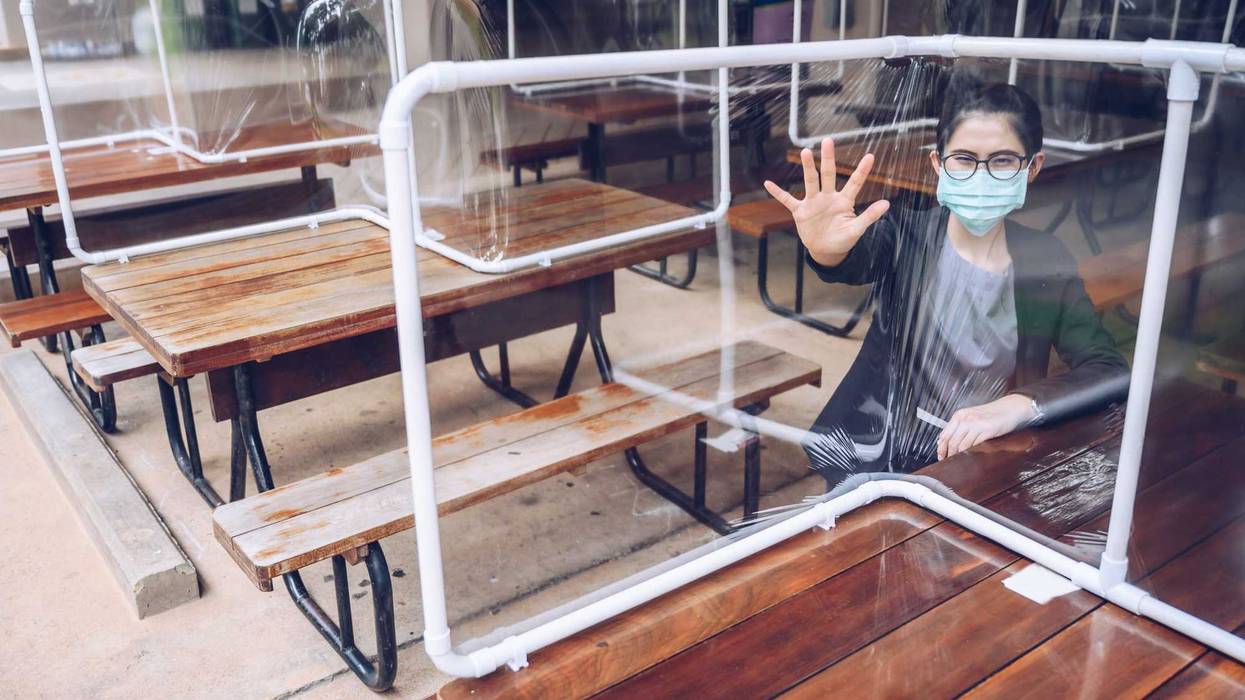

The plastic shields that have popped up everywhere from schools to nail salons since the start of the COVID-19 pandemic may actually make it easier to catch the virus, reported the New York Times this week.
Some research from scientists who study aerosols (such as the microscopic droplets that can cause coronavirus infections), air flow and ventilation suggest that the barriers can create dead zones of air flow. In these areas, aerosols particles can build up.
"If you have a forest of barriers in a classroom, it’s going to interfere with proper ventilation of that room," explained Linsey Marr, professor of civil and environmental engineering at Virginia Tech and one of the world’s leading experts on viral transmission. "Everybody’s aerosols are going to be trapped and stuck there and building up, and they will end up spreading beyond your own desk."
Typically, exhaled breath particles carried by air currents are replaced by fresh air every 15 to 30 minutes indoors, depending on a location’s ventilation system, said the New York Times.
A recent U.S. study published in June and led by researchers from Johns Hopkins that showed that desk screens in classrooms were associated with an increased risk of coronavirus infection. Research at a Massachusetts school district found that plexiglass dividers with side walls in the main office were impeding air flow and a study looking at schools in Georgia that found that desk barriers had little effect on the spread of the coronavirus.
British researchers have conducted modeling studies that screens are more effective when the person coughs, because the larger particles have greater momentum and hit the barrier. When a person speaks, the screen doesn’t trap the exhaled particles.
So far, research suggests that barriers are useful in limited situations, such as a salad bar sneeze guard or floor-to-ceiling barriers in places where people do not move much.
A study by researchers with the National Institute for Occupational Safety and Health in Cincinnati that hasn’t yet been peer-reviewed, found that under the right conditions, taller shields stopped about 70 percent of the particles from reaching the particle counter on the other side.
"We have shown this effect of blocking larger particles, but also that the smaller aerosols travel over the screen and become mixed in the room air within about five minutes," said Catherine Noakes, professor of environmental engineering for buildings at the University of Leeds in England.
She said most screens she has seen are "poorly positioned and are unlikely to be of much benefit."
Further research is needed to determine the effect of transparent shields around school or office desks, said the New York Times. Most experts agreed that the shields are unlikely to help but likely to disturb air flow.
“If there are aerosol particles in the classroom air, those shields around students won’t protect them,” said Richard Corsi, the incoming dean of engineering at the University of California, Davis.
Instead of shields, scientists recommend vaccinations, improvements to ventilation such as filtering machines, and masking.