


WASHINGTON (AP) — The U.S. military destroyed five Iranian oil tankers in response to Iranian efforts to hit a U.S. warship with ballistic missiles over the past two days, U.S. Central Command said in a social media post on Tuesday.
“The U.S. warship successfully evaded the attempted Iranian attacks and continued to patrol regional waters. No American personnel were harmed,” U.S. Central Command said.
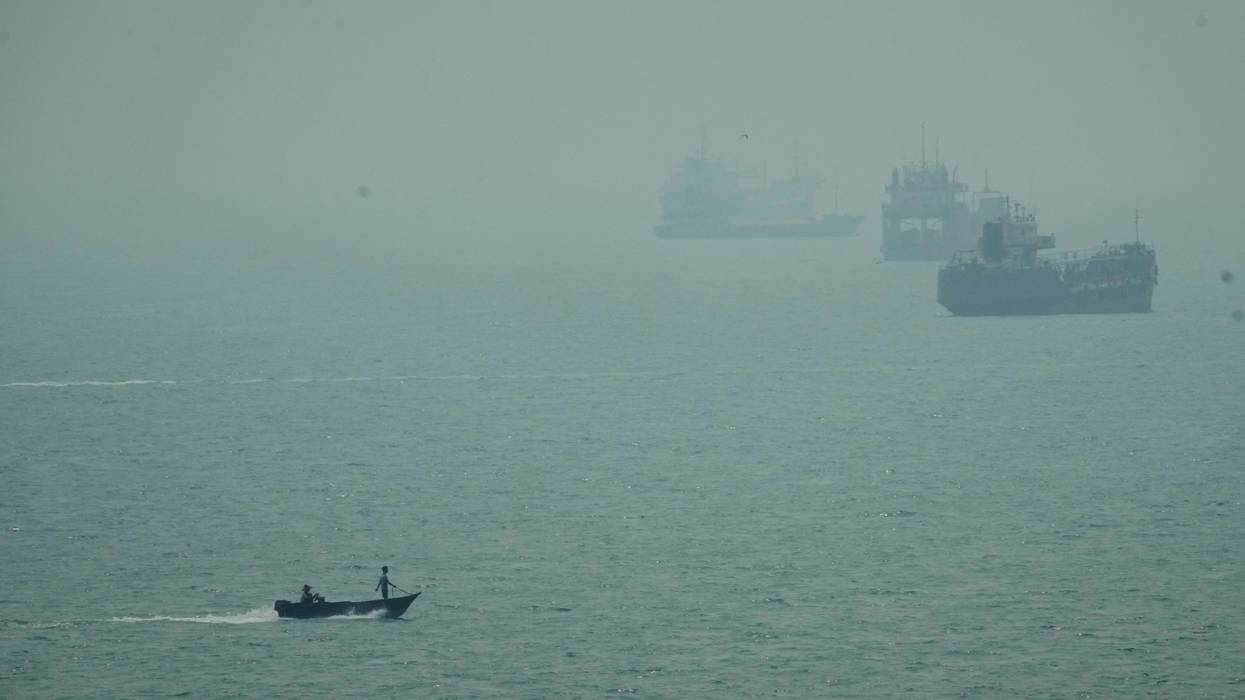
The tankers destroyed in the attack were the Kivik, Charminar, Horizon 1 and the Riesco in the Gulf of Oman. The U.S. military also destroyed the vessel Derya, which was located near Kharg Island in the Strait of Hormuz.
U.S. Central Command said the crews of the five vessels were told to abandoned ship before the attacks.
The strike comes just three days after U.S. forces destroyed three Iranian oil tankers after Iran’s Revolutionary Guards tried to attack a U.S. aircraft carrier and destroyer.
Iranian state television also reported the U.S. strikes, saying U.S. forces attacked at least three Iranian oil tankers near the southern port of Jask and near Kharg Island in the Persian Gulf. It said the crews were evacuated.
The latest tit-for-tat strikes come as Washington and Tehran lurch back toward fighting during more than six months of war.
Secretary of State Marco Rubio said the U.S. will not allow Iran's attacks to go unanswered.
“Iran continues to try to hit U.S. naval ships. And for every time they do that or try to do that, they’re going to lose tankers. And I think you’ll see that again today,” Rubio told reporters Tuesday when asked about the latest attacks in Iran while on a trip to Colombia.
Danny Citrinowicz, an Iran expert at Israel’s Institute for National Security Studies, warned that such back-and-forth strikes can only risk more retaliation and further impact to the global economy.
“There is no kinetic solution to the Strait of Hormuz problem,” he said on social media. “Every attempt to impose one only brings Washington and Tehran closer to an escalation that may become increasingly difficult to control.”
An Iranian state TV reporter in Jask said an Iranian tanker was struck near the coast of Yekbeni, while another explosion was heard in the area whose source and location were not immediately clear.
State TV later reported that the U.S. military attacked a second tanker near waters off Jask. It said the crews of both vessels were being evacuated by lifeboat toward the Jask coast.
Separately, state television reported that another Iranian tanker was attacked in Kharg Island anchorage area. It said the crew was safely evacuated shortly after the strike.
Iran’s Revolutionary Guard Navy on Tuesday warned crews of oil tankers near ports in Kuwait and Bahrain to immediately leave their vessels, saying the ships could be targeted in retaliation for U.S. attacks on Iranian tankers. It accused Kuwait and Bahrain of hosting U.S. forces and assisting in the attacks.
On Saturday, the U.S. military said it had struck three Iranian oil tankers after Navy warships were targeted with ballistic missiles, warning that it would, “if necessary, destroy Iran’s limited and exposed oil fleet.” Iran later said it planned to announce a new “exclusion zone” near the Strait of Hormuz aimed at vessels intending to transit.
The latest strikes are part of a dual economic and military approach by President Donald Trump as he struggles to bring an end to a more than six-month-old war with Tehran.
The Trump administration on Tuesday also imposed sanctions on additional elements of Iran’s aviation industry, targeting more than two dozen commercial and private airlines as well as foreign cargo service providers in its new push to isolate Tehran from its remaining trading partners.
Both the U.S. and Iran are seeking to exert control over the Strait of Hormuz, where about one-fifth of the world’s oil passed before the war began. Rising energy prices are posing political problems for Trump and his Republican Party ahead of the November midterm elections. A barrel of international standard Brent crude briefly climbed as high as $99.46 on Tuesday.
A U.S. blockade of Iranian ports has squeezed the country’s economy by limiting its oil exports, while the American military has been helping a limited number of ships transit on a route through the Strait of Hormuz off Oman. Tehran wants ships to follow a route that it chooses through the strait, which was considered an international waterway before the war.