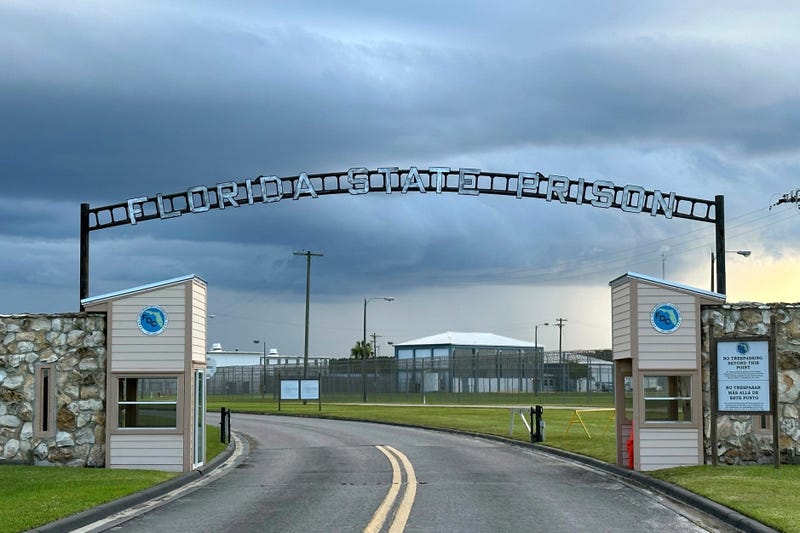
STARKE, Fla. (AP) — A man convicted of killing a 70-year-old grocery store owner was put to death Tuesday in Florida, becoming the second person executed by the state this year after a record 19 executions in 2025.
Melvin Trotter, 65, was pronounced dead at 6:15 p.m. following a lethal injection at Florida State Prison near Starke for the 1986 stabbing death of Virgie Langford, according to authorities. Alex Lanfranconi, a spokesman for Gov. Ron DeSantis, said there were no complications.
Trotter was convicted of first-degree murder and sentenced to death in 1987. After the state Supreme Court found the trial court erred in handling aggravating factors in his case, he again drew the death penalty at resentencing in 1993.
The execution and another earlier this month in Florida follow the unprecedented 19 executions by the state last year. In 2025, Republican Ron DeSantis oversaw more executions in a single year than any other Florida governor since the death penalty's reinstatement in 1976. The previous Florida record was eight executions in 2014.
According to court records, Trotter stabbed and strangled Langford on June 16, 1986, at her store in Palmetto near the southern edge of Tampa Bay. Afterward, a truck driver found Langford bleeding but alive on the back floor of the store, and she provided key details about her attacker before dying at a hospital.
Besides recalling Trotter’s physical appearance, Langford said he had a Tropicana employee badge with the name “Melvin” on it. According to court records, police later found a T-shirt with Langford’s blood type at Trotter’s home and the man’s handprint on a meat cooler at the store.
The Florida Supreme Court recently denied appeals in which Trotter's attorneys argued officials had mismanaged his death penalty protocols. They also argued Trotter's advanced age of 65 should exempt him from execution.
The U.S. Supreme Court denied Trotter’s final appeal Tuesday.
Separately, Justice Sonia Sotomayor raised questions about the state’s administration of lethal drugs. Trotter’s attorneys argued that Florida could “maladminister” the state’s protocol in a way that heightens the risk for a “mangled” execution in violation of the Eighth Amendment's prohibition on cruel and unusual punishment.
Sotomayor wrote that, going forward, she hopes the state “will recognize the paramount importance of ensuring that it conducts executions consistently” with the proper protocols.
A total of 47 people were executed in the U.S. in 2025. Florida led the way with a flurry of death warrants signed by DeSantis. Alabama, South Carolina and Texas tied for second with five executions each last year.
Besides the two Florida executions this year, Texas and Oklahoma have conducted one execution each so far in 2026.
On Feb. 10, a man convicted of killing a traveling salesperson became the first person executed in Florida this year. Ronald Palmer Heath, 64, received a lethal injection for the 1989 killing of Michael Sheridan.
Two more Florida executions are scheduled next month starting with Billy Leon Kearse on March 3 and Michael Lee King on March 17.
All Florida executions are carried out by injecting a sedative, a paralytic and a drug that stops the heart, according to the Department of Corrections.
Hours before Tuesday's execution, Florida Corrections officials said, Trotter awoke at 3:20 a.m. and had one visitor during the day. He requested a meal that included fish, cornbread, cake and soda.