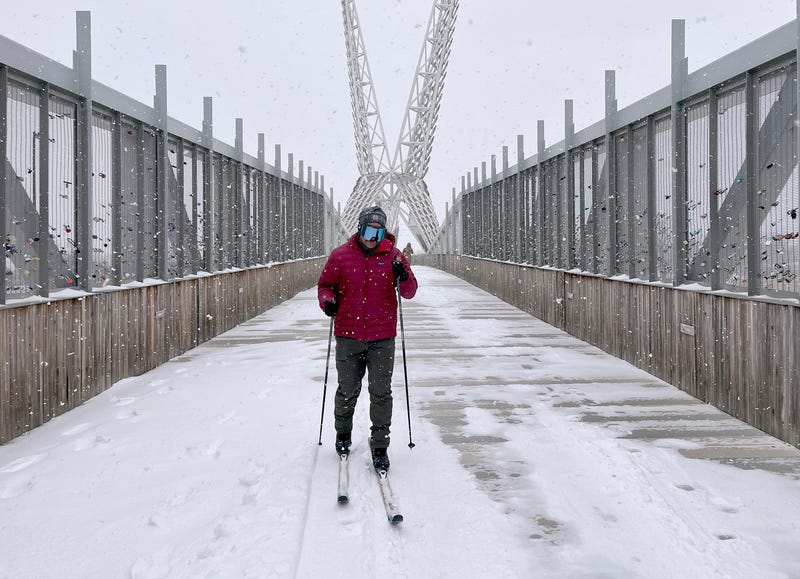
OKLAHOMA CITY (AP) — Thousands of flights across the U.S. set to take off over the weekend were canceled as a monster storm started to wreak havoc Saturday across much of the country, knocking out power and snarling major roadways with dangerous ice.
Widespread heavy snow, sleet and freezing rain threatened nearly 180 million people — more than half the U.S. population — in a path stretching from the southern Rocky Mountains to New England, the National Weather Service said Saturday night. It warned people to brace for a string of frigid days.
“The snow and the ice will be very, very slow to melt and won’t be going away anytime soon, and that’s going to hinder any recovery efforts,” said Allison Santorelli, a meteorologist with the National Weather Service.
President Donald Trump had approved emergency declarations for at least a dozen states by Saturday, with more expected to come. The Federal Emergency Management Agency pre-positioned commodities, staff and search and rescue teams in numerous states, Homeland Security Secretary Kristi Noem said.
“We just ask that everyone would be smart – stay home if possible,” Noem said.
As crews in some southern states began working to restore downed power lines Saturday, officials in some eastern states issued final warnings to residents.
“We are expecting a storm the likes of which we haven’t seen in years," New Jersey Gov. Mikie Sherrill said Saturday while announcing restrictions on commercial vehicle travel and a 35 mph (56 kph) speed limit on highways. She added: “It’s a good weekend to stay indoors.”
Power outages hit Louisiana and Texas
Forecasters say the damage, especially in areas pounded by ice, could rival that of a hurricane.
About 140,000 power outages were reported in the path of the winter storm Saturday, including more than 58,000 in Louisiana about 50,000 in Texas, according to poweroutage.us.
In Shelby County, Texas, near the Louisiana border, ice weighed down on pine trees and caused branches to snap, downing power lines. About a third of the county's 16,000 electric customers lost power on Saturday.
“We have hundreds of trees down and a lot of limbs in the road,” Shelby County Commissioner Stevie Smith said from his pickup truck. “I’ve got my crew out clearing roads as fast as we can. It’s a lot to deal with right now.”
There were reports of vehicles hitting fallen trees and trees falling onto houses in DeSoto Parish, Louisiana, where more than half of all electric customers lost power.
“We got limbs that are dragging the ground,” said Mark Pierce, a spokesperson for the local sheriff’s office. “These trees are just completely saturated with ice.”
Airplanes are grounded
More than 13,000 flights were canceled Saturday and Sunday across the U.S., according to the flight tracking website FlightAware. Sunday's cancellations, which are still growing, already are the most on any single day since the coronavirus pandemic, according to aviation analytics firm Cirium.
All Saturday flights were canceled at Will Rogers International Airport in Oklahoma City, and all Sunday morning flights also were called off, as officials aimed to restart service Sunday afternoon at Oklahoma’s biggest airport.
Dallas–Fort Worth International Airport, a major hub, saw more than 700 departing flights canceled on Saturday and nearly as many arriving flights called off. Disruptions were also piling up at airports in Chicago, Atlanta, Nashville, and Charlotte, North Carolina.
By late Saturday afternoon, nearly all departing flights scheduled to leave Ronald Reagan Washington National Airport on Sunday had already been canceled.
A warning about the biggest ice storm in a decade
Officials in Georgia advised people in the state’s northern regions to get off the roads by sundown Saturday and be prepared to stay put for at least 48 hours.
Will Lanxton, the senior state meteorologist, said Georgia could get “perhaps the biggest ice storm we have expected in more than a decade” followed by unusually cold temperatures.
“Ice is a whole different ballgame than snow,” Lanxton said. “Ice, you can’t do anything with. You can’t drive on it. It’s much more likely to bring down power lines and trees.”
Crews began treating highways with brine after midnight Saturday, with 1,800 workers on 12-hour shifts, Georgia Department of Transportation Commissioner Russell McMurry said.
“We’re going to do what we can to keep the ice from sticking to the roads,” McMurry said. “This is going to be a challenge.”
After earlier putting 500 National Guard members on standby, Georgia Gov. Brian Kemp announced Saturday that he was deploying 120 of them to northeast Georgia “to further strengthen our response in the hardest hit areas.”
After sweeping through the South, the storm was expected to move into the Northeast, dumping snow exceeding 1 foot (30 centimeters), the weather service predicted.
“Please, if you can avoid it, do not drive, do not travel, do not do anything that can potentially place you or your loved ones in danger,” New York City Mayor Zohran Mamdani said Saturday. “Instead, I urge every New Yorker who can to put a warm sweater on, turn on the TV, watch ‘Mission Impossible’ for the 10th time, above all to stay inside.”
Frigid temperatures affect the Midwest and North
The Midwest saw windchills as low as minus 40 F (minus 40 C), meaning that frostbite could set in within 10 minutes. The minus 36 F (minus 38 C) reading in Rhinelander, Wisconsin, on Saturday morning was the coldest in almost 30 years.
In Minneapolis, the worst of an extreme cold wave was over, but protesters calling for U.S. Immigration and Customs Enforcement to leave Minnesota on Saturday still faced an outdoor temperature of minus 6 degrees Fahrenheit (minus 21 Celsius).
Workers from The Orange Tent Project, a Chicago nonprofit that provides cold weather tents and other supplies to unhoused individuals throughout the city, went out to check on those who did not or could not seek shelter.
“Seeing the forecasted weather, I knew we had to come out and do this today,” CEO Morgan McLuckie said.
Mardi Gras and classes canceled. Opry performs without audience
Churches moved Sunday services online, and the Grand Ole Opry in Nashville, Tennessee, decided to hold its Saturday night radio performance without fans. Mardi Gras parades in Louisiana were canceled or rescheduled.
School closings were already announced for Monday in numerous cities, including Dallas, Houston, Philadelphia and Memphis, Tennessee.
Some universities in the South canceled classes for Monday, including the University of North Carolina at Chapel Hill and the University of Mississippi’s main campus in Oxford.
Around the southeast, people used the cancellations to have some fun. On a hill outside the Capitol building in Nashville, adult sledders on green discs and inflatable pool animals giggled with joy as they slid in the snow.
Weather forecasters said the winter storm was unusual.
“I think there are two parts of this storm that make it unique. One is just a broad expanse of spatial coverage of this event ... You’ve got 2,000 miles of country that’s being impacted by the storm with snow, sleet, and freezing rain,” said Josh Weiss, a meteorologist at NOAA’s Weather Prediction Center. “The other part of this storm that’s really impressive is what’s going to happen right afterward. We’re looking at extreme cold, record cold.”
___
Associated Press writers Mike Schneider in Orlando, Florida, Rio Yamat in Las Vegas, Julie Walker in New York, David A. Lieb in Jefferson City, Missouri, George Walker in Nashville and Laura Bargfeld in Chicago contributed to this report. Amy reported from Atlanta and Collins reported from Hartford, Connecticut.