

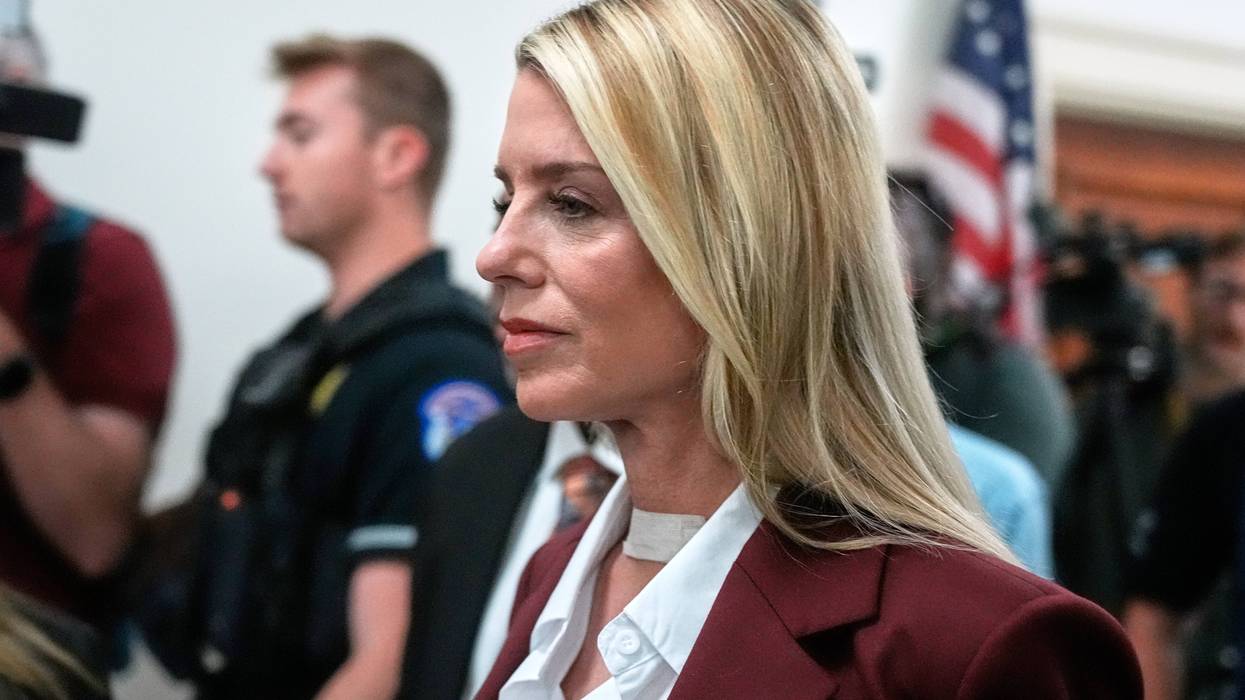

WASHINGTON (AP) — Former Attorney General Pam Bondi refused to answer questions Friday on President Donald Trump's involvement in the release of the Jeffrey Epstein case files as she defended the Trump administration's actions before House lawmakers scrutinizing the process.
Bondi, who spent roughly four hours on Capitol Hill for her closed-door interview, was again defiant when she was confronted by lawmakers about the Epstein investigation. In her opening statement, she stood behind the Department of Justice's handling of the case files and said that Deputy Attorney General Todd Blanche, now the acting attorney general and Trump's former personal attorney, had overseen the process to publish them.
“The bottom line is: justice and transparency in this matter have been delivered at the direction of President Trump and his administration,” she said, according to her opening statement.
Bondi's transcribed interview presented lawmakers with an opportunity to question a Cabinet official who was central to the political firestorm over Epstein that at times has rattled Trump's Republican administration. She initially raised expectations for the full release of the Epstein case files, only to later backtrack. That reversal prompted Congress to step in and pass the law requiring the release.
But Democratic lawmakers said that Bondi told them she would not speak about the president in the interview and, consulting with a lawyer from the Department of Justice, said that she could decline those questions because she agreed to appear before the committee voluntarily.
“It's a sham in there," said Democratic Rep. Dave Min of California during a break in the interview. "They are not answering any questions.”
Democratic Rep. James Walkinshaw of Virginia said he asked Bondi whether Trump had any knowledge of Epstein's crimes before they became public. Reading from his notes of the exchange, Walkinshaw told reporters that Bondi's response was, “I'm not certain of the extent of his knowledge.”
Epstein killed himself in a New York City jail cell in 2019 while awaiting trial for trafficking and sexually abusing underage girls. Trump was friends with Epstein in the 1990s and early 2000s but has said he cut ties with him years before Epstein pleaded guilty to Florida state charges in 2008 for soliciting prostitution from a minor.
Survivors tried to confront Bondi
Several survivors of Epstein's abuse gathered outside the Capitol office where the interview was taking place. They tried to make their presence known to Bondi as she entered the room, but several said they were shoved aside by police officers.
“I just hope that she does have a moment where she remembers her own humanity and our humanity and finds her compassion and remembers that this is a bigger story than political rhetoric,” said Danielle Bensky, one of the survivors.
The survivors also implored lawmakers to hold Bondi accountable for the handling of the Epstein case files' release, which included the personal information of potential victims.
They confronted the committee chair, Republican Rep. James Comer of Kentucky, and he told them that he would press for the complete release of case files mandated by law.
“We want justice for the survivors, we do,” Comer added.
Bondi told lawmakers in her opening statement that releasing the Epstein case files was “an enormously complicated and labor-intensive process” and conceded that the Justice Department had made redaction errors. But she mostly defended the department’s work, saying that it had complied with the law and demonstrated “an unprecedented commitment to transparency.”
Even after being ousted as attorney general last month, Bondi has stayed within the Republican president's orbit.
Trump appointed Bondi, who revealed this week that she is being treated for thyroid cancer, to a White House panel on artificial intelligence this week, and she was be accompanied Friday by Justice Department officials, including Harmeet Dhillon, who heads the department's Civil Rights Division, acting as her counsel.
Democrats called that arrangement a conflict of interest.
Dhillon told reporters after the interview that she had been there to “represent the interests of the Department of Justice” because Bondi was answering questions about her time as attorney general. She said she had advised Bondi to only answer questions that were within “the ground rules laid with the committee” and not on other topics.
Interview was not videoed
Friday's interview was only the latest clash between Bondi and Democrats.
Bondi was subpoenaed by the committee in March in a bipartisan vote, but she tried to head off that demand by holding a closed-door meeting with lawmakers. The maneuver only added to the enmity between her and Democrats on the committee.
Bondi's departure from the Justice Department also raised doubts about the enforcement of the congressional subpoena. After the committee's Democrats maneuvered to press for a civil contempt of Congress resolution against Bondi, she agreed to sit for a transcribed interview rather than a sworn deposition.
Democrats on the Oversight panel criticized that arrangement, saying it allowed Bondi to decline to answer questions. They also objected to Comer's decision not to video the interview.
“We continue to be incredibly disappointed of the decision to not have this interview videotaped and then released to the American public,” said Rep. Robert Garcia of California, the top Democrat on the panel.
Comer has said he allowed Bondi to sit for a transcribed interview rather than a deposition as an incentive to cooperate. Previously, he had enforced a subpoena on former President Bill Clinton and former Secretary of State Hillary Clinton after they resisted the demand. Both of their depositions were video-recorded.
Comer said that Bondi could face prosecution if she lies to Congress and that the committee would release a transcript of the interview.
Meanwhile, Democrats suggested they could still press to enforce the subpoena for Bondi. They also said they wanted to subpoena Blanche. Both actions would need Republican support.
“It's important that we continue to keep this pressure on them,” said Democratic Rep. Summer Lee of Pennsylvania.
___
Associated Press writer Alanna Durkin Richer in Washington contributed to this report.
___
Follow the AP's coverage of the Jeffrey Epstein case at https://apnews.com/hub/jeffrey-epstein.