



TEMPE, Ariz. (AP) — For three years, Ethan Mock worked part-time at a gym to make ends meet while taking on more than $100,000 in debt to pursue a degree in business administration. Earlier this year — his fifth and final at Northern Arizona University — he began looking beyond his major for a stable career.
So in July, when he learned over the radio about a tuition-free, three-month semiconductor crash course at Rio Salado College, he signed up immediately, despite having no background in the field. The draw: the community college's new program offered students a chance to interview with major chipmakers in Arizona.
Two months later, clad in protective gear inside a lab, Mock was operating advanced machinery used to turn thin slices of silicon into semiconductor chips that power smartphones, robotics and data centers.
“I do want to be in a booming industry,” said Mock, 23. “It was very exciting to get right into the meat and bones of the semiconductor manufacturing, which is really cool.”
Learning alongside him were a 64-year-old middle school teacher, a software developer in his 50s who recently was laid off, gig workers without degrees, and younger students considering alternatives to a traditional college degree.
The cohort is enrolled in a highly specialized chip-manufacturing course that’s part of a growing network of short-term, hands-on programs at community colleges. Their goal is to fill entry-level positions, such as technicians who maintain and service production equipment, more quickly.
The push comes as the world’s leading chipmakers struggle to find workers to run new U.S. plants. Encouraged by the sweeping 2022 CHIPS Act seeking to boost domestic production, they have poured over $800 billion into new U.S. semiconductor fabrication plants.
Yet the U.S. semiconductor industry could face a shortage of as many as 157,000 full-time workers by 2030, said Shari Liss, who leads talent initiatives at the global chip industry group SEMI and manages a workforce development program funded by the CHIPS Act.
Experts warn that Texas, Ohio, California, New York and Arizona are set to encounter the most acute semiconductor labor shortages, which may stall production plans and cripple U.S. ambitions to lead in artificial intelligence.
“What keeps me up at night is: how are we going to fill all of these roles?” Liss said. “The task is daunting.”
Community colleges expand training with government and industry support
Spurred by the CHIPS Act, federal agencies like the National Science Foundation and leading producers in the field, such as Taiwan Semiconductor Manufacturing Company, Samsung and SK Hynix, are funding the partnerships.
Governments and companies setting up plants help local schools buy equipment and expand access, while also advising them on the core skills the industry urgently needs so schools can accelerate targeted training.
Rio Salado College in Tempe, Arizona, is among schools shortening courses that once spanned up to two years. After consulting with companies like TSMC and Intel, the college opened a free, 12-week program to the public this fall.
An earlier version of the training serving veterans began about 15 years ago, when no Arizona community college offered semiconductor manufacturing programs, and Intel required a two-year associate degree for its entry-level jobs, said Rick Vaughn, who manages technology and engineering courses at Rio Salado.
This fall, about a dozen students are going through Rio Salado’s semiconductor manufacturing program, which introduces students to skills needed in and around a fabrication plant.
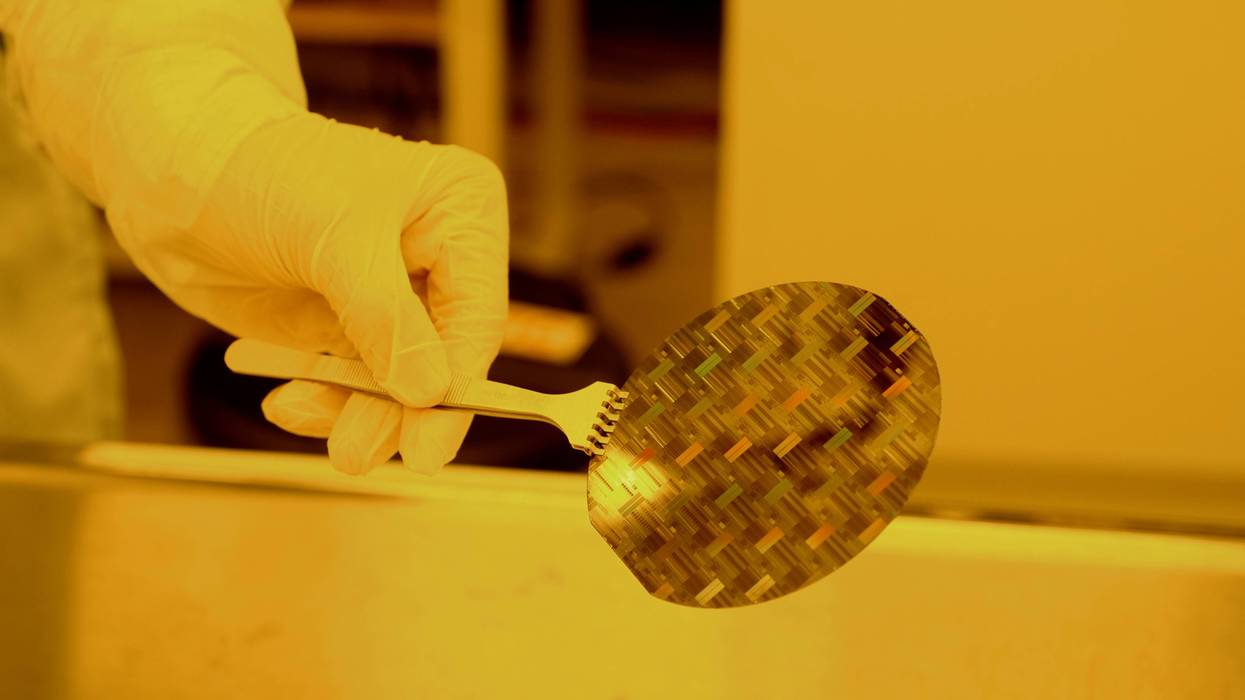
The cohort first learns fabrication procedures through virtual-reality headsets. Then, they receive about 20 hours of hands-on training in Arizona State University’s clean-room labs, wearing full protective suits and lab goggles that keep dust off equipment and raw materials.
Similar shorter on-ramps to interviews at semiconductor companies are offered at Austin Community College in Texas, West Valley College in Saratoga, California and many more schools. According to SEMI, over 200 community colleges and universities nationwide have coordinated with the group to prepare workers as new manufacturing plants come online.
“These short hands-on programs lead to well-paying local jobs at the biggest tech companies,” Vaughn said. “Without a four-year commitment, they’re not accumulating any debt. And this becomes a really credible path into this growing industry.”
Push is on to expand advanced chipmaking from Asia to America
Making a chip is one of the world’s most complicated manufacturing processes.
Technicians at the industry’s advanced fabrication plants repeat hundreds of tightly controlled steps, building microscopic layers that form tiny electronic components and connections on silicon wafers, which the community college students can practice and perfect in clean rooms, said Trevor Thornton, an ASU electrical engineering professor teaching semiconductor engineering.
“We’ve been able to expand the program to bring more and more of these community college students to the clean rooms, which makes it easier for the industry to train them,” Thornton said.
Some choose to pursue engineering degrees at ASU. “It’s good for everybody,” he added.
Whether accelerated programs have grown fast enough to meet the hiring demand of the likes of TSMC, Samsung and SK Hynix remains in question.
While trying hard to scout locally, those companies are bringing hundreds of experienced engineers and technicians from Taiwan and South Korea to help operate new facilities in Arizona, Texas and Indiana.
“They are here to train Americans,” said Pearl Chang Esau, an education and workforce consultant for TSMC Arizona.
TSMC’s $265 billion development project in northern Phoenix — the largest foreign direct investment in U.S. history — is expected to create 25,000 jobs in the next decade or so, Chang Esau estimated, with half of them being locally hired technicians.
“Because advanced semiconductor production has really only occurred in Asia, there’s an element to this that’s new and unprecedented,” she said. “It has to be handled with care.”
That care, Rick Vaughn once told his students, begins with habits that sound simple but matter inside a fabrication plant: precision, safety and reliability.
As Mock jotted down notes on workplace expectations and clean-room protocols, he considered starting as a technician and combining the front-line experience with his college degree in a few years.
It felt increasingly tangible, he said, as dozens of cranes rise over TSMC’s expanding complex near his home in a suburb north of Phoenix and a network of supporting businesses move into the metro area.
“There are so many avenues,” Mock said. “It’s really endless.”
___
The Associated Press’ education coverage receives financial support from multiple private foundations. AP is solely responsible for all content. Find AP’s standards for working with philanthropies, a list of supporters and funded coverage areas at AP.org.