




HONG KONG (AP) — Asian shares declined Tuesday, following more drops for stocks in the artificial intelligence industry on Wall Street ahead of Nvidia's earnings results.
U.S. futures were mixed and oil prices edged lower.
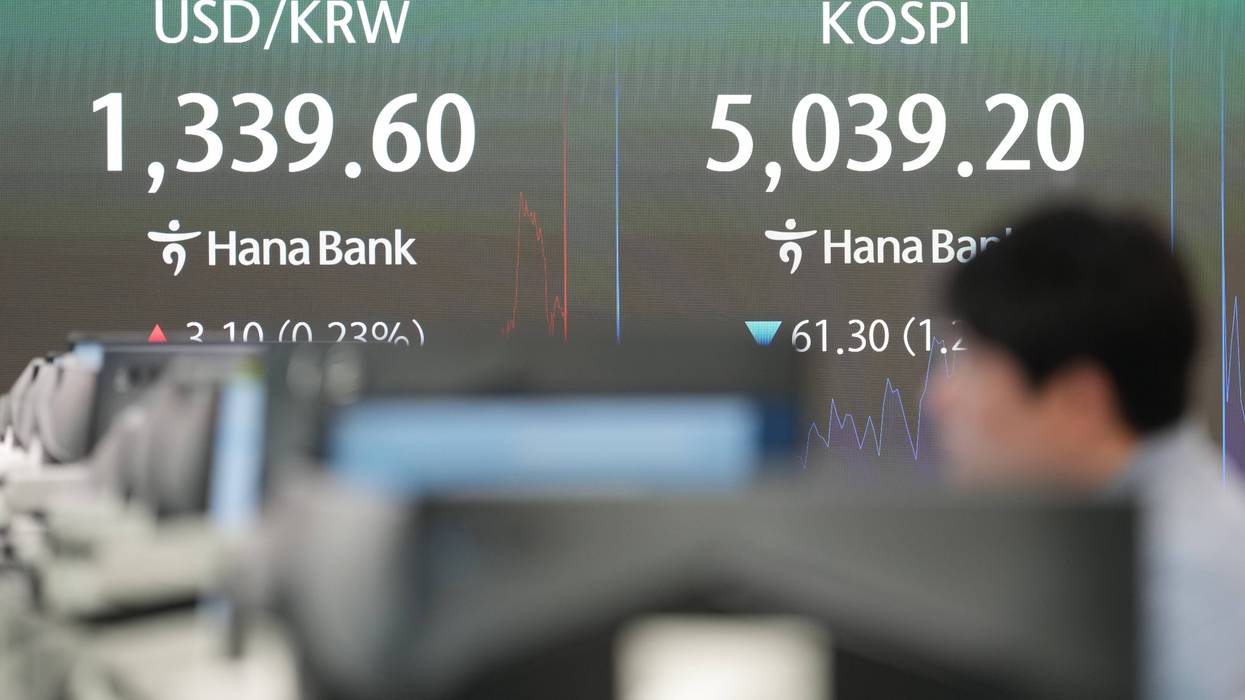
South Korea’s Kospi declined 1% to 5,051.93, while memory chipmaker Samsung Electronics fell 2.4% and SK Hynix rose 0.7%. The benchmark in Seoul has fallen more than 10% over the past month.
Japan’s benchmark Nikkei 225 lost 1.2% to 58,956.67. Shares of OpenAI investor SoftBank Group tumbled 6.2% and testing equipment maker Advantest slumped 4.3%.
In Hong Kong, the Hang Seng sank 1.2% to 23,458.87, while the Shanghai Composite index was 0.8% lower to 23,458.87.
Australia’s S&P/ASX 200 fell 1.5% to 8,907.50.
Taiwan’s Taiex slid 0.9%.
Regional leaders are gathering for the ASEAN summit in Manila, Philippines, and the APEC summit in Shenzhen, China, this week. Investors will be watching for signs of greater cross-border cooperation and progress on trade agreements, amid heightened geopolitical tensions.
On Monday, the S&P 500 index was 1.9% lower and the Nasdaq composite index lost 2.5%. The Dow also fell 1.4% as losses broadened into other sectors.
Nvidia sank 4.1% and was again the heaviest weight on Wall Street following its crisis of leadership. The company has lost $735 billion in market value since the disclosures of CEO Jensen Huang’s extramarital affairs and his ties to an alleged Chinese spy.
Nvidia is one of the most influential companies in the world not only because its chips are powering much of the world’s move into AI technology but also because its cash has helped companies across the industry to grow.
Huang’s resignation as Nvidia’s CEO is the latest challenge for the AI industry, which has also faced criticism that its stock prices were in a bubble and is worried Democrats empowered by victories in the U.S. midterm elections may favor restrictions on further construction of AI data centers.
“The market was already worried about this risk before what happened at Nvidia,” Zhiwei Zhang, president and chief economist at Pinpoint Asset Management, said in a commentary. “Now the risk has become even more serious.”
The sector is also now facing more scrutiny from the U.S. government. The Trump administration on Monday issued new rules to restrict remote access to advanced U.S. computing chips and servers.
Outside of Nvidia, other chip companies also fell. They had climbed in the earlier days of Nvidia’s fall on hopes that they could gain a competitive advantage.
Nvidia will report its latest quarterly results Tuesday, and interim CEO Colette Kress is set to speak to Wall Street. Investors have become accustomed to Nvidia not only reporting stronger results than analysts expected for each quarter but also giving a forecast for upcoming revenue that’s well above expectations.
Elsewhere on Wall Street, L3Harris Technologies fell 3.9% after officials in President Donald Trump’s administration suggested the contractor for the Federal Aviation Administration may be at fault for the ground stop of nationwide air traffic Friday. L3Harris said Saturday that it’s supporting the FAA in its investigation.
The recent swings for AI stocks have overshadowed what’s been another strong earnings reporting season for U.S. companies. The big businesses in the S&P 500 index are on track to deliver earnings per share for the summer nearly 32% higher than a year earlier, according to FactSet.
In the bond market, Treasury yields eased back following last week’s jump due to a worse-than-expected report on U.S. inflation.
The yield on the 10-year Treasury fell to 5.13% from 5.15% late Friday, though it remains well above a low of 4.80% reached earlier this month. Higher yields make borrowing money more expensive for everyone, and they’ve already hurt the housing industry through expensive mortgage rates.
In other dealings early Tuesday, the price of Brent crude, the international standard, edged 0.8% lower to $91.66 a barrel. U.S. benchmark crude oil slid 0.8% to $85.01 per barrel.
The U.S. dollar fell to 159.35 Japanese yen from 159.52 yen. The euro rose to 1.1003 from 1.1001.
___
AP Business Writer Stan Choe contributed to this report.