


OMAHA, Neb. (AP) — The last remaining passengers on a cruise ship hit by a deadly hantavirus outbreak disembarked Monday and boarded flights to more than 20 countries to enter quarantine. A French woman was the latest to be confirmed as infected, while an American was suspected of infection after initial testing.
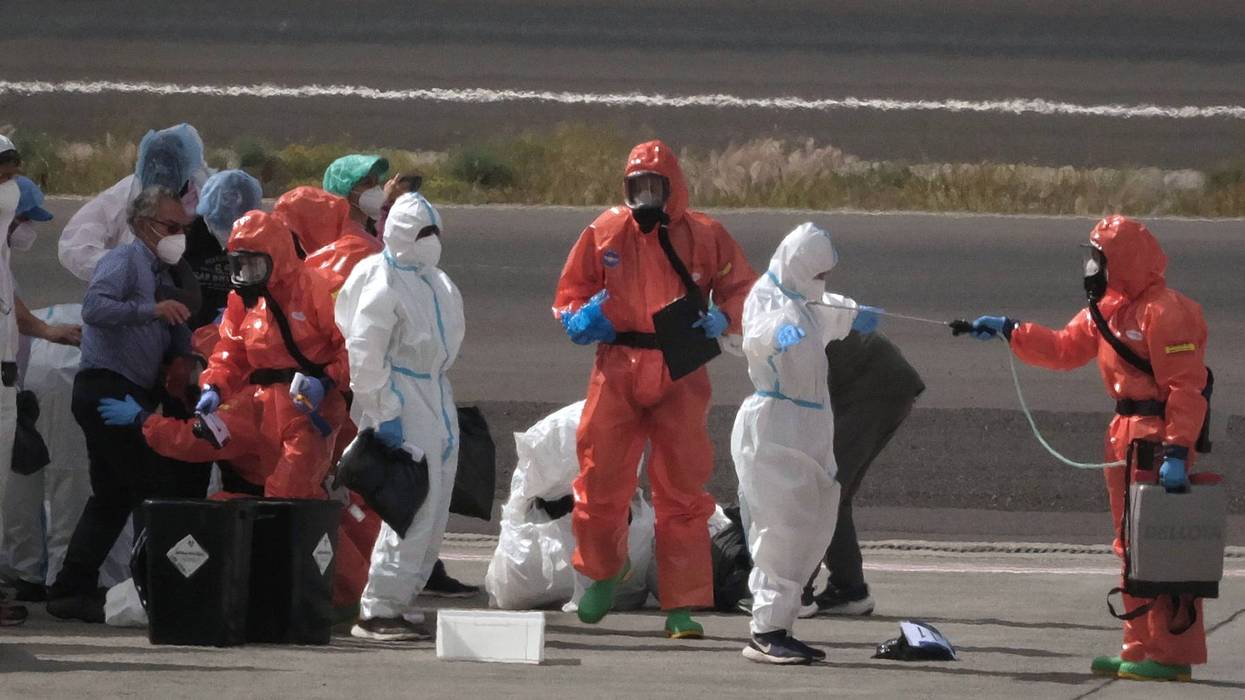
Passengers began flying home aboard military and government planes Sunday after the MV Hondius anchored in the Canary Islands. Personnel in full-body protective gear and breathing masks escorted the travelers from ship to shore in Tenerife, an effort that concluded Monday.
“If they stayed longer on the ship, the situation could have been difficult,” said Tedros Adhanom Ghebreyesus, director-general of the World Health Organization. He said citizens of the countries passengers are returning to should know “there is nothing to fear, the risk is low, this is not another COVID.”
Three cruise ship passengers have died, and six people with confirmed or suspected cases of hantavirus are being quarantined, according to the WHO. The lab results of the American who tested positive were inconclusive, WHO spokesperson Sarah Tyler said Monday.
Health authorities say it's the first hantavirus outbreak on a cruise ship. While there is no cure or vaccine for hantavirus, the WHO says early detection and treatment improves survival rates.
The ship's captain, Jan Dobrogowski, issued a video message Monday praising passengers and crew for their courage and perseverance, and he called for respect for their privacy.
“I could not imagine sailing through these circumstances with a better group of people, guests and crew alike,” he said.
New cases in France, United States
The French woman who tested positive for the hantavirus was in intensive care in stable condition at a Paris hospital, French Prime Minister Sebastien Lecornu said Monday. He said four French passengers who returned Sunday tested negative but remained in isolation at the same hospital.
One of 18 evacuated passengers flown to the U.S. also tested positive for the hantavirus but was not showing symptoms, while another had mild symptoms, U.S. health officials said.
After landing early Monday, 16 American passengers — one of them a British-U.S. dual citizen — were taken to the University of Nebraska Medical Center, which has a federally funded quarantine facility and a biocontainment unit for treating people with highly infectious diseases. They were being assessed to determine if they had close contact with any symptomatic people and their risk levels for spreading the virus.
An American who tested positive for hantavirus on the cruise ship was taken to the Omaha campus' biocontainment unit and will be tested again. The passenger “is doing well and not having symptoms at this time,” said Dr. Angela Hewlett, the unit's medical director.
The others taken to Nebraska will be monitored in quarantine for several days. They arrived “in good shape, good spirits,” said Dr. Michael Wadman, the quarantine unit's medical director.
Two additional American passengers, a couple, arrived Monday at Emory University Hospital in Atlanta. One of them had mild symptoms and will be tested for hantavirus.
“It doesn’t necessarily mean, just because someone has symptoms, that they’re going to end up having this illness,” said Dr. Brendan Jackson of the U.S. Centers for Disease Control and Prevention.
Some public health experts have accused the U.S. government of being slow to respond to the hantavirus outbreak. Health Secretary Robert F. Kennedy Jr. rejected the notion that cuts at his agency had left the U.S. less prepared.
“We have this under control," Kennedy said Monday, “and we’re not worried about it.”
WHO recommends close monitoring of former passengers
Oceanwide Expeditions, which owns and operates the cruise ship, said 25 crew and two medical professionals remained on board Monday as the Hondius departed the Canary Islands. It was expected to arrive in Rotterdam on Sunday.
The Hondius left the southern Argentine port of Ushuaia on April 1 and a Dutch passenger died on board April 11. It wasn’t until early May that the WHO said it was reacting to a suspected hantavirus outbreak on the ship, which by that time was off the West African island nation of Cape Verde.
South African health authorities said on Monday that the condition of a British man admitted to a hospital in Johannesburg and being treated for hantavirus was gradually improving. He was evacuated from the ship on April 27 after becoming ill.
The Dutch couple who presented the first two cases had traveled through Argentina, Chile and Uruguay before boarding the ship, the WHO said. They visited sites where the species of rat known to carry Andes virus was present.
Health officials say risk to public is low
Hantavirus usually spreads from rodent droppings and is not easily transmitted between people. But the Andes virus detected in the cruise ship outbreak may be able to spread between people in rare cases. Symptoms — which can include fever, chills and muscle aches — usually show between one and eight weeks after exposure.
Tedros of the WHO advised that returning passengers should stay in quarantine, either in their homes or in other facilities, for 42 days. He added that WHO cannot enforce its guidance, and that different countries may handle monitoring of passengers without symptoms in different ways.
Numerous countries have said their people will be quarantined or hospitalized for observation.
___
This story has been corrected to show that it is the U.S. Centers for Disease Control and Prevention, not the U.S. Centers of Disease Control and Prevention.
___
Corder reported from the Hague, Netherlands. AP journalists Jamey Keaten in Geneva; Scott Bauer in Madison, Wisconsin; Mike Stobbe in New York; Collin Binkley in Washington and Russ Bynum in Savannah, Georgia, contributed.