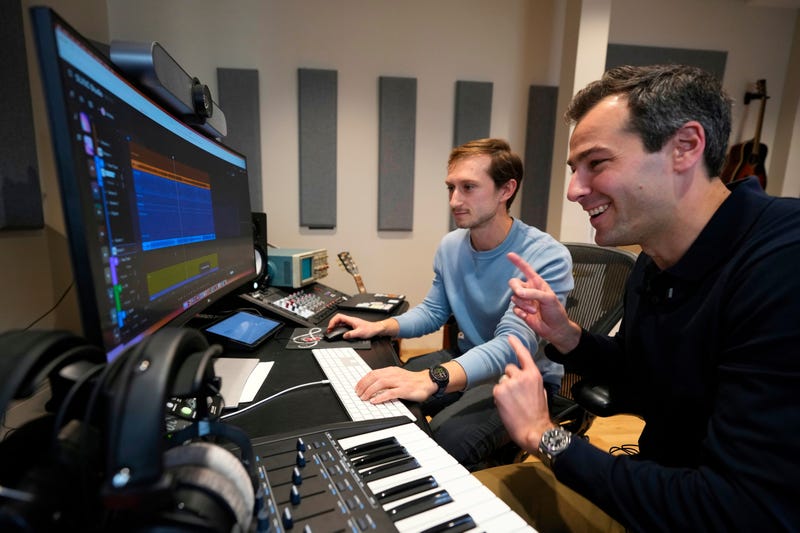
CAMBRIDGE, Mass. (AP) — Suno CEO Mikey Shulman pulls up a chair to the recording studio desk where a research scientist at his artificial intelligence company is creating a new song.
The flute line sounds promising.
The percussion needs work.
Neither of them is playing an instrument. They type some descriptive words – Afrobeat, flute, drums, 90 beats per minute – and out comes an infectious rhythm that livens up the 19th century office building where Suno is headquartered in Cambridge, Massachusetts. They toggle some editing tools to refine the new track.
Much like early experiences with ChatGPT or AI text-to-image generators, trying to make an AI-generated song on platforms like Suno or its rival, Udio, can seem a little like magic. It takes no musical skills, practice or emotional wellspring to conjure up a new tune inspired by almost any of the world’s musical traditions.
But the process of training AI on beloved musicians of the past and present to produce synthetic approximations of their work has angered the music industry and brought much of its legal power against the two startups.
Now, after their users have flooded the internet with millions of AI-generated songs, some of which have found themselves on streaming services like Spotify, the leaders of Suno and New York-based Udio are trying to negotiate with record labels to secure a foothold in an industry that shunned them.
“We have always thought that working together with the music industry instead of against the music industry is the only way that this works,” said Shulman, who co-founded Suno in 2022. “Music is so culturally important that it doesn’t make sense to have an AI world and a non-AI world of music.”
Sony Music, Universal Music and Warner Records sued the two startups for copyright infringement in 2024, alleging that they were exploiting the recorded works of their artists.
Since then, the pair have strived to make peace with the industry. Suno, now valued at $2.45 billion, last year struck a settlement with Warner, and Udio has signed licensing agreements with Warner, Universal and independent label Merlin. Only one major label, Sony, has not settled with either startup as the lawsuits move forward in Boston and New York federal courts. Suno also faces legal challenges in Europe brought by groups representing music creators.
The first of the settlement deals, between Udio and Universal, led to an exodus of frustrated Udio users who were blocked from downloading their own AI-generated tracks. But Udio CEO Andrew Sanchez said he's optimistic about what the future will bring as his company adapts its business model to let fans of willing artists use AI to play with and potentially alter their works.
“Having a close relationship with the music industry is elemental to us,” Sanchez said in an interview. “Users really want to have an anchor to their favorite artists. They want to have an anchor to their favorite songs.”
Many professional musicians are skeptical. Singer-songwriter Tift Merritt, co-chair of the Artists Rights Alliance, recently helped organize a “Stealing Isn't Innovation” campaign by artists — including Cyndi Lauper and Bonnie Raitt — to urge AI companies to pursue licensing deals and partnerships rather than build platforms without regard for copyright law.
“The economy of AI music is built totally on the intellectual property, globally, of musicians everywhere without transparency, consent, or payment. So, I know they value their intellectual property, but ours has been consumed in order to replace us,” Merritt said in an interview in Raleigh, North Carolina.
Shulman contends technology “evolves very often faster than the law,” and his company tries to be thoughtful about “not breaking the law" but also "deliver products that the world really wants.”
Suno CEO doesn’t really think ‘people don’t enjoy’ making music
When the music industry first confronted Suno over alleged copyright infringement, the company’s antagonistic response alienated professionals like Merritt.
Symbolizing the divide was a clip last year in which Shulman was quoted as saying, “it's not really enjoyable” to make music most of the time. Shulman started learning piano at age 4 but later dropped it. He took up bass guitar at 12, playing in rock bands in high school and college. He said that experience gave him some of the best moments of his life.
“You need to get really good at an instrument or really good at a piece of production software,” Shulman said on the “The Twenty Minute VC” podcast. “I think the majority of people don’t enjoy the majority of the time they spend making music.”
“Clearly, I wish I had said different words,” Shulman told the AP. The context, he added, was that “to produce perfect music takes a lot of repetitions and not all of those minutes are the most enjoyable bits of making music. On the whole, obviously, music is amazing. I play music every day for fun.”
Udio CEO pitches his company as the friendly alternative
Sanchez, the Udio CEO, also would like people to know he loves making music. He's an opera-loving tenor who's sung in choirs and grew up crooning Luciano Pavarotti in his family's home in Buffalo, New York.
Founded in 2023 by a group that included several AI researchers from Google, the startup now employs about 25 people. It has fewer users and raised less capital than Suno, reducing its leverage in its negotiations with record labels.
But like ride-hailing company Lyft, which pitched itself as the friendly alternative to Uber’s aggressive expansion tactics more than a decade ago, Udio embraces its underdog status.
“So many tech companies actively cultivate this I-am-a-tech-company-crusader and that’s part of their identity,” Sanchez said. “That alienates people who are creative and I am uniformly opposed to that.”
Sanchez said he knows not every artist is going to embrace AI, but he hopes those who leave the room after talking with him realize he’s not imposing a kind of “AI bravado.”
“If you took what we’re doing and pretended that the word AI wasn’t a part of it, people would be like, ‘Oh my gosh. This is so cool.’”
In the basement office of his Philadelphia, Mississippi home, Christopher “Topher” Townsend is a one-man band, making and marketing Billboard-chart-topping gospel music — none of which he sings himself — and doing it in record time.
The rapper, whose lyrics reflect his political conservatism, downloaded Suno in October and, within days, created Solomon Ray, a fictional singer that Townsend calls an extension of himself.
Townsend uses ChatGPT to write lyrics, Suno to generate songs and other AI tools to create cover art and promotional videos under the Solomon Ray name.
“I can see why artists would be afraid,” Townsend said. ”(Solomon Ray) has an immaculate voice. He doesn’t get sick. You know, he doesn’t have to take leave, he doesn’t get injured and he can work faster than I can work.”
Trying to dispel that fear for aspiring artists is Jonathan Wyner, a professor of music production and engineering at the Berklee College of Music in Boston, who sees generative AI as just another tool.
“To the creative musician, AI represents both enormous potential benefits in terms of streamlining things and frankly making kinds of music-making possible that weren’t possible before, and making it more accessible to people who want to make music,” he said.
Such a vision remains a tough sell for artists who feel their work has already been exploited. Merritt says she's particularly concerned about labels making deals with AI companies that leave out independent artists. An open letter she co-signed this week says “many in our community are embracing responsible AI as a tool for creation” but targets Suno as a “smash and grab” business that artists should avoid.
“Artists need to know the difference – all AI platforms are not the same, and Suno, which is being sued for copyright infringement, is not a platform artists should trust,” says the letter from Merritt and six others.
—————-
O'Brien reported from Cambridge, Massachusetts and New York. Ngowi reported from Cambridge and Somerville, Massachusetts. AP journalists Sophie Bates in Philadelphia, Mississippi and Allen G. Breed in Raleigh, North Carolina, contributed to this report.