

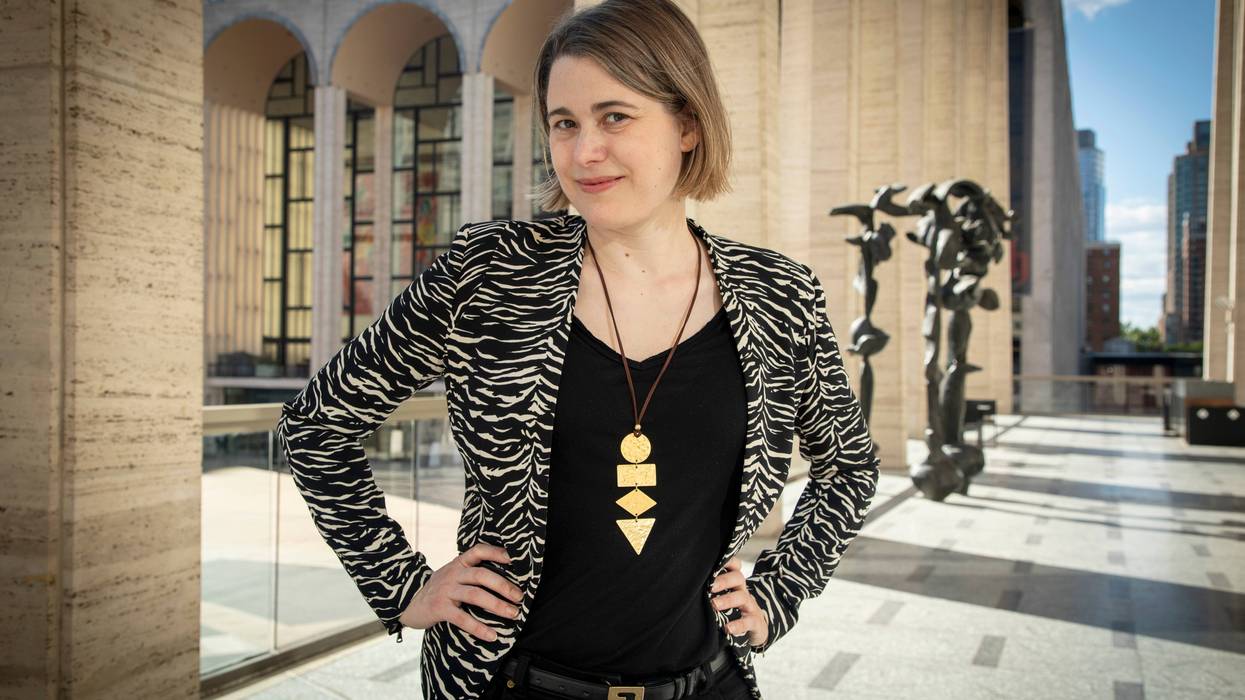

NEW YORK (AP) — It’s less than a 40-minute walk uptown to the Metropolitan Opera House from where Heartbeat Opera got its humble start in a yoga studio. But for Louisa Proske, it’s been an artistic journey years in the making.
Proske, who co-founded the scrappy company in 2014, is making her Met debut in the highest-profile assignment imaginable: opening the season directing a new production of Verdi’s “Macbeth” with an all-star cast.
The job came her way less than a year ago after another director bowed out. Planning for new productions typically starts two or more years in advance.
“I was aware of Louisa’s success at Heartbeat, and she had been on my radar,” Met general manager Peter Gelb said. “In terms of who was available on relatively short notice, Louisa was an obvious choice.”
As Proske recalled her conversation with Gelb, “He said, ‘Can you do it very, very fast? The design was due yesterday.’”
“I said it’s a big challenge,” she added. “But I love impossible challenges.”
Impossible challenges are nothing new for Proske
She had plenty of those at Heartbeat, which developed a reputation for reimagining the classics in eye-opening ways while operating on a shoestring budget.
Luckily she was able to recruit partners she had already worked with: costume designer Montana Levi Blanco and set designer Jon Bausor — both with previous Met experience — and choreographer Jorrell Lawyer-Jefferson. “That sealed the deal,” she said.
It also helped that Proske was intimately familiar with the Shakespeare play, having written her thesis on it at the University of Cambridge.
Now for the past few weeks, she has put her knowledge and imagination to work, immersing her cast — which includes a contingent of dancing witches — in what she calls “a terrifying tale for terrifying times.”
A Met newcomer who took charge like a veteran
And if she felt any trepidation about taking on such a huge challenge at a huge house, it wasn’t apparent in rehearsal.
“If this had been my first outing with the Met, I would have guessed that she’d been working here for at least a few years,” said baritone Quinn Kelsey, who portrays Macbeth. “She doesn’t come in there like a drill sergeant, but when she needs everyone’s attention, she gets it.
“It’s obvious she’s excited,” he said, “and wanting to show us all these wonderful ideas she’s come up with for us to portray our characters.”
Kelsey heads a cast that includes soprano Lise Davidsen as Lady Macbeth, tenor Freddie De Tommaso as Macduff, and bass-baritone Ryan Speedo Green as Banquo. Met music director Yannick Nezet-Seguin conducts the orchestra and chorus in the production, which opens Tuesday and runs for 10 performances. The Saturday matinee on Oct. 17 will be broadcast live to movie theaters around the world.
‘Macbeth’ shows a society in collapse
To Proske the opera is about “the corrupt lust for power, the disintegration of the society, the slide into tyranny, all things that I think Shakespeare wrote very acutely about.
“I think it expresses the agony of living in times that you don’t really understand anymore,” she continued. “That it only takes three steps for all guardrails to be gone, the world descending into total savagery and bloodshed. And I do think this is a very current sentiment.”
She has taken inspiration from Verdi’s remark that the story has three major characters: Macbeth, Lady Macbeth — and the witches, who in this production act as what Proske called “greedy voyeurs of the Macbeths’ descent into crime and bloodshed.”
“Sometimes they just lurk in the shadows, and you have a sense that they’re there,” she said. “Almost like insects, or mold, they sort of creep through the walls, more and more invading those spaces as rules are broken and values transgressed.”
Bausor’s set suggests a modern war-torn landscape, with a false proscenium like a giant concrete wall with a huge hole blasted through it and rubble piled at the sides. Within the gap, scenes in the castle and on the battlefield play out on the revolving turntable.
In contrast, Blanco’s costumes evoke Shakespeare’s era, with plush robes, gowns and tunics. “To me there’s something exciting about these grand clothes from Renaissance England,” Proske said. “How they speak about power.”
Keeping true to the values of Heartbeat Opera
Despite the bigger budget and the bigger stage, Proske has aimed to bring the same values to the Met that flourish at Heartbeat.
“The core of Heartbeat was always the desire for exact, inventive, visceral storytelling,” she said. “So I feel like that was my playground and my deep passion for the first years of being an opera director, and it’s where I cut my teeth and developed a whole vision of what opera can be.”
She left the company in 2021 and returned to her native Germany, where she spent four seasons directing at Oper Halle in the northeastern state of Saxony-Anhalt. More recently, she has been freelancing in Europe and the U.S.
Her old friends at Heartbeat have watched her rise with pride.
Jacob Ashworth, the company’s artistic director, said he laughs when some fans ask if he isn’t disappointed by Proske’s move uptown. “There have been people who say, ‘But isn’t the Met the enemy?’” he said. “Of course we don’t think that at all.
“In this business it’s the downtown renegades and radical companies that toss out the ideas that then eventually trickle up to the big companies,” Ashworth said. “So it’s kind of fun when the actual people also trickle up.”
___
This story has been updated to correct that Proske left Heartbeat Opera in 2021, not 2018.