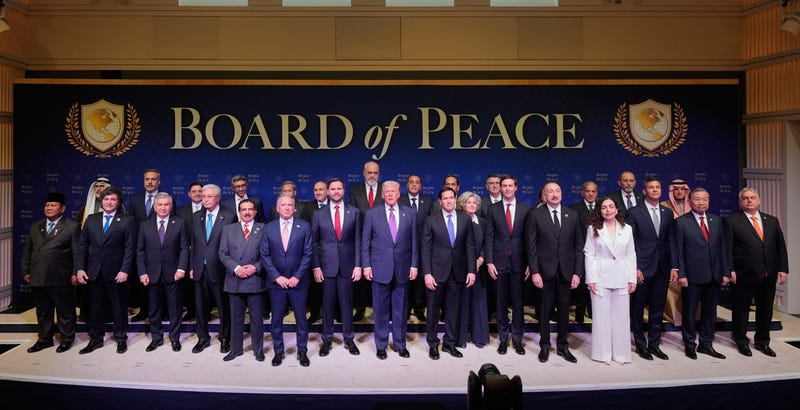
WASHINGTON (AP) — Indonesian President Prabowo Subianto signed a reciprocal trade agreement on Thursday with U.S. President Donald Trump while in Washington to attend the first meeting of the Trump-led Board of Peace.
Details were not immediately released, but the countries had reached a framework trade deal last summer to have Southeast Asia's largest economy eliminate tariffs for most American goods, while the U.S. would set tariffs on Indonesian goods at 19%. That is the same rate as for Cambodia and Malaysia.
Indonesian and U.S. companies also reached 11 deals this week worth $38.4 billion, including purchases of U.S. soybeans, corn, cotton and wheat, cooperation in critical minerals and oil field recovery, and joint ventures in computer chips.
“We have negotiated very intensively over the last few months, and I think we have reached solid understandings on many issues," Prabowo told business executives Wednesday at the U.S. Chamber of Commerce.
A White House statement called it a “great deal.”
“The Agreement will help both countries to strengthen economic security, promote economic growth, and thereby continuously lead to global prosperity,” the White House said.
Indonesia's pledge for Gaza stabilization force
The agreement was signed the same day that Prabowo, leader of the world’s most populous Muslim country, reiterated his pledge at the Board of Peace meeting to send 8,000 troops or “more if necessary” for an international stabilization force in Gaza.
Indonesia was among the first to make a firm commitment to a critical element of Trump’s postwar Gaza reconstruction plan.
“President Prabowo of Indonesia, thank you very much,” Trump said at the Board of Peace meeting. “It’s a big country you have, and you do a great job.”
Prabowo praised Trump in return. “We are very optimistic with the leadership of President Trump, this vision of real peace will be achieved,” Prabowo said. “There will be problems, but we will prevail.”
Cambodia and Vietnam are the two other Southeast Asian countries that joined the board, which was originally envisioned to oversee the Gaza ceasefire but has taken shape with wider ambitions to broker other global conflicts.
Their leaders also came to Washington for the inaugural meeting. Cambodia has already inked a trade deal with the U.S., while Vietnam has reached a framework agreement.
Critical minerals play into Indonesia deal
Indonesian companies agreed this week to buy 1 million tons of soybeans, 1.6 million tons of corn and 93,000 tons of cotton from the U.S. They also pledged to buy up to 5 million tons of U.S. wheat by 2030.
The countries agreed to cooperate on critical minerals, though details were not immediately available.
Washington is seeking Indonesia’s agreement to lift restrictions on critical mineral exports, which the Trump administration argues could safeguard U.S. manufacturers from supply‑chain disruptions. The administration has sought to defend against China’s stranglehold on the key elements needed for everything from fighter jets to smartphones.
At the Chamber of Commerce event, Prabowo said Indonesia can serve as a “bridge” and “honest broker” between great powers, apparently referring to the U.S.-China competition.
Vietnam's leader makes first visit to the US since being reelected
At the Board of Peace meeting, Trump called Vietnam “incredible as a country and as a force” and told leader To Lam that it was “a really great honor to have you."
Lam's visit to the U.S. is his first since he was reelected as the head of Vietnam's ruling Communist Party last month. Typically, China is an initial stop in a nod to the countries' ideological ties and Beijing’s status as Vietnam’s largest trading partner. Lam did visit China in August 2024 before traveling to the U.S. during his first term.
Analysts say Lam's visit to the U.S. before traveling to Beijing this time around is a notable shift in sequencing. Hanoi describes its foreign policy as independent and balanced among major powers.
Trade negotiations between Vietnam and the United States are ongoing following the Trump administration levying 20% tariffs on Vietnamese exports. The latest, sixth round of talks concluded in early February.
___
Karmini reported from Jakarta, Indonesia, and Ghosal from Hanoi, Vietnam.