


HONG KONG (AP) — Asian stocks were mixed Monday with markets in Japan and South Korea trading higher and setting new records, while oil prices edged lower on fresh optimism over progress in U.S.-Iran negotiations.
U.S. futures were trading lower.
Tokyo’s Nikkei 225 jumped 1.6% and ended at another all-time record of 72,353.96, led by technology stocks that were fueled by excitement over the global artificial intelligence boom.
Japan’s SoftBank Group, the multinational investment holding company with a strong AI focus, rose 1.9%. Chip equipment maker Tokyo Electron was up 3.2%.
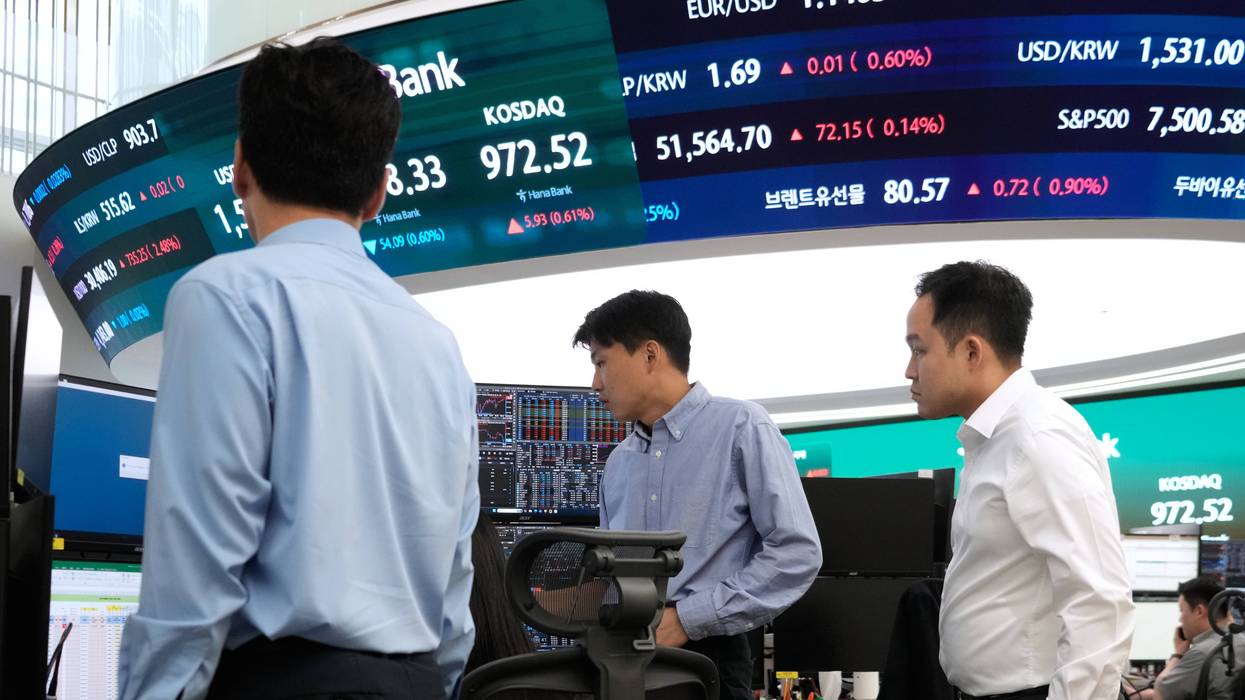
South Korea’s Kospi gained 0.7% to 9,114.55, also a record closing high, helped by AI-related shares. Memory chip maker SK Hynix surged 5.6%.
The Nikkei 225 and Kospi were up more than 40% and 120%, respectively, over the past six months. Both benchmark indexes have been setting fresh records in recent days on AI enthusiasm and positive developments from the Iran war.
“We’re seeing another strong market today,” Neil Newman, managing director and head of strategy at Astris Advisory Japan, said. He cautioned that the Japanese market is “probably getting a little stretched” from an investor’s point of view, “especially with what’s going (on) in the Middle East.”
Hong Kong’s Hang Seng lost 0.6% to 23,785.50, while the Shanghai Composite index was 1.8% higher at 4,163.10.
Australia’s S&P/ASX 200 was down 0.1% to 8,816.10.
Taiwan’s Taiex rose 2.8%. India’s Sensex was up 0.4%.
Oil prices fell as talks progressed over a permanent end to the Iran war. Brent crude, the international standard, was trading 1.1% lower to $79.70 per barrel. It was at roughly $70 a barrel before the start of the war in late February.
High-level negotiations in Switzerland between the U.S. and Iran concluded early Monday, with lower-level technical talks set for the rest of the week. Mediators Qatar and Pakistan said “encouraging progress” was made during the negotiations.
Meanwhile, while Iran said the Strait of Hormuz, a key waterway for oil and gas transport, was shut again over the weekend, the U.S. said that traffic had continued.
“Moving towards a more permanent deal will be challenging, with very real risks of a flare-up in hostilities,” ING commodities strategists Warren Patterson and Ewa Manthey wrote in a commentary on Monday.
Thomas Mathews, head of Markets, Asia Pacific of Capital Economics, believes energy flows in the strait are more likely to recover only gradually. “With the controversial — and fragile — U.S.-Iran peace process now underway, attention is turning to how quickly tankers return to the Strait of Hormuz to load energy supplies,” he wrote in a note.
In the U.S., investors are also monitoring May's personal consumption expenditures price index, or PCE, the preferred inflation gauge of the Federal Reserve, which is due to be released this Thursday.
In other dealings, the U.S. dollar rose to 161.76 Japanese yen from 161.22 yen. The euro was trading at $1.1445, down from $1.1473.
___
Associated Press senior producer Mayuko Ono in Tokyo contributed to this report.