DETROIT (AP) — Colin Farrell's had it done — many times. So have Angelina Jolie and Megan Fox. Heck, even Bart Simpson did.
Whether it's Marilyn Monroe's face, Billy Bob Thornton's name, a sultry rose or even Bart's partially inscribed homage to his mother, some tattoos simply have to go for one reason or many others.
But the process of taking them off is longer, much more costly and ouch — extremely more painful than getting them put on, according to professionals in the industry.
Also, due to health reasons, some souls who braved the ink needle, should be wary of the laser when having their body art erased or covered up.
Tattoos have been around for centuries
The oldest known tattoos were found on remains of a Neolithic man who lived in the Italian Alps around 3,000 B.C. Many mummies from ancient Egypt also have tattoos, as do remains from cultures around the world.
Tattoo removal likely is almost as old as the practice of inking and included scraping the skin to get the pigments off or out.
A more “civilized” method evolved in the 1960s when Leon Goldman, a University of Cincinnati dermatologist, used “hot vapor bursts” from a laser on tattoos and the skin that bore them.
Many choose tattoos to honor someone
A 2023 survey by the Pew Research Center determined that 32% of adults in the United States have tattoos. About 22% have more than one, according to the survey.
Honoring or remembering someone or something accounts for the biggest reason Americans get their first tattoo. About 24% in the survey regret getting them.
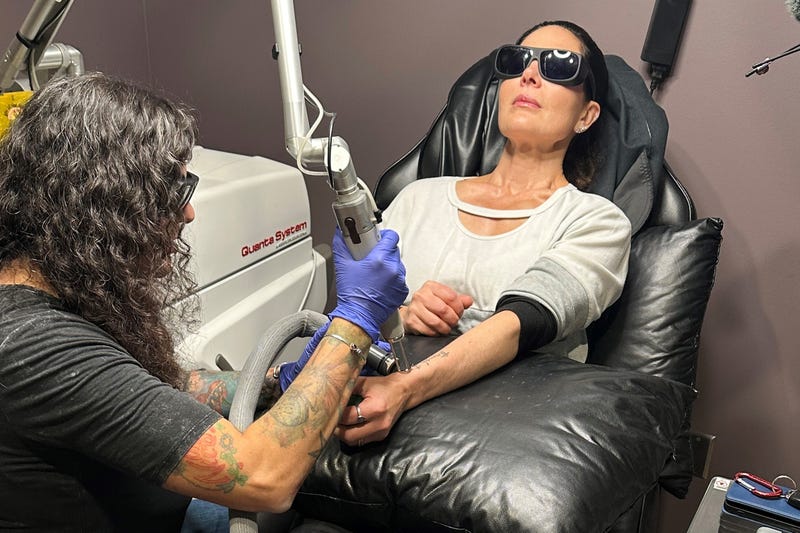
Tracy Herrmann, 54, of Plymouth, Michigan, just west of Detroit, has eight tattoos and is in the process of getting four phrases, including “One step at a time,” “Surrender,” and “Through it all,” removed from her feet and arms.
She started inking up about six years ago and says she doesn't regret getting tattoos.
“Maybe a different choice, maybe,” Herrmann said following her fourth tattoo removal session at Chroma Tattoo Studio & Laser Tattoo Removal in Brighton, Michigan.
“There was a period in my life that I felt I needed some extra reminder,” Hermann said. “I thought I would just embrace the period in my life, so that helped and then just to surrender and give it over to God. So, half of them were really, really pivotal to getting me over a hump in my life.”
Boredom among reasons to remove tats
Herrmann says the four getting lasered are part of her past and that's where she wants them to stay.
“Now, I just want to move forward and go back to the original skin I was born with,” she said. “But the other four I’m going to keep. They still mean a lot to me, but they’re more hidden.”
Reasons for getting a tattoo removed are as varied and personal as the reasons for getting them in the first place, says Ryan Wright, a registered nurse and owner of Ink Blasters Precision Laser Tattoo Removal in Livonia, Michigan.
“A lot of people, when they get a new tattoo that makes some of their old tattoos look bad they get (the older tattoos) removed or reworked,” Wright said.
Chroma owner Jaime Howard says boredom plays a role, too.
“They got a tattoo off a whim and they’re like ‘hey, I’m really bored with this. I don't want this anymore,’” Howard said. “It’s not about hating their tattoo, it’s about change for yourself.”
Like snapping a ‘rubber band’ on your skin
Howard and Wright, like many who perform laser removals, use something called a Q-switching, or quality switching, laser. It concentrates the light energy into intense short bursts or pulses.
“It's very painful. Nine out of 10,” Wright said. “It kind of feels like a rubber band being snapped on your skin with hot bacon grease.”
Howard has had some of her tattoos removed and admits the procedure is painful.
But “you get through it,” she said. “A couple of days later you’re still feeling the sunburn, but it's OK. If you want it bad enough, you’ll take it off because that’s what you want.”
Light heat from the laser breaks the ink into particles small enough to be absorbed by the body and later excreted as waste.
It's not a “one and done.” Wright said. Tattoo removal can take eight to 12 treatments or more. A new tattoo can go over the old one once the skin has had time to sufficiently heal.
Howard consulted with Herrmann as her fourth session at Chroma began. They spoke about the previous session and how far along they were with the ink removal. Both then donned dark sunglasses to protect their eyes from the brightness of the laser. Herrmann winced. Seconds later, it was done. But she still has more sessions ahead.
“Oh gosh, it’s a 10 when you’re getting it done," Herrmann said of the pain. "It’s pretty intense. It’s doable. I know price is sometimes an issue, but it’s worth it.”
Howard says the minimum she charges is $100 per session. Wright says that on a typical day he does about a dozen treatments and that cost depends on the square-inch size of the tattoo.
“The cost is really the technology in the laser,” Wright said. “It's not like a time thing. Most treatments are under a minute. You're paying for the technology and the person who knows how to use the technology. You can damage the skin if you don't know what you're doing."
Using lasers to remove tattoos comes with some risks. Skin that bore the tattoo can be left lighter than surrounding skin. There also can be temporary scarring, infection, redness or soreness, according to the U.S. Food and Drug Administration.
Consultations on the procedure's complications should take place before laser tattoo removal. Wright says his clients have to sign a waiver that they understand possible complications.
People who have diabetes and are not controlling the diabetes should be wary, he said.
“Anybody with autoimmune disease or any immune deficiencies,” Wright said. “We can't do it if you're on blood thinners. I go over the side effects with everyone."