

Is the US taking over Greenland next?

Following the latest surprise military action from President Donald Trump and his second administration, talk about the U.S. taking over Greenland has reignited. How realistic is the proposal?
Let’s start with some background on Greenland and then get into the Trump administration’s latest comments on the matter.
Greenland is an island in the arctic and, at 836,330 square kilometers, it is actually the largest island in the world. Most of Greenland (80%) is ice, and according to the Central Intelligence Agency, it has an arctic to subarctic climate with cool summers and cold winters. It also has several natural resources, including coal, iron ore, lead, zinc, molybdenum, diamonds, gold, platinum, niobium, tantalite, uranium, fish, seals, whales and hydropower, as well as possible oil and gas, per the CIA.
Danish colonization of the island began in the 18th century and Greenland became part of the Kingdom of Denmark in 1953. It joined the European Community (now the EU) with Denmark in 1973 but withdrew in 1985 “over a dispute centered on stringent fishing quotas,” said the CIA. President Harry Truman unsuccessfully tried to purchase Greenland in 1946.
Trump floated the idea of the U.S. taking over or buying Greenland in 2019, during his first term in office. He’s brought the idea up again during his second term and poll results from Rasmussen Reports found that more than two-thirds of Republican voters supported his suggestion to buy the country early last year.
As of 2026, Greenland has a parliamentary democracy, with King Frederick X of Denmark serving as chief of state. Its current head of government is Premier Jens-Frederik Nielsen.
While Senior White House aide Stephen Miller said in a recent interview with CNN’s Jake Tapper that the population of Greenland is “30,000” people, its total population is estimated at closer to 56,000 people. That’s still relatively small, smaller than the population of Cheyenne, Wyo., in fact.
During the interview, Miller also said: “The real question is, by what right does Denmark assert control over Greenland? What is the basis of their territorial claim?”
A Jan. 3 X post from his wife, podcaster Katie Miller, in part set off the renewed discussion of the U.S. potentially taking over Greenland. Her post came in the wake of the U.S. capturing Venezuelan leader Nicolas Maduro and Trump’s announcement that the U.S. would “run the country” for the time being.
Trump also said in an interview with The Atlantic this month that: “We do need Greenland, absolutely,” and said the island was surrounded by Russian and Chinese ships.
“It’s so strategic,” Trump told reporters onboard Air Force One on Sunday, per CNBC. “Right now, Greenland is covered with Russian and Chinese ships all over the place. We need Greenland from the standpoint of national security.”
Miller avoided answering Tapper’s questions about whether the U.S. would be willing to take Greenland via military force, which CNBC noted could be a violation and possible end of the North Atlantic Treaty Organization (NATO) multinational alliance. However, Miller did say that “the United States is the power of NATO” and “nobody’s going to fight the United States, militarily, over the future of Greenland.”
In a Wednesday Truth Social Post, the president said: “Remember, for all of those big NATO fans, they were at 2% GDP, and most weren’t paying their bills, UNTIL I CAME ALONG.”
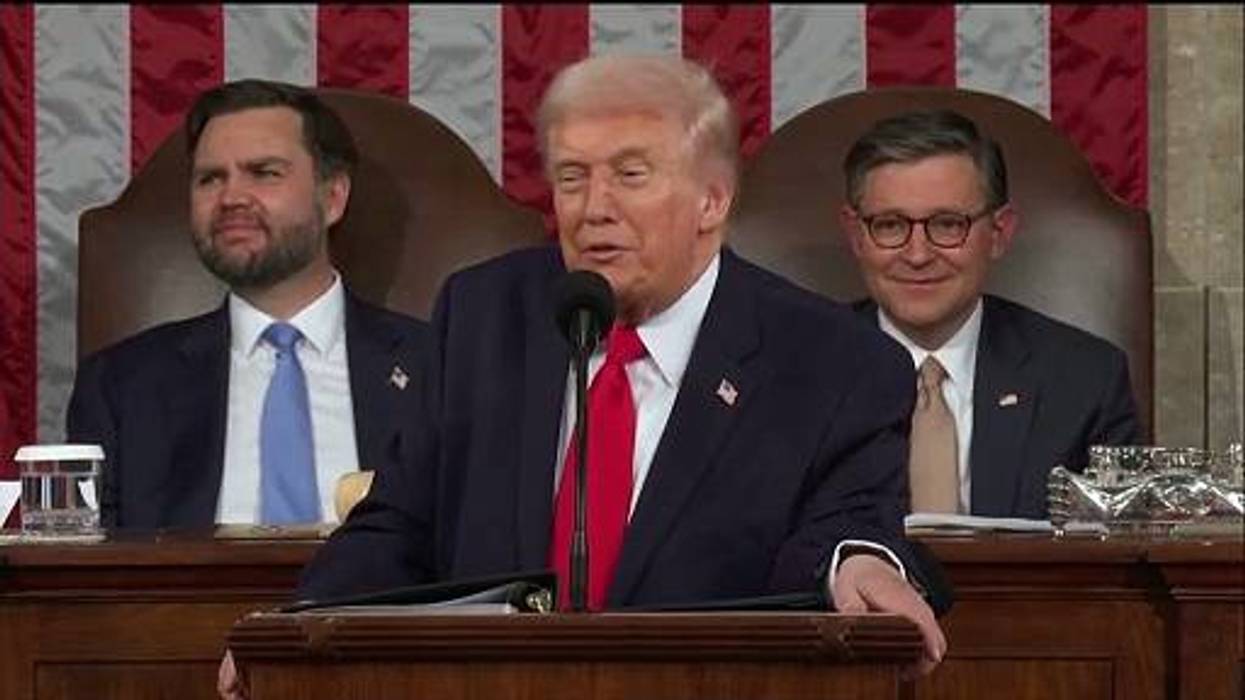
He also said “one way or the other, we’re going to get it,” of Greenland during a previous address to Congress.
In a statement provided to CNN, White House Press Secretary Karoline Leavitt said this week that: “President Trump has made it well known that acquiring Greenland is a national security priority of the United States, and it’s vital to deter our adversaries in the Arctic region,” and that “the President and his team are discussing a range of options to pursue this important foreign policy goal, and of course, utilizing the U.S. Military is always an option at the Commander in Chief’s disposal.”
CNN noted that Secretary of State Marco Rubio also told lawmakers this week that the Trump administration is considering buying Greenland. Per the outlet, Greenland has requested a meeting with Rubio.
In general, Greenland, Denmark, and Europe have not been very open to the idea of the U.S. taking over Greenland.
“Americans and their leader need to understand this,” said Greenland’s former premier, Múte Inequnaaluk Bourup Egede in a March Facebook post. “We’re not for sale and can’t just be taken. Our future is decided by us in Greenland.”
In a Jan. 6 Facebook post, new Premier Nielsen said “I made it very clear that we in Greenland have increased diplomatic and political efforts in our fight to establish that Greenland is our country and our territory. Our country isn't something you can deny or take over because you want to.”
He also referenced a joint statement from President Emmanuel Macron of France, Chancellor Friedrich Merz of Germany, Prime Minister Giorgia Meloni of Italy, Prime Minister Donald Tusk of Poland, Prime Minister Pedro Sánchez of Spain, Prime Minister Kier Starmer of the United Kingdom and Prime Minister Mette Frederiksen of Denmark on Greenland.
“Greenland belongs to its people,” said the statement. “It is for Denmark and Greenland, and them only, to decide on matters concerning Denmark and Greenland.”
The world leaders also stressed the importance of adhering to NATO and the United Nations Charter.
Neilsen went on to say that: “In a situation where the American President has again said that the United States is very serious about Greenland, this support from our allies in NATO is very important and unambiguous.”
He added that he hopes the U.S. will “seek respectful dialogue through the correct diplomatic and political channels and utilizing pre-existing forums that are based on agreements already in place with the United States. The dialogue must take place with respect to the fact that Greenland’s status is rooted in international law and the principle of territorial integrity.”
According to The Guardian, Starmer repeated British support for Denmark at a press conference in Paris where Trump’s special envoy, Steve Witkoff, and son-in-law, Jared Kushner, were present. However, CNBC noted that “Europe appears to have fallen far behind other power blocs on a number of levels, with its economy in the slow lane and its geopolitical isolation – and apparent impotence,” in contrast to Miller’s positioning of the U.S. as a “superpower” during his interview with Tapper.
Justina Budginaite-Froehly of the Atlantic Council said in an analysis of the situation this week that “if Europe’s response to U.S. power politics is limited to declaring what is not allowed, it should not be surprised when its voice carries little weight in the new era of transactional power politics.”
She said that “Trump’s rhetoric about “taking” Greenland is neither new nor legally plausible,” and that there is “no legitimate pathway for a Venezuela-style intervention in the Arctic,” with Greenland embedded in NATO and protected by international law. At the same time, Budginaite-Froehly acknowledged that “legality alone does not create security.”
“The real lesson of Venezuela is that the Trump administration acts where it believes control is feasible, resistance manageable, and alternatives absent,” she said. “If Europe wants to ensure that no outside power – not the United States, not Russia, not China – can credibly contemplate coercive leverage over Greenland, then it must focus less on protest and more on its own strategic steps.”
The New York Times also posited another way that the U.S. might gain control of Greenland in an article this week. According to analysts cited by the outlet, a “Cold War agreement allows the president to increase the American military presence almost at will.”