


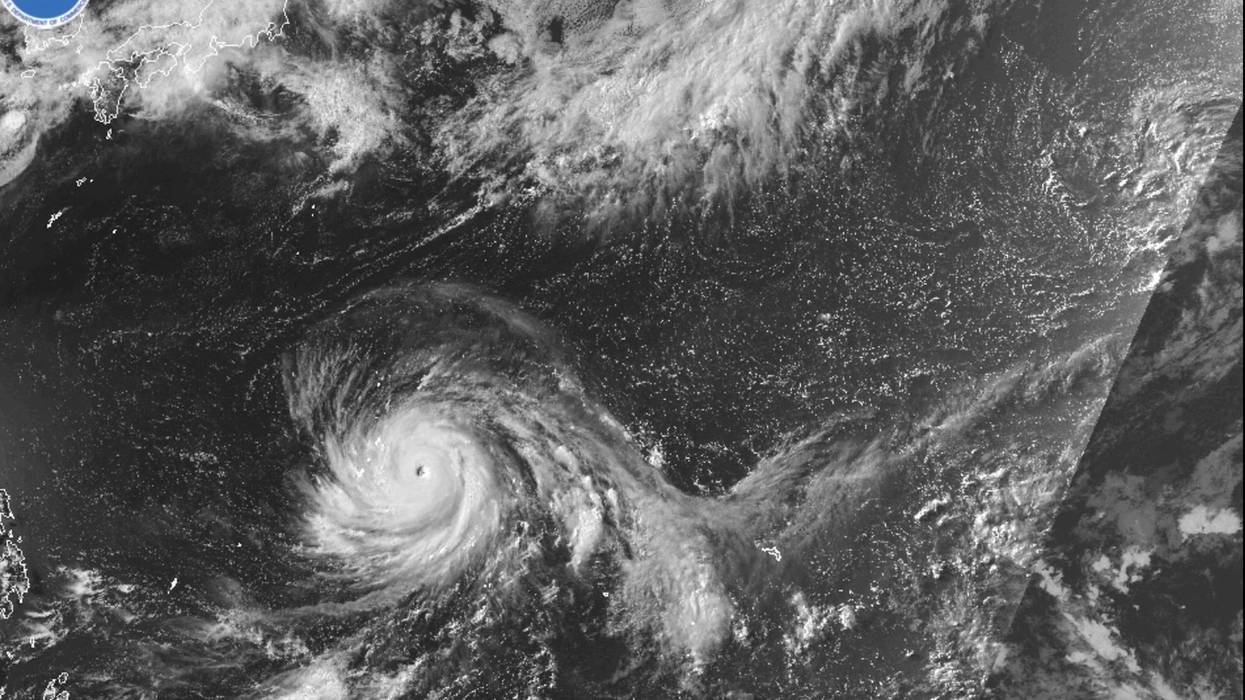

Super Typhoon Bavi made landfall Monday over a tiny U.S. territorial island in the western Pacific near Guam, bringing powerful winds and torrential rain to the Northern Mariana Islands.
The eye of the storm passed over the island of Rota Monday morning local time, bringing winds of more than 150 mph (241 kph), according to the National Weather Service. It was traveling at around 9 mph (14 kph) west toward the Philippines, the weather service said.
“Hang tight,” National Weather Service meteorologist Brandon Aydlett said. “We're coming just out of the peak of conditions. It's going to be a slow improvement, but improvement is coming.”
The storm impacted other parts of the Northern Mariana Islands, a U.S. territory, as well as Guam. The area was still recovering from another destructive cyclone that struck in April.
On the island of Saipan, the international airport recorded wind gusts of more than 100 mph (161 kph), the weather service said. Many people living in Saipan and nearby Tinian had been without power since the Super Typhoon Sinlaku, the agency said.
Bavi was a Category 5 super typhoon with winds that could reach 180 mph (290 kph) per hour and gusts of 215 mph (346 kph) per hour, said weather service meteorologist Edwin Montvila.
In addition to Rota, typhoon and flash flood warnings were in effect for Guam, Tinian and Saipan, while tropical storm warnings and watches were in place for other islands in the area. The weather service said the storm could bring a total of at least 20 inches (51 centimeters) of rain by the time it passes through the region.
A cyclone becomes a super typhoon when it has maximum sustained winds of 150 mph (241 kph) or stronger. That’s equivalent to a high-end Category 4 or a Category 5 storm.
Bavi posed an “imminent danger to life,” Montvila said, with the weather service telling residents across the islands to move to interior rooms and stay away from windows.
“Entering outside can result in death from flying projectiles. Utility poles and associated power lines will be down,” Montvila said.
Bavi passed through the region at a faster pace than Sinlaku, the weather service said. But because of the size of the storm, the islands could still face tropical storm conditions, including torrential rains, through at least Monday night.
Guam Gov. Lou Leon Guerrero urged people to stay home or at a shelter.
“Here we are experiencing another severe force of winds on our island, but as we know, we are always ready and prepared in our planning and our protection of our people,” she said in a video posted on social media Sunday.
The Rev. Francis Hezel, a priest at Santa Barbara Catholic Church in Dededo, Guam, heard winds howling outside his house for hours since waking up before dawn. He said he hoped the typhoon wouldn't cause widespread damage on the island because most residents live in concrete homes.
“By this time, people are used to typhoons,” he said. “They know what they have to do to prepare for them.”