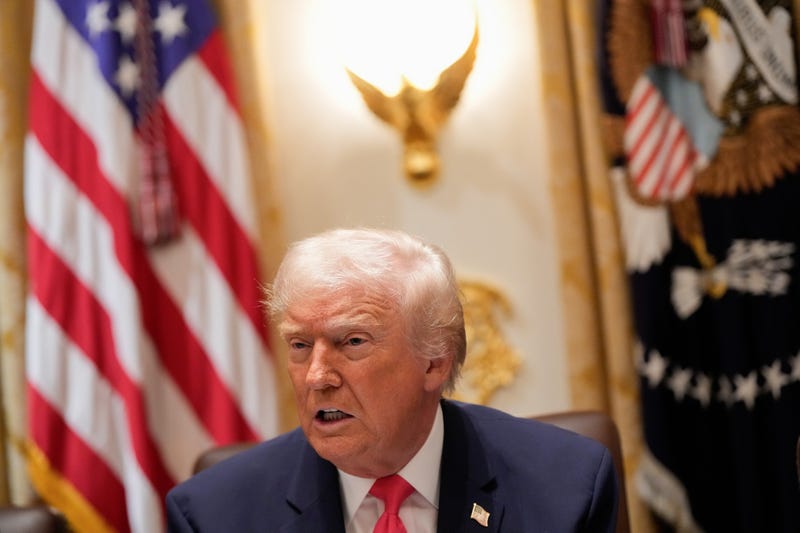
He said it four times in seven seconds: Somali immigrants in the United States are “garbage.”
It was no mistake. In fact, President Donald Trump’s rhetorical attacks on immigrants have been building since he said Mexico was sending “rapists” across the border during his presidential campaign announcement a decade ago. He's also echoed rhetoric once used by Adolf Hitler and called the 54 nations of Africa “s—-hole countries.” But with one flourish closing a two-hour Cabinet meeting Tuesday, Trump amped up his anti-immigrant rhetoric even further and ditched any claim that his administration was only seeking to remove people in the U.S. illegally.
“We don't want ‘em in our country,” Trump said five times of the nation's 260,000 people of Somali descent. “Let ’em go back to where they came from and fix it.” The assembled Cabinet members cheered and applauded. Vice President JD Vance could be seen pumping a fist. Defense Secretary Pete Hegseth, sitting to the president's immediate left, told Trump on-camera, “Well said.”
The two-minute finale offered a riveting display in a nation that prides itself as being founded and enriched by immigrants, alongside an ugly history of enslaving millions of them and limiting who can come in. Trump's U.S. Immigration and Customs Enforcement raids and deportations have reignited an age-old debate — and widened the nation's divisions — over who can be an American, with Trump telling tens of thousands of American citizens, among others, that he doesn’t want them by virtue of their family origin.
“What he has done is brought this type of language more into the everyday conversation, more into the main,” said Carl Bon Tempo, a State University of New York at Albany history professor. “He’s, in a way, legitimated this type of language that, for many Americans for a long time, was seen as outside the bounds.”
A question that cuts to the core of American identity
Some Americans have long felt that people from certain parts of the world can never really blend in. That outsider-averse sentiment has manifested during difficult periods, such as anti-Chinese fear-mongering in the late 19th century and the imprisonment of some 120,000 Japanese Americans during World War II.
Trump, reelected with more than 77 million votes last year, has launched a whole-of-government drive to limit immigration. His order to end birthright citizenship — declaring that children born to parents who are in the United States illegally or temporarily are not American citizens despite the 14th Amendment — is being considered by the Supreme Court. He has largely frozen the country's asylum system and drastically reduced the number of refugees it is allowed to admit. And his administration this week halted immigration applications for migrants from 19 travel-ban nations.
Immigration remains a signature issue for Trump, and he has slightly higher marks on it than on his overall job approval. According to a November AP-NORC poll, roughly 4 in 10 adults — 42% — approved of how the president is handling the issue, down from about half who approved in March. And Trump has pushed his agenda with near-daily crackdowns. On Wednesday, federal agents launched an immigration sweep in New Orleans,
There are some clues that Trump uses stronger anti-immigration rhetoric than many members of his own party. A study of 200,000 speeches in Congress and 5,000 presidential communications related to immigration between 1880 and 2020 found that the “most influential” words on the subject were terms like “enforce,” “terrorism” and “policy” from 1973 through Trump’s first presidential term.
The authors wrote in the Proceedings of the National Academy of Sciences that Trump is “the first president in modern American history to express sentiment toward immigration that is more negative than the average member of his own party.” And that was before he called thousands of Somalis in the U.S. “garbage.”
The U.S. president, embattled over other developments during the Cabinet meeting and discussions between Russian President Vladimir Putin and U.S. envoys, opted for harsh talk in his jam-packed closing.
Somali Americans, he said, “come from hell” and “contribute nothing.” They do “nothing but bitch” and “their country stinks.” Then Trump turned to a familiar target. Rep. Ilhan Omar, D-Minn., an outspoken and frequent Trump critic, “is garbage," he said. "Her friends are garbage.”
His remarks on Somalia drew shock and condemnation from Minneapolis to Mogadishu.
“My view of the U.S. and living there has changed dramatically. I never thought a president, especially in his second term, would speak so harshly,” Ibrahim Hassan Hajji, a resident of Somalia's capital city, told The Associated Press. “Because of this, I have no plans to travel to the U.S.”
Omar called Trump's “obsession” with her and Somali-Americans “creepy and unhealthy.”
“We are not, and I am not, someone to be intimidated,” she said, “and we are not gonna be scapegoated.”
Trump's influence on these issues is potent
But from the highest pulpit in the world's biggest economy, Trump has had an undeniable influence on how people regard immigrants.
“Trump specializes in pushing the boundaries of what others have done before,” said César Cuauhtémoc García Hernández, a civil rights law professor at Ohio State University. “He is far from the first politician to embrace race-baiting xenophobia. But as president of the United States, he has more impact than most.” Domestically, Trump has “remarkable loyalty” among Republicans, he added. “Internationally, he embodies an aspiration for like-minded politicians and intellectuals.”
In Britain, attitudes toward migrants have hardened in the decade since Brexit, a vote driven in part by hostility toward immigrants from Eastern Europe. Nigel Farage, leader of the hard-right Reform U.K. party, has called unauthorized migration an “invasion” and warned of looming civil disorder.
France’s Marine Le Pen and her father built their political empire on anti-immigrant language decades before Trump entered politics. But the National Rally party has softened its rhetoric to win broader support. Le Pen often casts the issue as an administrative or policy matter.
In fact, what Trump said about people from Somalia would likely be illegal in France if uttered by anyone other than a head of state, because public insults based on a group's national origin, ethnicity, race or religion are illegal under the country's hate speech laws. But French law grants heads of state immunity.
One lawyer expressed concerns that Trump’s words will encourage other heads of state to use similar hate speech targeting people as groups.
“Comments saying that a population stinks — coming from a foreign head of state, a top world military and economic power — that’s never happened before,” said Paris lawyer Arié Alimi, who has worked on hate speech cases. “So here we are really crossing a very, very, very important threshold in terms of expressing racist … comments.”
But the “America first” president said he isn’t worried about others think of his increasingly polarizing rhetoric on immigration.
“I hear somebody say, ‘Oh, that’s not politically correct,’” Trump said, winding up his summation Tuesday. “I don’t care. I don’t want them.”
___
Contributing to this report are Associated Press writers Will Weissert and Linley Sanders in Washington, John Leicester in Paris, Jill Lawless in London, Evelyne Musambi in Nairobi, Kenya, and Omar Faruk in Mogadishu.