DOHA, Qatar (AP) — An international body tasked with governing the Gaza Strip under the next phase of the U.S.-brokered ceasefire is expected to be announced by the end of the year, an Arab official and a Western diplomat said Friday.
According to the ceasefire agreement, the authority — known as the Board of Peace and chaired by U.S. President Donald Trump — is to oversee Gaza's reconstruction under a two-year, renewable U.N. mandate.
It will include about a dozen other Middle Eastern and Western leaders, the Arab official and the Western diplomat told The Associated Press, speaking on condition of anonymity because they were not authorized to speak on the matter.
The path forward for Gaza
Also to be announced is a committee of Palestinian technocrats who will run the day-to-day administration of post-war Gaza, they two said. The Western diplomat, who spoke to the AP over the phone from Cairo, said the announcement about this will likely happen when Trump and Israeli Prime Minister Benjamin Netanyahu meet later this month.
The ceasefire deal also calls for an armed International Stabilization Force to keep security and ensure the disarming of the militant Hamas group, a key demand of Israel.
The announcement would be a significant step forward in implementing Trump's 20-point plan for the territory devastated by Israel's two-year campaign against Hamas.
The shaky ceasefire, which came into effect on Oct. 10, has been tested by outbursts of violence and accusations by both sides of violations of the truce. The first phase of the ceasefire has neared completion, though Hamas is still to hand over the remains of a last Israel hostage called for under the deal.
The Arab official said that talks are still ongoing over which countries will take part in the international force for Gaza but that he expects deployment will begin in the first quarter of 2026.
A U.S. official gave a similar timeline, saying that “boots on the ground” could be a reality in early 2026. The official spoke to the AP on the same condition of anonymity. Axios first reported the anticipated announcement on Thursday.
The Arab official said that “extensive talks” will start immediately with Hamas and Israel on the details of the second phase, which he expects to be tough.
Those talks are expected the tackle the issue of disarming Hamas, a step the militant group has not yet agreed to. The plan also calls for Israeli forces to withdraw from the roughly half of the Gaza Strip that they still control as the international force deploys.
Funding for a rebuilding plan for the Gaza Strip still has not been determined. Some Palestinians have expressed concern over the apparent lack of a Palestinian voice in the body and the lack of a firm promise in the plan that they will eventually gain statehood.
Netanyahu's government rejects the creation of a Palestinian state, and the U.S.-brokered deal includes only a vague provision that a pathway toward statehood may be possible if certain conditions are met.
Israel's plan to open a Gaza border crossing with Egypt
Israel announced on Wednesday that it plans to reopen the Rafah border crossing between Gaza and Egypt in the coming days, allowing Palestinians to leave the devastated strip as laid out by the ceasefire agreement. That could be a major development for residents, for whom leaving has been extremely difficult — if not impossible — for most of the war.
However, the governments of Egypt, Jordan, United Arab Emirates, Indonesia, Pakistan, Turkey, Saudi Arabia and Qatar all expressed “deep concern” on Friday about the plan.
A dispute also emerged between Egypt and Israel — Cairo wants Palestinians to be able to return to Gaza through the crossing and says it would only be opened if movement is allowed both ways. Israel has said that Palestinians will not be able to return to Gaza through the crossing until the last hostages’ remains are returned from Gaza.
In a joint statement, the foreign ministers of the eight countries said the Rafah crossing must be open in both directions to allow for “freedom of movement” for Palestinians. They also expressed concern that if Palestinians were to leave Gaza, they might not be allowed to return.
The ministers underscored “their absolute rejection of any attempts to expel the Palestinian people from their land,” they wrote.
A rising death toll
On Friday, Israel’s military said it killed a man in northern Gaza who was approaching the troops with another man, both of whom were “carrying suspicious objects.”
Israeli forces also killed another man in the occupied West Bank. The Palestinian Health Ministry said a 38-year-old was shot by Israeli forces in the northern West Bank while the military said the man threw a rock at soldiers.
The killings mark the latest violence in the Palestinian territories, which has fueled concern that it could shake Gaza's fragile truce.
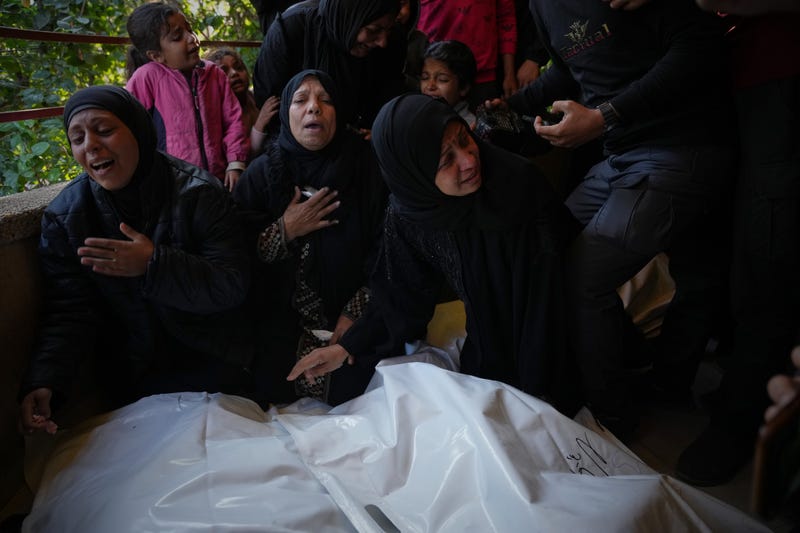
The latest Israel-Hamas war started when Hamas-led militants attacked southern Israel on Oct. 7, 2023, killing around 1,200 people and taking more than 250 others hostage. Israel’s subsequent campaign in Gaza has killed more than 70,100 Palestinians, according to the Gaza Health Ministry. The ministry, which operates under the Hamas-run government, is staffed by medical professionals and maintains detailed records viewed as generally reliable by the international community.
___
Associated Press writers Josef Federman in Doha, Qatar, and Megan Janetsky in Jerusalem contributed to this report.