

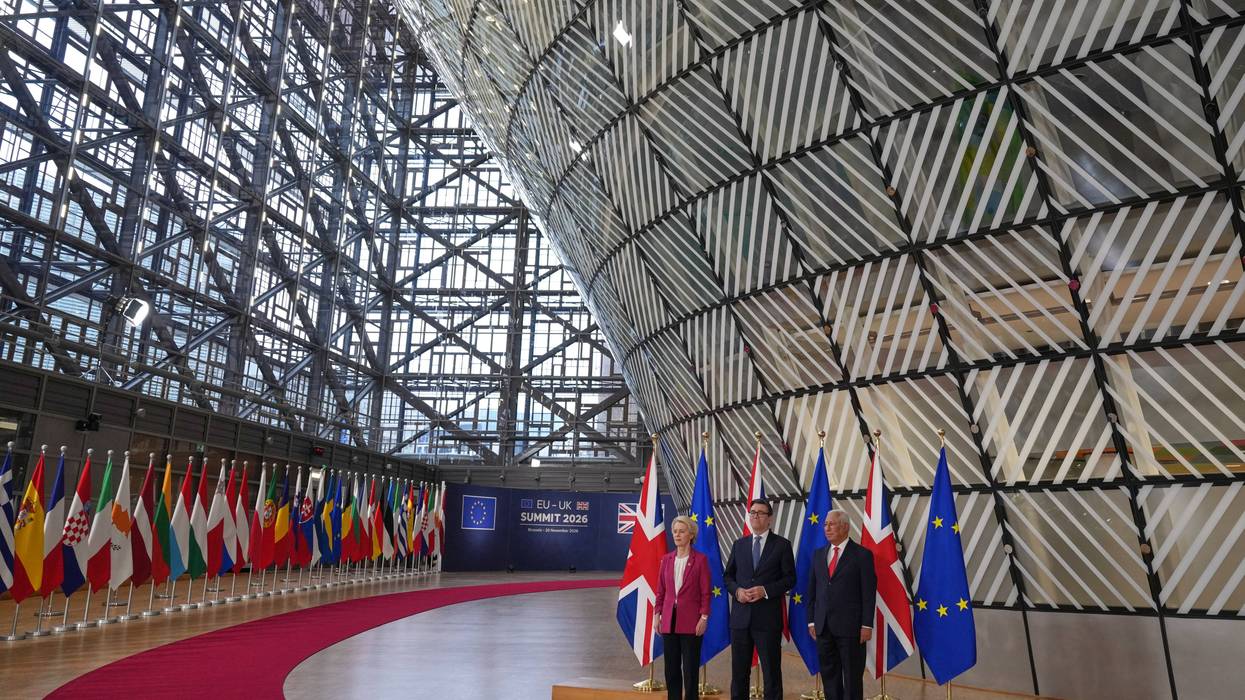

BRUSSELS (AP) — Britain and the European Union agreed Friday to remove barriers to trade and expand travel opportunities for young people as they pledged to rebuild their strained ties with an “ambitious and dynamic” relationship. But they left big decisions about softening or reversing Brexit for another day.
In a joint statement after a summit in Brussels, the U.K. and EU confirmed agreements that will scrap border checks on plant and animal products, cut carbon taxes on some exports by linking their emissions trading schemes and let 100,000 young adults from each side live and work in the other's countries for up to three years.
Other areas remain a work in progress, with the two sides giving themselves six months to reach an agreement on the level of university fees for EU students in the U.K. and vice versa.
Friday’s summit was part of efforts to forge a closer relationship, a decade after Britain voted to leave the EU and six years after the divorce became final.
Supporters of Brexit argued that leaving the EU’s vast free-trade area and web of rules would let Britain take back control of its borders, laws and economy, and strike new trade deals around the world. Critics say Brexit has left Britain weaker and more isolated, and new deals with countries including Australia and Japan have not made up for the economic hit from erecting barriers between Britain and its closest and biggest economic partners.
European Commission President Ursula von der Leyen said the deal is “a turning point” in EU-U.K. relations, and U.K. Prime Minister Andy Burnham called it a "historic moment.”
“This is a good day for Britain, and this is a good day for Europe," he said.
This was only the second EU-U.K. summit since Britain became the first country to leave the world’s biggest trading bloc. Months — likely years — of negotiations lie ahead on everything from electricity markets to manufacturing rules.
Burnham said the summit was a step toward undoing a decade of damage caused by the divorce.
He said the two sides are “rebuilding the bridges that were broken all of those years ago” and "building a much more constructive relationship with our nearest neighbors and our largest market.”
Burnham has said all options should be on the table for future relations, including rejoining the now 27-nation bloc. But he's stressed that reversing Brexit is just one possible outcome, and far from imminent. It would need the backing not just of British voters, but the unanimous support of a mistrustful EU. Still, he has broken a long political code of silence on the option of rejoining.
"We remain open to have the closest possible relationship,” European Council President António Costa said. But he also recalled the obligations of EU membership, including single-market principles on the free movement of goods, services, people and capital.
Burnham says closer ties will ease the cost of living
Burnham pitched the package of agreements approved Friday as a way of “cutting costs, keeping prices down in the supermarkets and creating opportunities for young people.” He said the deals could bring in 17 billion pounds ($22 billion) a year and add 0.5% to Britain’s economic output.
British retailers welcomed the deal to remove checks on food and agricultural products, which will make it cheaper and easier for U.K. businesses to export to Europe.
“Getting our spaghetti bolognese from Lincolnshire onto a shelf in Dublin takes hundreds of extra miles, mountains of paperwork, a vet’s signature and even the Latin name of a cow," said Alex Freudmann, managing director of food at Marks and Spencer.
Freudmann said Friday's announcement “is a major step forward.”
But nothing in U.K.-EU relations is ever quick or simple. EU negotiators want European students to pay domestic fees if they study in Britain rather than the higher fees for foreign students, something the U.K. has resisted.
An EU official said negotiations had not been easy but they sensed good will to resolve the issue. The official was designated to brief reporters about the summit but only on condition that they not be named.
Talks are also continuing on Britain’s desire to be included in the bloc’s “made in Europe” rules, which favor European manufacturers for public projects over rivals from China or elsewhere.
Critics say the deals are a betrayal of Brexit
To get the deals, the U.K. must accept some EU rules and standards that it has no role in setting. Supporters of Brexit say that undermines Britain’s independence.
Nigel Farage, leader of the euroskeptic, anti-immigration party Reform UK, told reporters in Brussels that Burnham had taken “the first step, incrementally, to take us back into membership of the European Union.”
The war in Ukraine, and the U.K.’s military strength, are drawing the two sides back together, and the summit produced pledges of stronger cooperation on security and defense, as well as efforts to restrict irregular migration.
Nevertheless, feelings remain raw, and EU officials have been reluctant to encourage talk of the U.K. rejoining. They are weary from the shifting demands of seven British prime ministers over the last decade and want clarity about the country’s intentions.
Von der Leyen said that a lot has changed in their relations since the Brexit vote, including the pandemic and Russia’s war on Ukraine. She said that the EU is “totally open to do the necessary brainstorming for the wider picture, the bigger picture” of what ties could look like in the future.
Burnham said he wanted the two sides to do that brainstorming before their next summit, probably a year from now.
For now, Burnham remains bound by the pledge made by Keir Starmer, his predecessor as Labour Party leader and prime minister, not to rejoin the bloc’s tariff-free customs union or frictionless single market, or to restore free movement for EU nationals to the U.K.
He acknowledged Friday’s agreements are “the limit of what we can achieve” before a national election.
“Incremental steps … only take us so far,” he said.
___
Lawless reported from London.