WASHINGTON (AP) — President Donald Trump ’s pledge to provoke a sweeping tariff fight with Europe to get his way in taking control of Greenland has left many of America’s closest allies warning of a rupture with Washington capable of shattering the NATO alliance that had once seemed unshakable.
The European Union’s top official on Tuesday called Trump’s planned new tariffs over Greenland a “mistake” and questioned Trump's trustworthiness. French President Emmanuel Macron said the EU could retaliate by deploying one of its most powerful economic tools, known colloquially as a trade “bazooka.”
Trump prides himself on ratcheting up pressure to try to negotiate through a position of strength. He was leaving Tuesday — the anniversary of his inauguration — for the World Economic Forum in Davos, Switzerland, a venue that offers Trump the chance to defuse tensions as quickly as he stirred them up.
But European leaders — digging in and vowing to defend Denmark and its control over semiautonomous Greenland — may be seeking just as hard to meet an extraordinary moment with a show of their fierce resolve.
That could hurt the chances of Trump finding a quick way to turn around the crisis. Greenland’s leader insisted on respect for its territorial integrity and said recognition of international law is “not a game.”
‘We will work something out’
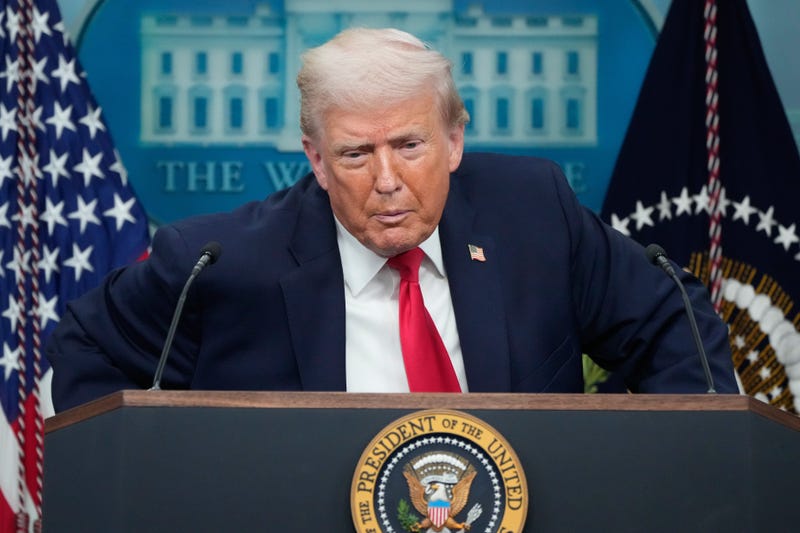
Trump made an unusual appearance in the White House briefing room to mark the one year he'd been in office. When asked how far he'd be willing to go to acquire Greenland, Trump said only, “You'll find out.” He also mistakenly referred to Greenland as Iceland at one point.
Still, the president predicted there could be a deal in the making with allies. “I think that we will work something out where NATO is going to be very happy, and where we’re going to be very happy," he said, without providing specifics.
Trump said he'd been encouraged that NATO had increased military spending, but he also belittled the alliance, saying other members may not protect Washington's interests. The president suggested NATO members expect the U.S. to come to their rescue but “I just really do question whether or not they’ll come to ours.”
European Commission President Ursula von der Leyen pushed back against Trump's announcement that, starting February, a 10% import tax will be imposed on goods from eight European nations that have rallied around Denmark. Greenland is a semiautonomous territory of Denmark, a NATO member.
“The European Union and the United States have agreed to a trade deal last July,” von der Leyen said in Davos. “And in politics as in business – a deal is a deal. And when friends shake hands, it must mean something.”
“We consider the people of the United States not just our allies, but our friends. And plunging us into a downward spiral would only aid the very adversaries we are both so committed to keeping out of the strategic landscape,” she added.
She vowed that the EU’s response “will be unflinching, united and proportional.”
Taking firmer stances defied the approach that many European leaders have offered since Trump returned to office. It had mostly entailed saying nice things about the president to try to stay in his good graces, while working furiously through other avenues to find compromise.
Trump says the U.S. needs Greenland to deter possible threats from China and Russia. But his continued insistence in recent weeks that anything short of the U.S. owning Greenland is unacceptable is testing the limits of the softer strategy.
Danish Prime Minister Mette Frederiksen said “the worst may still be ahead of us.” Speaking to parliament, she said “we have never sought conflict. We have consistently sought cooperation.”
‘Not a game’
Greenland's Prime Minister Jens-Frederik Nielsen said at a news conference in the island's capital, Nuuk, that “we need to have respect for international law and territorial integrity.” He said those principles should unite Western democratic countries, and expressed gratitude for EU allies' support.
“International law, it's not a game,” he said, adding, "We are willing to cooperate much more, but of course in mutual respect, and if we cannot see that, it will be very difficult to have a good and reliable partnership.”
Trump's threats have sparked outrage and a flurry of diplomatic activity across Europe, as leaders consider possible countermeasures, including retaliatory tariffs and the unprecedented use of the EU's anti-coercion instrument.
Unofficially known as the “trade bazooka,” the anti-coercion instrument could sanction individuals or institutions found to be putting undue pressure on the EU. The EU has two other major economic tools it could use to pressure Washington: new tariffs, or a suspension of the U.S.-EU trade deal.
Macron warned in Davos that the additional tariffs could force the EU to use its anti-coercion mechanism for the first time against the United States.
“Can you imagine that?” he said, arguing that allied countries should be focusing instead on bringing peace to Ukraine. “This is crazy.”
In general, he said, the mechanism “is a powerful instrument and we should not hesitate to deploy it in today’s tough environment.”
Trump earlier posted a text message from Macron in which the French president suggested a meeting of members of the Group of Seven industrialized democracies in Paris after the Davos gathering. An official close to Macron, who spoke anonymously in line with the French presidency's customary practices, confirmed the message shared by Trump is genuine.
In his latest threat of tariffs, Trump indicated that the import taxes would be retaliation for last week’s deployment of symbolic numbers of troops from the European countries to Greenland — though he also suggested he was using the tariffs as leverage to negotiate with Denmark.
‘In the midst of a rupture’
Canadian Prime Minister Mark Carney, whose country is a founding NATO member, warned of global fissures beyond Greenland, suggesting it was an “illusion” and “fiction” that there remains a rules-based international order.
“Let me be direct: We are in the midst of a rupture, not a transition,” Carney said during a speech in Davos.
Belgian Prime Minister Bart De Wever said at Davos that Europe cannot be a “miserable slave’ to Trump.”
Others encouraged NATO leaders to stand up to Trump. Speaking on the sidelines of Davos, California Gov. Gavin Newsom slammed Europe’s response to Trump's tariff threats as “pathetic” and “embarrassing,” and urged continental leaders to unite and stand up to the United States.
“It’s time to stand tall and firm, have a backbone," Newsom, a Democrat, told reporters.
Greenland’s European backers have also looked at establishing a more permanent military presence to help guarantee security in the Arctic region, a key demand of the United States, Swedish Defense Minister Pål Jonson said.
In Moscow, meanwhile, Russian Foreign Minister Sergey Lavrov strongly denied any intention by Russia and China to threaten Greenland, while also describing Greenland as a “colonial gain” for Denmark.
Trump was asked Tuesday what would happen to his tariff threats related to Greenland if the Supreme Court rules against his ability to impose import tariffs as part of a case it is considering.
“Well, I'll have to use something else,” Trump said. “We have other alternatives.” He didn't respond when asked about using force.
___
Keaten reported from Davos, Switzerland, Burrows reported from Nuuk, Greenland. AP writers Sylvie Corbet in Paris, Jill Lawless in London and Lorne Cook in Brussels contributed to this report.