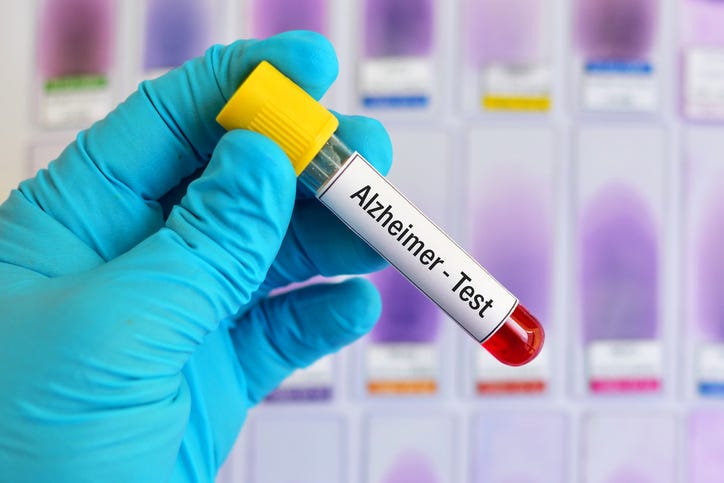

Health officials have endorsed the first blood test that can help diagnose Alzheimer's, the debilitating condition that shortens lives and causes heartache and caregiver burdens for families across the U.S.
Dr. Rohit Marwara, a neurologist at the Detroit Medical Center, talked to WWJ Newsradio about this news, saying the approval is groundbreaking.
The Associated Press reported more than 6 million people in the United States and millions more around the world have Alzheimer’s, the most common form of dementia.
The new test, from Fujirebio Diagnostics, Inc., identifies a sticky brain plaque, known as beta-amyloid, that is a key marker for Alzheimer’s.
Sometimes there's more than one clinical study that leads to an FDA approval and Dr. Marwara said in this particular case there was a pivotal trial of 499 people with cognitive problems. Participants in the study had a verbal test, and they also had a PET scan, and a spinal fluid test. And the study found that a positive blood result matched the PET scan of the spinal fluid findings 90% of the time. And the negative result was correct 97% of time.
"So that clinical trial helped pave the way for the FDA approval," he explained.
The FDA has approved it and limited it to adults 55 and older who are already showing signs of cognitive decline and are being evaluated in a memory clinic or a similar specialty setting. It is not approved as a screening test for healthy people. And your doctor has to order it and interpret it in the context of your clinical history, exam, and other labs.
For patients who qualify, this means earlier access to crucial treatment drugs, and more.
"Currently, there are two medications that are available for Alzheimer's disease, which I consider this is modifying, and they work by clearing the amyloid plaques from the brain. Insurers require a proof of amyloid before they pay for treatment. And a reliable blood test means faster confirmation, quicker access to therapy, and fewer costly scans," the doctor told WWJ.
Specifically, the AP explained the blood test could help expand use of two new drugs, Leqembi and Kisunla, "which have been shown to slightly slow the progression of Alzheimer’s by clearing amyloid from the brain." Doctors are required to test patients for the plaque before prescribing the drugs, which require regular IV infusions.