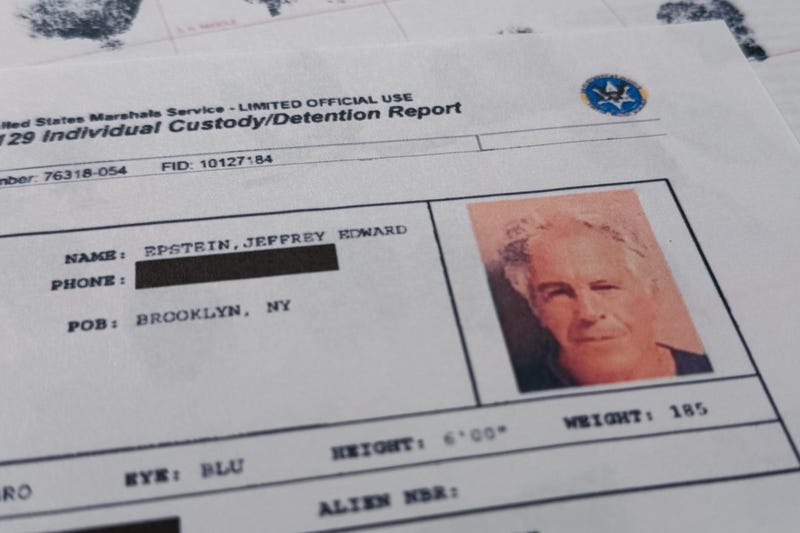
NEW YORK (AP) — The Justice Department said Monday that it had withdrawn several thousand documents and “media” related to disgraced financier Jeffrey Epstein after lawyers complained to a New York judge that the lives of nearly 100 victims had been “turned upside down” by sloppy redactions in the government's latest release of records.
The exposed materials include nude photos showing the faces of potential victims as well as names, email addresses and other identifying information that was either unredacted or not fully obscured.
The department blamed it on “technical or human error.”
In a letter to the New York judges overseeing the sex trafficking cases brought against Epstein and confidant Ghislaine Maxwell, U.S. Attorney Jay Clayton wrote that the department had taken down nearly all materials identified by victims or their lawyers, along with a “substantial number” of documents identified independently by the government.
Clayton said the department has “revised its protocols for addressing flagging documents” after victims and their lawyers requested changes. Documents are promptly pulled down when flagged by victims, then evaluated before a redacted version of the document can be reposted, “ideally within 24 to 36 hours.”
Two lawyers for Epstein victims wrote the court Sunday seeking “immediate judicial intervention” because of what they described as thousands of instances when the government had failed to redact names and other personally identifying information.
Eight women who identify as Epstein victims added comments to the letter to Judge Richard M. Berman. One wrote that the records’ release was “life threatening." Another said she’d gotten death threats after 51 entries included her private banking information, forcing her to try to shut down her credit cards and accounts.
“There is no conceivable degree of institutional incompetence sufficient to explain the scale, consistency, and persistence of the failures that occurred — particularly where the sole task ordered by the Court and repeatedly emphasized by DOJ was simple: redact known victim names before publication,” the lawyers, Brittany Henderson and Brad Edwards, wrote.
Berman, who presided over Epstein’s sex trafficking case, scheduled a conference for Wednesday.
Also Monday, a section of the Justice Department’s Epstein files website that had contained public court records from Epstein and Maxwell’s criminal cases and civil lawsuits was no longer functioning.
A message seeking comment on the website issue was left for the Justice Department.
Uncensored photos
Deputy Attorney General Todd Blanche said in an interview Sunday on ABC’s “This Week” that there have been sporadic errors in redacting, or blacking out, sensitive information but that the Justice Department has tried to work quickly to address them.
“Every time we hear from a victim or their lawyer that they believe that their name was not properly redacted, we immediately rectified that. And the numbers we’re talking about, just so the American people understand, we’re talking about .001 percent of all the materials,” Blanche said.
Dozens of Associated Press reporters analyzing the files have so far found multiple occasions where a name was redacted in one document, only to be left exposed in another version of the same file.
In other places, names and email addresses are crossed out but not fully blackened out, so they’re still visible. Other text redactions can be easily overridden by simply double clicking on them to reveal the hidden text underneath.
The Justice Department has said all nude or pornographic images were redacted from the 2,000-some videos and 180,000 images in the release, even if they were commercially produced, as the agency considered all women depicted in the images as potential victims.
But reporters with The New York Times still found dozens of uncensored photos of naked young people with their faces unredacted.
The newspaper said the images have since been largely removed or redacted after it notified the Justice Department. It said some of the images appeared to have been taken on the beach at Epstein’s private Caribbean island while others are in a bedroom setting.
In another instance, the AP found a set of more than 100 images of a young, unidentified female lounging on a bed, standing on a beach and at other summertime locations while wearing a short top.
The images are almost fully blacked out so only the person’s arms and legs are clearly visible, save for the very last image, a profile photo that is completely unredacted and reveals her face.
Elsewhere in the files, the face of one of Epstein's alleged underage victims was clearly shown on an organizational chart created by federal investigators.
Practical consequences in an unrelated court case
At an unrelated sex trafficking trial in New York on Monday, lawyers for two high-end real estate brokers and their brother asked for a mistrial because their names had appeared in some of the Epstein documents.
Deanna Paul, a defense lawyer at the trial of Tal, Oren and Alon Alexander, said prosecutors had “destroyed the possibility of a fair trial” by letting documents get out that falsely suggested an association with Epstein. The brothers have pleaded not guilty to drugging and raping multiple girls and women from 2008 to 2021. They aren't accused of having anything to do with Epstein's abuse of underage girls.
Judge Valerie E. Caproni rejected the mistrial request after she individually questioned jurors, all of whom said they hadn’t seen any news about the brothers. Still, she confronted a prosecutor about the matter, asking, “Government, really?”
“Yes, I understand where the court's coming from,” replied Assistant U.S. Attorney Elizabeth Espinosa.
She said the documents had been withdrawn from public circulation.
__ The AP is reviewing the documents released by the Justice Department in collaboration with journalists from CBS, NBC, MS NOW and CNBC. Journalists from each newsroom are working together to examine the files and share information about what is in them. Each outlet is responsible for its own independent news coverage of the documents.