

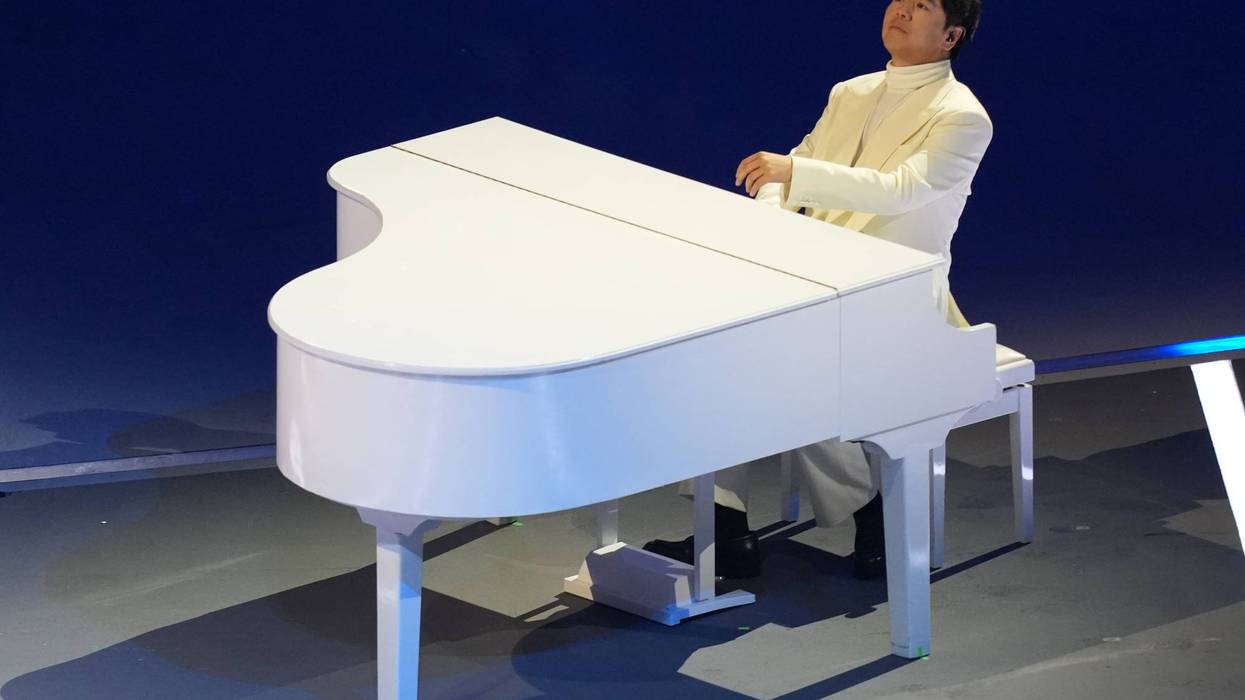

Star Chinese pianist Lang Lang needed more than a quarter-century on classical music's touring circuit before he felt ready to record all five Ludwig van Beethoven piano concertos.
“I've become a little bit older,” he says, searching aloud for a metaphor describing his development. “Red wine.”
Deutsche Grammophon announced Friday it is releasing Lang Lang's interpretations on March 5, taken from recordings with conductor Andris Nelsons and the Leipzig Gewandhaus Orchestra over six sessions in an empty auditorium last June.
Timed to align with the 200th anniversary of Beethoven’s death (March 26), a three-CD set will be distributed along with releases on streaming services and an analog vinyl version of the “Emperor” concerto, which the Gewandhaus premiered in 1811.
Lang Lang is scheduled to play all five concertos over three performances with Paavo Järvi and the Chicago Symphony Orchestra from March 24-27. A documentary and concert version of Nos. 3 and 5 also are being released.
Now 44, Lang Lang is a rare classical musician with crossover appeal to pop fans through collaborations with Sting, Metallica, Ed Sheeran, Herbie Hancock and Pharrell Williams. A 2016 recording covered Jay-Z's “Empire State of Mind” and the Eagles' “New York Minute.” Lang Lang was featured during the opening ceremonies of the 2008 Summer Olympics and this year's Winter Olympics.
“He manages to reach out to much broader audiences, not only through collaborations with artists from other spaces, but also just through the power of his artistry,” DG president Clemens Trautmann says. “He is the household name for the global piano community.”
Each pianist has a different interpretation of Beethoven
Lang Lang became friends with Nelsons when they recorded Camille Saint-Saëns’ Piano Concerto No. 2 in 2023.
“I felt that the Leipzig Gewandhaus has a very traditional, unique, rich sound,” he said during a recent Zoom interview between performances in Germany. “This is the project and the way I play, the style of my interpretation.”
Lang Lang's recordings will compete with well-regarded versions by Alfred Brendel, Leon Fleisher, Artur Rubinstein and Artur Schnabel.
“It’s kind of a natural choice for being the centerpiece of the Beethoven anniversary,” Trautmann says.
Lang Lang recorded Nos. 1 and 4 in 2007 with conductor Christoph Eschenbach and the Orchestre de Paris at the Salle Pleyel, earning the pianist his only Grammy nomination. He credited Eschenbach for sparking “the imagination, the creativities and also the mood of the sound of the interpretation.”
“There are some similarities between the recordings, but there are also quite different interpretations,” Lang Lang says. “I feel much more mature to play the Beethoven cycle especially after the recording of the ‘Goldberg Variations,'” referencing his 2020 recording of the famous Johann Sebastian Bach composition.
That recording was made three years after Lang Lang canceled several months of appearances when he developed tendinitis while trying to learn Maurice Ravel’s “Piano Concerto for the Left Hand.” The “Goldberg Variations” had a profound impact.
“That really changed many of my kind of thinking of creating the sound, especially for the slower passages and also with the sixteenth notes,” he says.
Lang Lang’s favorite Beethoven piano performances are by Daniel Barenboim. He compares Barenboim’s style to that of Schnabel and Wilhelm Furtwängler.
“Very solid, very deep, very struggling,” Lang Lang says. “When we work together, he also brings a lot of the elegancy of Beethoven and also the ideal, logical way to make the sound work from the right posture of (the) hand.”
After a meteoric rise, he waited until his mid-40s to complete the recordings
Born in 1982, in Shenyang, China, Lang Lang won competitions in Beijing and Germany, then finished first in the 1995 International Tchaikovsky Competition for Young Musicians. He studied at the Curtis Institute in Philadelphia and gained attention in 1999 when he replaced André Watts at the Ravinia Festival, playing Tchaikovsky’s Piano Concerto No. 1 with Eschenbach leading the CSO.
In 1999, Lang Lang also had a private performance at Carnegie Hall for music executives.
“It was absolutely captivating. There was such a refreshing spontaneity about him and great joy in the music making,” says New York Philharmonic president Matías Tarnopolsky, then the CSO's senior director of programming. “We got to meet him and talk to him afterward and it was this immediate connection; the human being and the artist were very much in sync.”
Lang Lang made his public Carnegie Hall debut in 2001 and had a much-hyped solo recital there in 2003, recorded by DG. The performance received a harsh review from Anthony Tommasini, then chief classical music critic of The New York Times.
“For all its color, flair and energy, his playing was often incoherent, self-indulgent and slam-bang crass,” he wrote. “Mr. Lang’s head seems to be so full of his own hype that there can’t be much room left for analytic thinking.”
“People can write whatever they feel (is) right, and you can play whatever you feel (is) right,” Lang Lang says. “This is the freedom of art, for our artistic interpretations.”
Lang Lang has returned to Carnegie Hall many times, opening the season in 2010, 2017 and 2024. His foundation has held Young Scholars’ finals concerts there and he is a frequent partner with the hall’s music education events.
Carnegie Hall artistic director Clive Gillinson feels the timing of Lang Lang's Beethoven concertos is significant.
“When people are younger, the talent dazzles. What is most important with an artist is they continue to demand more of themselves and that they keep trying to grow and develop,” Gillinson says. “A lot of people rush into these things. I think the fact that for the first time he’s recording them all is a huge tribute to his humility.”