

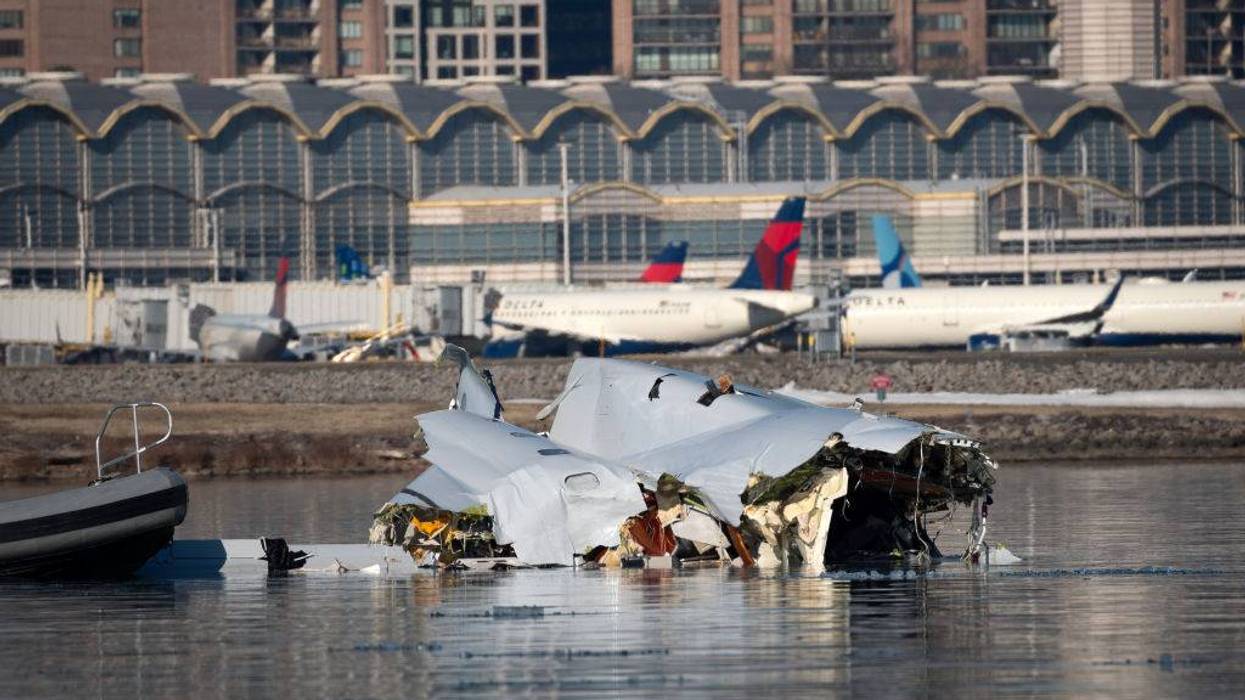

The U.S. Army found systemic safety breakdowns behind last year’s midair collision between a Wichita-to-D.C. American Airlines jet and a Black Hawk helicopter near Reagan National Airport, recommending changes to prevent future tragedies.
The Army report — completed in May and released publicly Thursday after months of pressure from the victims' families — identified failures involving air traffic control, helicopter routes, training, and safety practices.
The deadliest plane crash on U.S. soil in over two decades happened when the helicopter collided with the descending airliner as it approached the runway, sending both plummeting into the icy Potomac River and killing 67 people.
The Army report highlighted how the air traffic control at the airport could have prevented the crash, but it also acknowledged the military’s own failings.
The Army found multiple systemic failures when a Black Hawk helicopter was involved in a midair crash with a commercial airliner over the Potomac River in 2025, killing 67 people. (from @MatthewAdams60) https://t.co/XjQY9vgaa7
— Stars and Stripes (@starsandstripes) October 9, 2026
Tim Lilley, whose son Sam was the airliner's first officer, said the report leaves important questions unanswered. Parts were redacted, and responsibility for the Army's failures was assigned broadly rather than to individuals.
Investigations of the crash emphasize years of missed warnings by the Federal Aviation Administration, along with a weak military safety culture.
The Army faulted the air traffic controller for not giving the helicopter crew more precise information about the approaching jet and for not warning the jet’s pilot about the helicopter. After the crash, the FAA prohibited controllers from relying on pilots to maintain visual separation in busy airspace.
The report singled out two failed radio transmissions that contributed to the helicopter crew not identifying the jet. The military pilots' night-vision goggles also restricted their view and made it hard to spot the plane amid the city lights.
The poorly designed helicopter route allowed only 75 feet of vertical separation between a helicopter and a plane landing on the airport's secondary runway, assuming helicopters stayed near the riverbank, which the route didn't require; the helicopter was flying nearly 100 feet higher than its instruments read.
More than a year-and-a-half after the crash, the House of Representatives and the Senate have passed separate aviation safety bills, but have yet to agree on a final version.