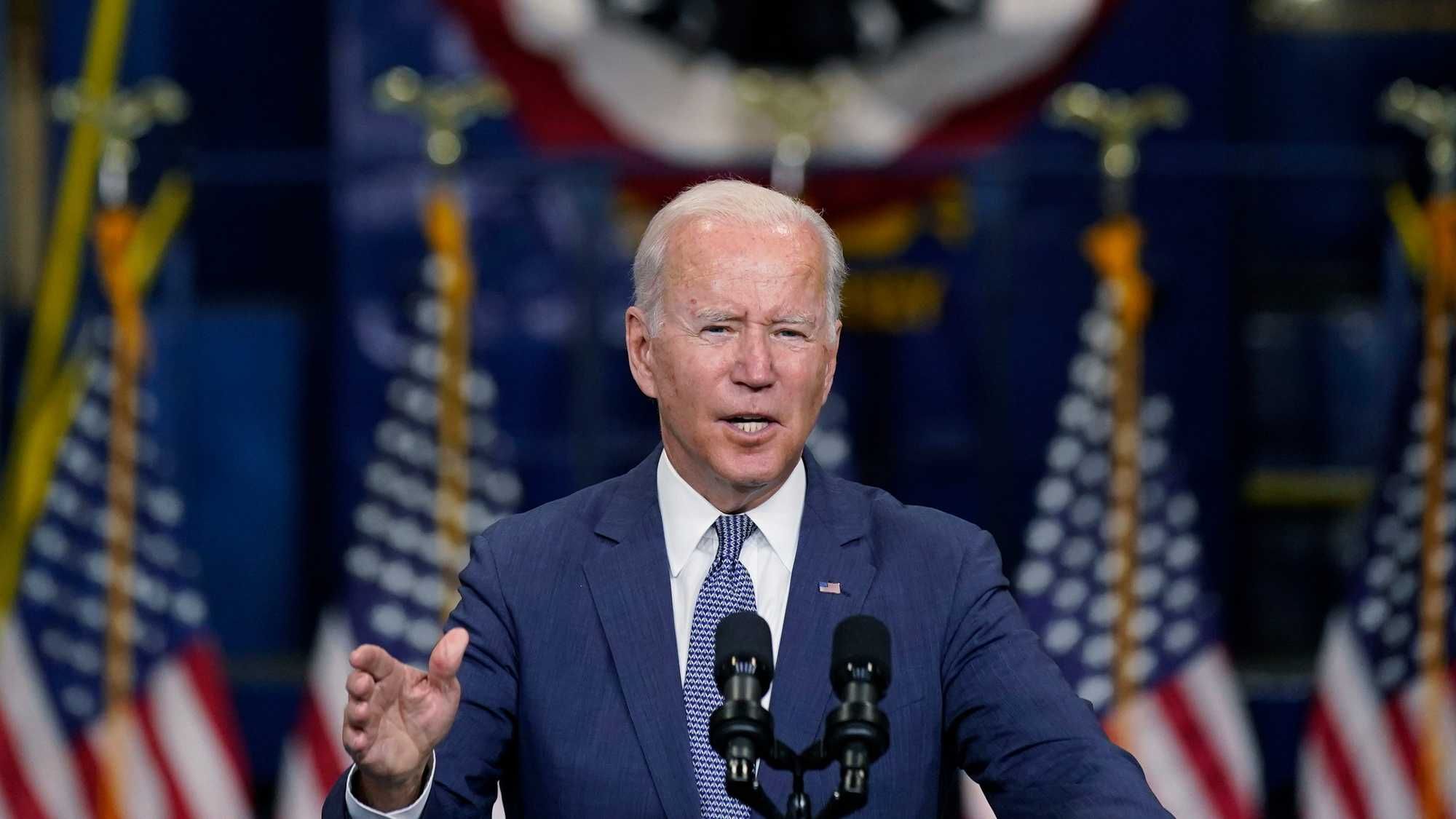



President Joe Biden went to the Capitol Thursday to announce a $1.85 trillion social safety net and climate change bill framework after delaying a trip to Europe to work out kinks in the legislation with fellow Democrats.
"Today, I'm pleased to announce that after, after months of tough and thoughtful negotiations, I think we have a historic -- I know we have a historic economic framework," Biden said, explaining that the framework will add millions of jobs and help grow the economy.
Economists believe that the bill will improve the economy going forward, Biden said. And although parts of the bill that the president initially wanted were axed, he said it was worth it for the sake of compromise.
In his remarks, the president said that the United States was able to lead the world in the 20th century due to its investment in its people. He noted that the country has fallen behind in infrastructure and education.
"We can't be competitive in the 21st century global economy if we continue this slide," he said.
The bill should improve child care and early childhood education options as well as direct the economy away from dependence on fossil fuels, according to The New York Times. Biden was expected to meet with House Democrats Thursday to discuss the package.
When it was first proposed, the spending package was estimated at $3.5 trillion. It has since been scaled back, mostly due to opposition from Senate Democrats Joe Manchin III of West Virginia and Kyrsten Sinema of Arizona.
Key cuts to the original plan include:
-The removal of free community college
-$500 billion federal paid family and medical leave benefit
-Clean electricity initiative that included penalties
-Tax on the wealth of billionaires
-Proposal to lower the cost of prescription drugs by allowing Medicare to negotiate with pharmaceutical companies.
Expected expansion of Medicare was reduced to hearing only and the expanded Child Tax Credit was extended to 2023 rather than becoming permanent.
With Republicans unanimously against the package, Democrats are attempting to pass it through a process called reconciliation, which requires a simple majority. However, they need all members of the party in the Senate to vote in favor of the package for it to pass. As of Thursday, Manchin and Sinema still had not pledged to support it.
Biden also aimed to convince liberal members of the party that a final compromise was close enough to allow them to support a separate, $1 trillion infrastructure bill that has already passed the Senate. Liberals were skeptical, said the New York Times.
"There's been so many changes in this process — so many people, you know, yes, no, doing the Hokey Pokey, one foot in one foot out," said Rep. Alexandria Ocasio-Cortez as she headed into the meeting. "We need certainty that we're going to be able to deliver."
Though there have been significant cuts to the initial package proposal, The New York Times said the legislation is poised to offer "a significant boost to middle-class families that have struggled for decades with economic uncertainty."
Universal preschool for more than 6 million 3 and 4-year old children should help these families, as well as subsidies for child care that would limit child care costs to no more than 7 percent of income. These programs are expected to be funded for at least six years. Programs for home health care and community care for older Americans are also included in the latest version of the bill.
During his remarks, Biden noted how hard it is for working mothers without help for the government. He also said the new initiatives will help cut child poverty in half.
Another $555 billion for programs intended to encourage Americans to buy electric vehicles and move utilities away from natural gas and coal are included as well. The New York Times said this is the country's largest federal investment in combating climate change.
Other parts of the package include $150 billion for rental assistance, home-buying help, public housing repair and other affordable housing programs as well as $40 billion for worker education and $100 billion for immigration streamlining.
Funding for the package is expected to come from $2 trillion in tax increases on corporations and high earners.