

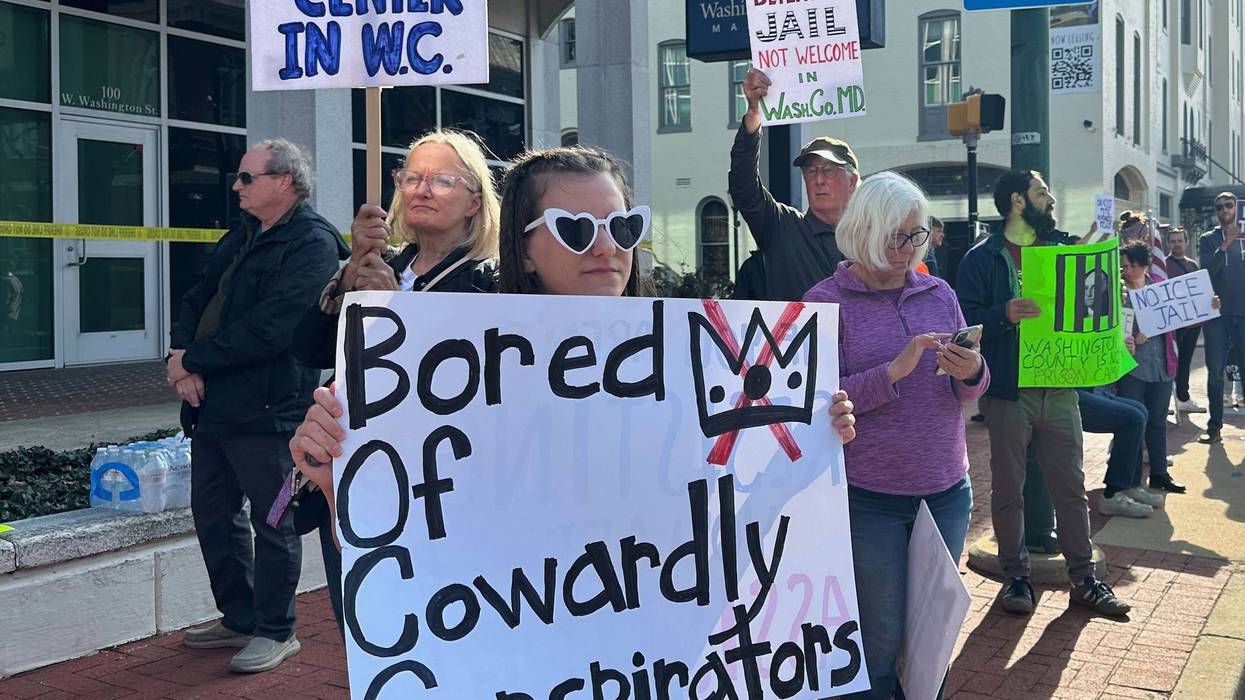

HAGERSTOWN, Md. (AP) — Horns blared and protesters screamed “Stop ICE!” outside a meeting on the western edge of Maryland where county officials were discussing mundane issues like the solid waste budget.
It's been like this ever since the Department of Homeland Security bought an 825,000-square-foot (76,645-square-meter) building in Washington County as part of a plan to transform warehouses across the U.S. into detention facilities for tens of thousands of immigrants.
“This is a facility built for packages, not people,” Patrick Dattilio, the founder of an anti- Immigration and Customs Enforcement group called Hagerstown Rapid Response, said as he stood outside the county commission meeting.
The federal government has faced fierce opposition in communities where it spent a total of $1.074 billion for 11 warehouses under a plan that Homeland Security Secretary Markwayne Mullin is reviewing. Washington County is the most welcoming community — a place where officials said they supported ICE, albeit amid whistles and jeers. The processing center there was supposed to be one of the first to open in a facilities project hatched under Mullin’s predecessor, Kristi Noem.
But now DHS' plan for the Washington County building is paused — mired in a court battle like some of the other warehouse-to-detention projects across the U.S. Questions swirl about whether Mullin will move ahead with the facilities project or chart another course as he pursues President Donald Trump’s mass deportation agenda.
County commissioners proclaimed their ‘unwavering support’ for ICE
The sprawling blue-and-white warehouse in Washington County has been the subject of intense debate in part because of the way commissioners voiced their support for ICE.
While repeatedly insisting that their hands were tied because the federal government already bought the building, the commissioners also approved a proclamation during their Feb. 10 meeting declaring their “unwavering support” for DHS and ICE.
The proclamation, which didn’t specifically mention the warehouse purchase, was met with so much booing and yelling that the commission president cleared the room.
The county wanted something, too. It forwarded the proclamation to Noem the next day in an email identifying hundreds of millions of dollars' worth of sewer, airport and highway upgrades that it said were needed, according to a public records request received by local resident Ethan Wechtaluk, who's running for Congress in the district that includes the warehouse.
ICE, flush with cash from a massive congressional appropriation, has since signed a contract worth $113 million to renovate the building for 500 to 1,500 detainees, but a judge temporarily halted work after Maryland's attorney general sued. A hearing is scheduled for April 15.
County commissioners did not respond to email or telephone requests for comment. County administrator Michelle Gordon in a statement said the commissioners were declining all interview requests.
Many residents of the county — a place Civil War buffs come to visit the Antietam battlefield before making their way to nearby Gettysburg — are outraged both because they have moral objections to the facility and because they didn't find out about the purchase beforehand.
“We have had no voice in this,” Carroll Sager said over the din of protesters and honking cars. Behind her, the sheriff's department had cordoned off part of the county building with crime scene tape to deter protesters. Two deputies watched the demonstrators.
During the meeting, Sager sat quietly, holding a sign that read: “Disenfranchised in Washington County.”
Other communities across the US have also balked at DHS' plans
The pushback in other communities has included a New Jersey lawsuit that alleges an “utter lack of communication” and a lawsuit in Michigan questioning why DHS didn’t look at using empty state prisons. Officials in Salt Lake City and Pennsylvania have threatened to withhold or limit water. In Georgia, the town of Social Circle placed a lock on the water meter at a warehouse DHS purchased.
Meanwhile, questions also have come up about how much DHS paid for some warehouses. It paid double what the New Jersey warehouse was valued at in tax records and nearly five times more than the assessed value of the Social Circle warehouse.
Mullin was pressed during his confirmation hearing about whether he would continue Noem's policy of turning these warehouses into detention facilities. Without committing to anything, Mullin said the department wanted to “be good partners” with communities.
Days after he was sworn in, DHS paused the purchase of new warehouses intended to house immigrants. It's scrutinizing all contracts signed under Noem.
The federal government also said in a recent court filing in Maryland's lawsuit that “ICE is reconsidering the plans and scope of the warehouse.”
Asked whether any changes were afoot for the Maryland facility, DHS said in a statement: “As with any transition, we are reviewing agency policies and proposals.”
Washington County residents are waiting to see what happens
The plan was to turn the Maryland warehouse into an ICE processing facility that would hold recently arrested immigrants before they go to other facilities for long-term detention.
ICE officials have said the Washington County warehouse would serve the Baltimore ICE office's needs for detention space. State lawmakers have expressed concerns about the George H. Fallon Federal Building that houses ICE detainees in downtown Baltimore in part because a bacteria that causes Legionnaires’ disease was found in the water.
Activists and people who live near the Washington County warehouse are watching.
For nearly three decades Nica Sutch has had a home in the rolling hills of western Maryland, where she raised children and entertained grandchildren.
When the warehouse was built a few years ago to meet the demand for distribution centers, fueled by a growth in online shopping, she rationalized that it could be an economic boon for the region.
Now that ICE has purchased the building, she's eyeing a move.
“I love the area,” she said during an interview in her backyard. “I love everything. This has been my home for 28 years.”
__
Hollingsworth reported from Kansas City, Missouri.