


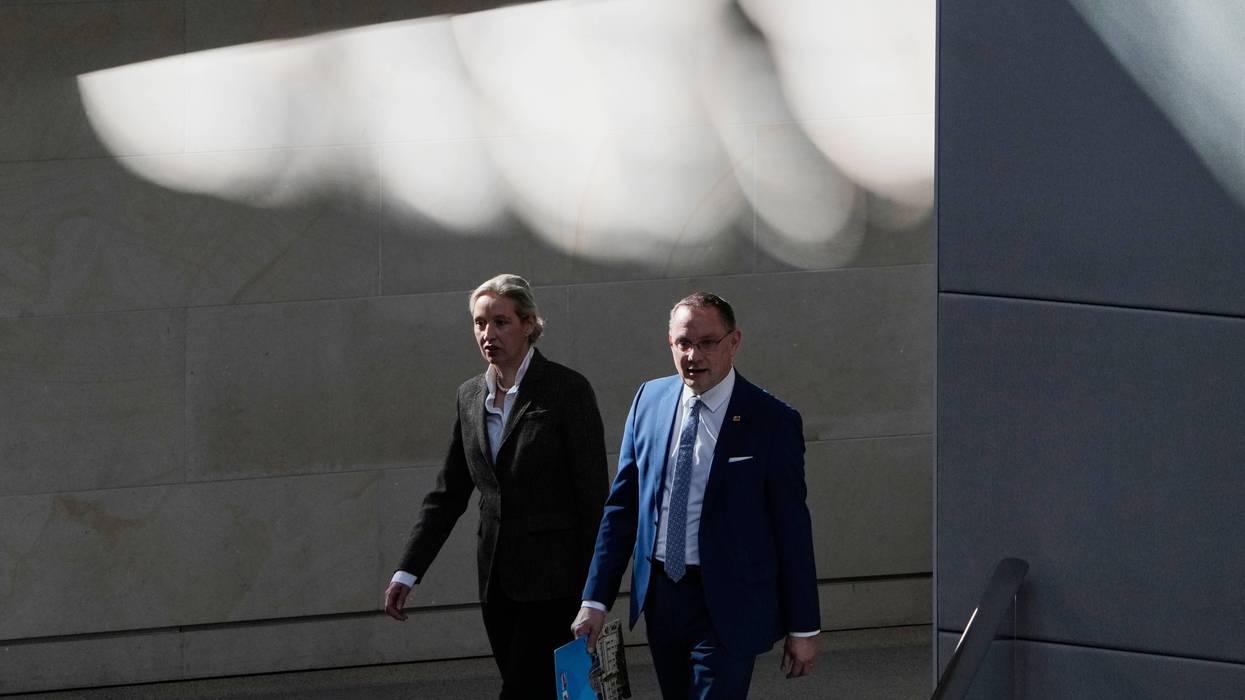

BERLIN (AP) — The far-right Alternative for Germany is in a buoyant mood as it holds a convention this weekend. It is capitalizing on the unpopularity of a government that’s trying to reform the sluggish economy, and eyeing promising prospects of power in an eastern region this fall.
Yet the anti-migration nationalist party is as polarizing as ever. Its meeting is expected to draw tens of thousands of protesters to the eastern city of Erfurt.
An established political force
Alternative for Germany, or AfD, is meeting to elect its leaders, which German parties do every two years. It will aim to put on a show of unity as it extends the terms of Alice Weidel and Tino Chrupalla, who have run the party together for four years.
In last year's national election, AfD achieved the best showing by a far-right party since World War II. Its second-place finish left it as the biggest opposition party nationally and the strongest political force in Germany's formerly communist east. Its support has since climbed above the 20.8% it won then, with recent assessments putting it in first place.
Weidel said recently that “2026 is a year of destiny for AfD.” Mainstream parties say they won’t work with it, a stance often known as a “firewall.”
But it hopes to win 40% of the vote or more in a state election Sept. 6 in the eastern region of Saxony-Anhalt. That could put it on course for an absolute majority or in a position where it might try to attract defectors, paving the way for its first state governor.
Another eastern state election follows two weeks later in Mecklenburg-Western Pomerania, and AfD is optimistic there too.
A slice of power
“AfD is standing before the gates of power, to some extent,” said Albrecht von Lucke, a political expert who edits the magazine Blätter für deutsche und internationale Politik.
AfD's first head of a county administration was elected in 2023 in Thuringia, the state where Erfurt is located. No more have followed since, as enough voters rallied around mainstream candidates to prevent a repeat.
But leading a state administration would be a far bigger prize. Germany's 16 states have extensive powers, for example in running the education system and in overseeing security matters.
Opponents worry about the prospect of AfD replacing large numbers of civil servants if it governs Saxony-Anhalt, and about the possibility of confidential information ending up in far-right circles or even Russia. “An AfD interior minister would be a security risk,” Gregor Maier, Thuringia's center-left interior minister, told ARD television.
AfD rejects concerns about it running a state government. “We will prove that we can do it better, and that is exactly what the old parties are afraid of,” Chrupalla said this week at a rally in Berlin.
Von Lucke, however, said it would be “a huge challenge” for the party to show it can govern Saxony-Anhalt well, with internal conflicts likely. “A lot speaks for this not succeeding,” he said.
A government under pressure
AfD has been helped by the deep unpopularity of Chancellor Friedrich Merz's national coalition government, which took office 14 months ago with pledges to reform and turn around Germany’s economy, Europe’s biggest. It is now embarking on potentially painful change after a long period of economic stagnation, but has yet to persuade voters that it can produce results.
Merz has pleaded for patience.
“It is unrealistic always just to lament decline, mope and wait for a big bang,” he said at an industry meeting recently. “There isn't going to be one. We are in a reform process ... and we are moving forward in this process.”
“We want to show that solutions are possible from the political center of this country, that we also recognize the problems correctly,” he added.
But AfD has long become adept at harnessing discontent with issues well beyond its signature theme of curbing migration, which powered its rise in the mid-2010s.
It has been supportive of the Trump administration's general approach, while criticizing the war in Iran. It also has long called for lifting of sanctions against Russia and opposes weapons deliveries to Ukraine. Merz, Chrupalla said, “thinks he has to escalate against Russia, like in the Cold War. He should be building bridges.”
A party under scrutiny
AfD is locked in a battle with Germany's domestic intelligence agency over the latter's assessment of the party. The Federal Office for the Protection of the Constitution announced last year that it was classifying AfD as a proven right-wing extremist group, but suspended the designation after a legal challenge. In February, a Cologne court said the agency can't use the designation while it considers the party's lawsuit in detail.
Some want to see the party banned, and protesters expected to turn out in force on Saturday and Sunday likely will underline those calls. But Germany's supreme court has set the bar for banning parties very high in the past.
Opponents of the idea are wary of handing AfD a victory by having a plea for a ban rejected after lengthy proceedings. Merz and conservative allies say the priority should be for the government to prove it can improve Germans' lives.
In a 2025 report issued on Tuesday, the intelligence agency said there were no indications that the party had backed off its problematic views.
“Many statements by the AfD and its representatives reflect an understanding of the nation that is based on ethnicity and ancestry and contradicts the understanding of the nation enshrined in Germany's constitution,” it said. It pointed to calls for the “remigration” of millions of people and to regular talk of an allegedly planned “great replacement” of the population.
AfD vehemently rejects accusations of extremism and argues the agency is being weaponized by mainstream parties.
___
Kerstin Sopke in Berlin contributed to this report.