


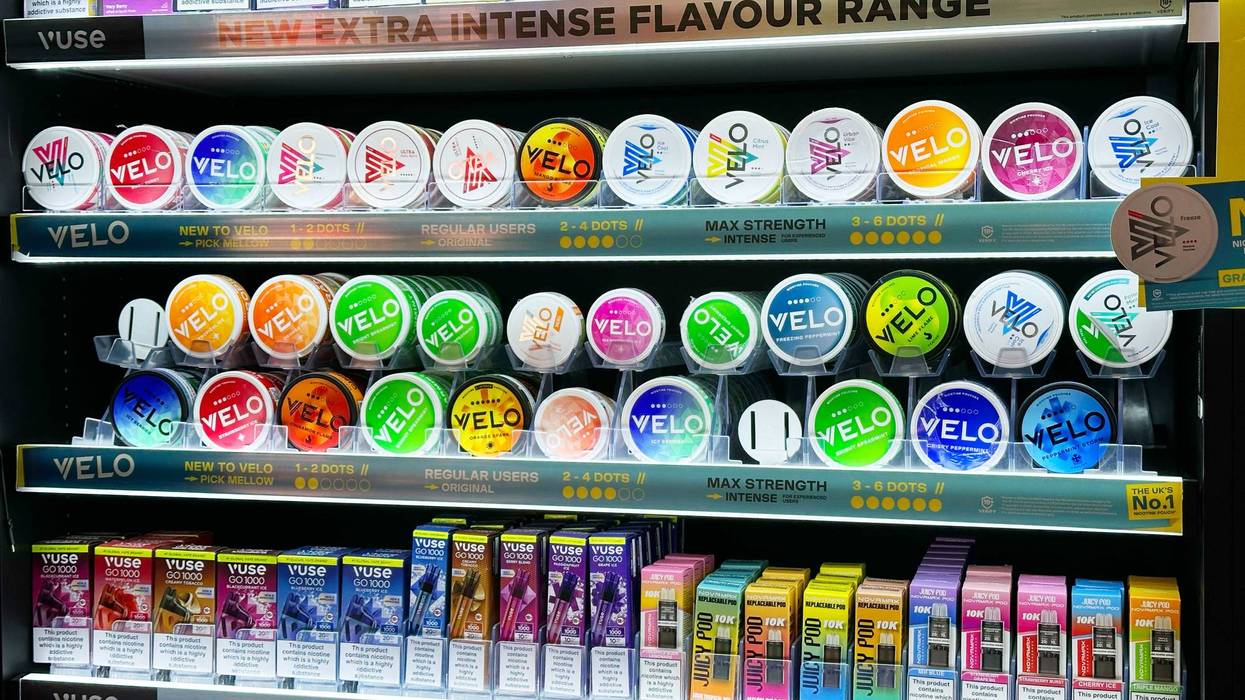

Move over, kombucha and protein bars. Some tech companies are now offering employees something with a considerably stronger kick: free nicotine pouches, dispensed from branded vending machines sitting right in the office.
Nicotine startups Lucy and Sesh have installed branded vending machines in Palantir's Washington, D.C., office, stocked with nicotine pouches available free to employees and guests over the age of 21, a Palantir spokesperson confirmed to the Wall Street Journal. Palantir pays to stock the products.
Eliano A. Younes, Palantir's head of strategic engagement, posted a photo on X of a Lucy-branded vending machine inside the office with the caption: "Palantir DC Office 🤝 @LucyNicotine 😵💫 🚀." When one user called it "completely inappropriate for the workplace," Younes responded: "What about a speakeasy?"
The pouches are about the size of a piece of gum and are tucked between the gums and cheek. Although most states classify them as tobacco products, they contain no tobacco - they are made from cellulose plant fiber blended with nicotine powder, sweeteners, and flavoring.
The trend extends beyond Palantir. Alex Cohen, founder of Hello Patient, an AI-powered healthcare startup based in Austin, experimented with a nicotine-pouch fridge in his office after noticing his software engineers using the products at their desks. "They were very productive, so I thought, 'Maybe there's something here,'" he told the Wall Street Journal. The experiment had a cautionary conclusion: after going through two or three pouches a day, Cohen said he had to stop — "Then, I accidentally got addicted."
There is also a financial connection between Palantir and one of the brands involved. Sesh received $40 million in funding from 8VC, the firm run by Palantir cofounder Joe Lonsdale, who helped the company scale up.
Medical experts are pushing back on the productivity framing. Vanderbilt University psychiatry and pharmacology professor Paul Newhouse said nicotine is "very unlikely to help the cognitive function of someone who is functioning at their normal capacity." Researchers at the University of Texas MD Anderson Cancer Center cautioned that describing the products as "smoke-free" does not eliminate the risk of addiction, and that the long-term health implications of nicotine pouches are still actively being studied.
Maxwell Cunningham, founder of nicotine startup Sesh, acknowledged the limits of the productivity argument directly: "I want to be clear, we can't make any productivity claims. But I do think it's really interesting to see the types of people and industries that are using our product."
The trend is unfolding against a broader Silicon Valley obsession with biohacking - the practice of optimizing the body's performance through supplements, devices, and lifestyle changes - and a cultural moment in which nicotine has gained an unlikely following among tech and media figures as a focus aid.
LISTEN on the Audacy App
Tell your Smart Speaker to "PLAY 1080 KRLD"
Sign Up to receive our KRLD Insider Newsletter for more news
Follow us on Facebook | Twitter | Instagram | YouTube