


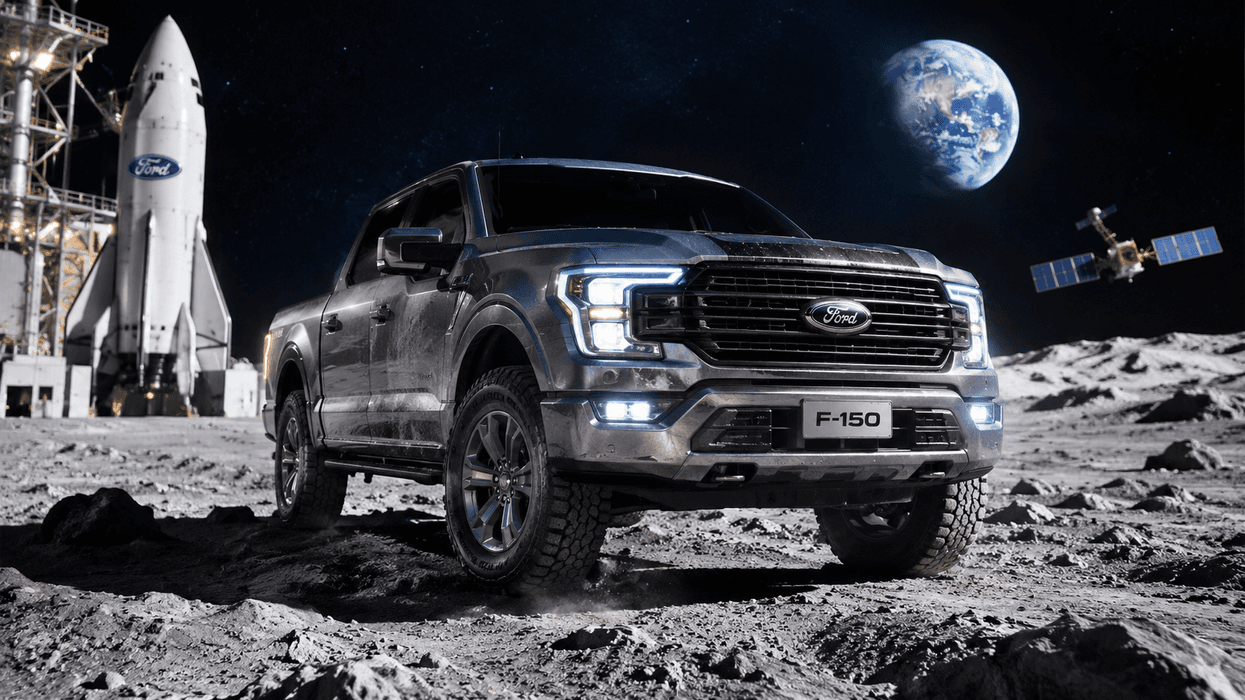

Ford Motor Company announced Monday that it is acquiring a minority stake in Boston-based Revolution Space to help mass-produce the company’s next-generation satellites and spacecraft.
The Dearborn, Michigan-based automaker made the investment through its Industrial Platform LLC subsidiary. Financial terms were not disclosed. The companies said the partnership will apply Ford’s high-volume manufacturing expertise to industrialize Revolution Space’s advanced propulsion systems and spacecraft, supporting missions from very low Earth orbit to geosynchronous altitude and into cislunar space.
Ford Chief Strategy Officer Marin Gjaja said the automaker’s strength in building complex products in large volumes matches the needs of today’s growing satellite market. He described the move as a chance to diversify into an attractive, high-growth sector that is less cyclical than traditional vehicle sales. Revolution Space Chairman Daniel S. Goldin, the longest-serving NASA administrator, said the company has shown it can meet performance requirements for future operational systems and looks forward to industrializing its technology with Ford across all orbit regimes.
Ford Motor Co. is investing in Revolution Space, a Charlestown satellite company, to help it scale up spacecraft production. Ford built satellites for NASA and the military in the 1960s and '70s. https://t.co/d8eIfiT6Ft
— Boston Business Journal (@BosBizJournal) November 24, 2026
The global space economy is projected to grow from roughly $600 billion today to $1.8 trillion by 2035, according to the World Economic Forum, with satellite manufacturing as one of the key drivers. Analysts have estimated the satellite manufacturing market at $22 billion to $26 billion in 2025, with projections of $87 billion to $114 billion by 2035. Ford noted that demand is rising for communications, navigation, Earth observation and other applications that require scalable production rather than hand-built units.
The investment continues a historical connection. Ford built communications and weather satellites for NASA, the military and NATO in the 1960s and 1970s, and its aerospace division won a $235 million contract in 1976 to build seven satellites for Intelsat. Closing of the current deal remains subject to customary conditions and required regulatory approvals.
No timeline for production scale-up or specific plant locations was announced.
LISTEN on the Audacy App
Tell your Smart Speaker to "PLAY 1080 KRLD"
Sign Up to receive our KRLD Insider Newsletter for more news
Follow us on Facebook | Twitter | Instagram | YouTube