


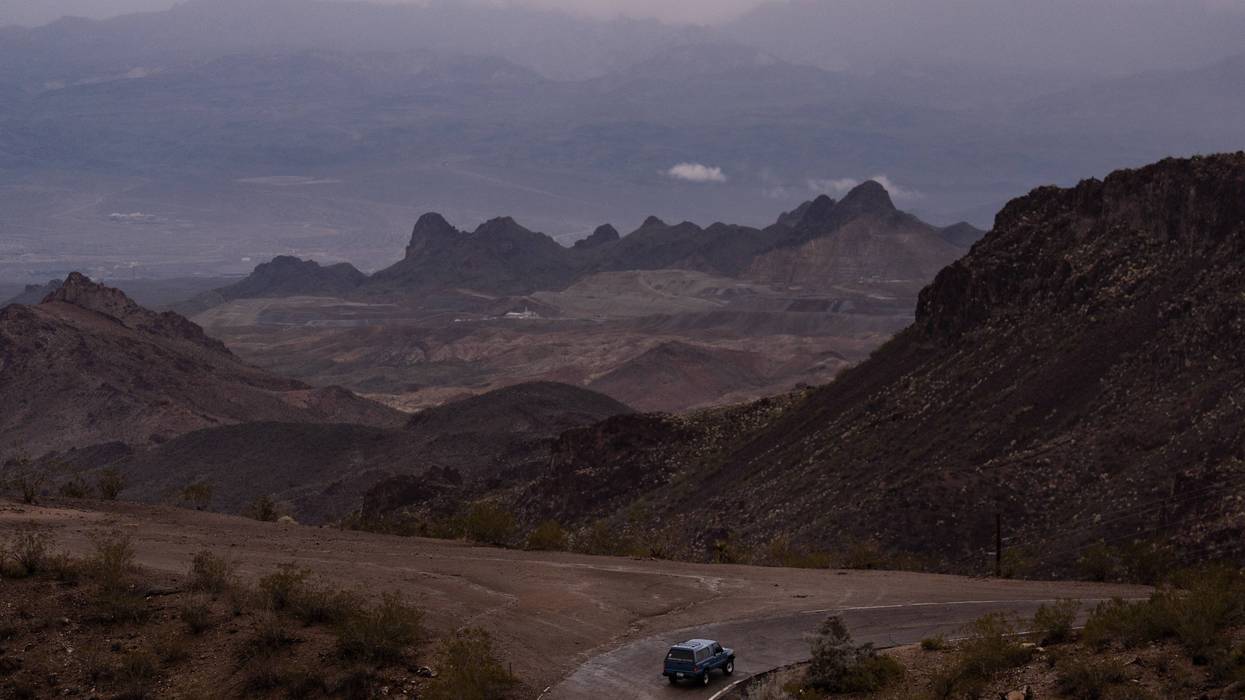

ALBUQUERQUE, N.M. (AP) — There are faster ways to get from Chicago to Los Angeles, but none have the allure or cultural cachet of Route 66.
To John Steinbeck, it was the Mother Road that led poor farmers from Dust Bowl desperation to sunny California. To Native Americans along the route, it was an economic boon that also left scars. To Black travelers, it offered sanctuary during segregation. And to music fans, it was the place to get their kicks.
Route 66 marks its 100th anniversary this year. Despite losing its status decades ago as one of the nation’s main arteries, people from around the world still flock to it to take perhaps the quintessential American road trip and soak in its neon lights, kitschy motels and attractions, and culinary offerings.
Each town has its own history and magic, said Sebastiaan de Boorder, a Dutch entrepreneur who, with his wife, breathed new life into The Aztec Motel in Seligman, Arizona.
“It's an essential part of American culture and history,” he said of the highway. “The historical aspect is just a very big important part of American culture, with its influence and its character.”
The dream
Route 66, which runs for roughly 2,400 miles (3,860 kilometers) from Chicago through Missouri, Kansas, Oklahoma, Texas, New Mexico and Arizona before ending in Santa Monica, California, was stitched together a century ago from a collection of Native American trading routes and old dirt roads with the goal of linking the industrial Midwest to the Pacific coast.
Oklahoma businessman Cyrus Avery, known as the Father of Route 66, saw it as more than just a way to cross the country efficiently. It was a chance to connect rural America and create new pockets of commerce.
Avery knew the number 66 would be ripe for marketing and could be seared into drivers' minds, and he was right: Route 66 has been immortalized in movies, books, including Steinbeck’s “The Grapes of Wrath” and Jack Kerouac’s “On the Road,” and songs such as Bobby Troup's “(Get Your Kicks on) Route 66,” which served as an anthem for post-World War II optimism and mobility.
Waves of migration
Since its November 1926 designation as one of the nation's original numbered highways, the onetime Main Street of America has embodied the promise of prosperity.
It became a literal path of hope for migrants escaping drought-ravaged farms and poverty during the 1930s Dust Bowl and the Great Depression. And during World War II, it was used to move troops, equipment and workers out West.
The postwar boom of the 1940s and 1950s were Route 66's heyday, as it became a popular vacation route. Cars became more affordable, disposable income increased, and people began chasing freedom on the open road.
“People generally have a sense of adventure, a sense curiosity. And you can find that on Route 66. This is the road of dreams,” author and historian Jim Hinckley said.
Going mainstream
Roadside diners and motels thrived, as crafty entrepreneurs dreamed up ways to part motorists from their money. There were rattlesnake pits, totem poles, trading posts, caverns where Old West outlaws purportedly hung out, and modern engineering marvels like St. Louis' gleaming steel arch.
Barns were painted with larger-than-life ads, billboards teased local attractions, and neon was everywhere.
The cherry on top? The food.
There were places to grab and go, but also to sit down and relish a slice of home. The Cozy Dog Drive In — famous for its breaded hot dogs on a stick — has fit both bills since 1949. Inside the dining room in Springfield, Illinois, travelers tell tales of life on the highway.
“The road wouldn’t be alive without the stories of all the places along it that kept it going from town to town,” third-generation owner Josh Waldmire said. “We just survive off each other. The road feeds us, and as long as we put our feelings and love back into the road, it will reverberate with the travelers and the stories of the people.”
A divided highway
Route 66 was an economic boon to the Native American tribes along the way. But although it brought tourists, it also left scars of eminent domain across tribal land and perpetuated stereotypes.
More than half of the highway crossed through Indian Country, and vendor signs often made casual references to tipis and feathered headdresses — symbols easily appropriated for marketing but not always representative of the distinct cultures found along the route.
At Laguna Pueblo west of Albuquerque, restaurants and service stations sprang up, some operated by military veterans from the pueblo who were masters at fixing everything from flat tires to busted radiators.
Pueblo women adapted too, turning utilitarian pottery vessels into works of art coveted by tourists. Homemade bread and pies sealed the deal.
Laguna leaders have long considered the road — or he-ya-nhee' in the tribe's language of Keres — as “the corridor of commerce,” said businessman and tribal member Ron Solimon. Capitalizing on that potential, the tribe has built a multimillion-dollar empire of casinos, burger stands and other businesses.
There were also dangers along the route, particularly during the Jim Crow era, when Black travelers had to rely on guides like the Green Book to find safe lodging and services.
“Especially for long-distance travel, segregation was a fact of life,” said Matthew Pearce, state historian for the Oklahoma Historical Society. “And so Black motorists needed to know a safe place to go.”
The Threatt Filling Station near the central Oklahoma community of Luther wasn't listed in the Green Book, but it did serve as a safe haven between two sundown towns, where people who weren't white needed to leave by sunset. The station offered barbecue and even baseball.
Edward Threatt, whose grandparents opened the station around 1933, recalled a TV program about travelers getting their kicks on 66. “By and large, the Black traveler didn’t get a lot of kicks on Route 66,” he said. “And if they got some kicks, it wasn’t the kind you would think of.”
A new direction
President Dwight Eisenhower’s vision for a modern interstate highway system eventually led to Route 66 being decommissioned as a federal highway in 1985. Some towns along the route died, and it fell to local governments, state historical societies, and private businesses to preserve their sections of the famed road.
A driving force was Angel Delgadillo, a barber who lobbied the Arizona Legislature to designate the road as a historic highway. He saved Seligman from turning into a ghost town and set the bar for preservation elsewhere.
In New Mexico, original sketches for neon signs have been preserved, Route 66-themed murals abound and developers in Albuquerque have restored motor lodges along the longest urban stretch of the road still intact.
More than 90% of the road is still drivable in California. Cadillac Ranch in the Texas Panhandle offers the chance to spray-paint half-buried cars. And at the Mississippi River, travelers can walk or bike across the old Chain of Rocks Bridge.
More than 250 of the route's buildings, districts and road segments are listed on the National Register of Historic Places. But it's more than bricks and asphalt that fuel the fascination.
“Some of the most interesting and fun things that happen to people when they travel the route is running into somebody they know or some happenstance thing that comes totally unexpected,” said author and historian Jim Ross. “And that's a great part of the Route 66 experience.”
___
Associated Press writers John O'Connor in Springfield, Illinois, and Sean Murphy in Oklahoma City contributed to this report.