



Though we all have differences, there's one commonality that has prevailed for all of humanity: we are all floating on a rock, flying through outer space at over a million miles an hour.
Thanks to the rapid advancement of technology in the past century, we can observe much more of the universe than we ever thought possible.
The scale and sheer size of the universe make it impossible to truly learn everything, but it doesn't mean we shouldn't try.
Here's what's happening in space this week.
The James Webb Space Telescope recently discovered carbon-bearing molecules on a distant exoplanet with a potential ocean-covered surface.
K2-18 b is an exoplanet located 120 light-years from Earth in the constellation Leo. It orbits its star in the habitable zone. A recent investigation with NASA's JWST revealed methane and carbon dioxide are present in the exoplanet's atmosphere.
This revelation adds to recent findings that K2-18 b may be a 'Hycean' exoplanet, meaning it potentially has an atmosphere rich in hydrogen with a liquid ocean on its surface.
K2-18 b is 8.6 times larger than Earth. Its size, which lies between the size of Earth and Neptune, makes it different than any celestial bodies in our own solar system. Due to this, these types of exoplanets and the composition of their atmospheres are not yet completely understood by astronomers.
Webb's discovery of methane and carbon dioxide coupled with the lack of ammonia support the possibility of a water ocean underneath a hydrogen-rich atmosphere in K2-18 b, according to NASA.
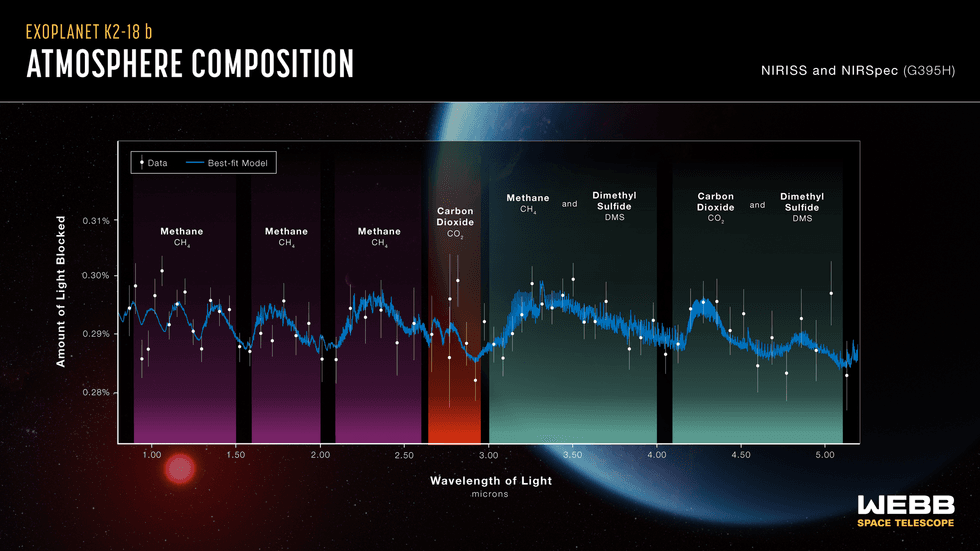 NASA, CSA, ESA, R. Crawford (STScI), J. Olmsted (STScI)
"Our findings underscore the importance of considering diverse habitable environments in the search for life elsewhere," explained Nikku Madhusudhan, lead author of the paper announcing these new discoveries.
"Traditionally, the search for life on exoplanets has focused primarily on smaller rocky planets, but the larger Hycean worlds are significantly more conducive to atmospheric observations."
Though the exoplanet exists within its star's habitable zone, it doesn't ensure that life is possible on it. The planet's size means its interior likely consists of high-pressure ice with an ocean surface. However, the ocean could be too hot to sustain life or be liquid.
"Although this kind of planet does not exist in our solar system, sub-Neptunes are the most common type of planet known so far in the galaxy," said Subhajit Sarkar of Cardiff University.
"We have obtained the most detailed spectrum of a habitable-zone sub-Neptune to date, and this allowed us to work out the molecules that exist in its atmosphere."
Identifying the characteristics and chemical makeup of planets like K2-18 b is especially difficult, even with advanced equipment, due to the brightness of their parent stars.
"This result was only possible because of the extended wavelength range and unprecedented sensitivity of Webb, which enabled robust detection of spectral features with just two transits," said Madhusudhan.
"For comparison, one transit observation with Webb provided comparable precision to eight observations with Hubble conducted over a few years and in a relatively narrow wavelength range."
The team will now work to further prove the new findings and further dissect the environment of K2-18 b. Ultimately, their goal is to one day find life existing on an exoplanet.
"Our ultimate goal is the identification of life on a habitable exoplanet, which would transform our understanding of our place in the universe," said Madhusudhan.
"Our findings are a promising step towards a deeper understanding of Hycean worlds in this quest."
LISTEN on the Audacy App
Tell your Smart Speaker to "PLAY 1080 KRLD"
Sign Up to receive our KRLD Insider Newsletter for more news
Follow us on Facebook | Twitter | Instagram | YouTube