


Though we all have differences, there's one commonality that has prevailed for all of humanity: we are all floating on a rock, flying through outer space at over a million miles an hour.
Thanks to the rapid advancement of technology in the past century, we can observe much more of the universe than we ever thought possible.
The scale and sheer size of the universe make it impossible to truly learn everything, but it doesn't mean we shouldn't try.
Here's what's happening in space this week.
After 186 days in orbit aboard the International Space Station, a crew of four international astronauts have returned to Earth. This marks the conclusion of SpaceX's sixth rotational crew mission to the ISS.
NASA's SpaceX Crew-6 embarked on their mission back in March, lifting off from NASA's Kennedy Space Center in Florida on a SpaceX Falcon 9 rocket.
Their six-month stay on the ISS ended in the early hours of Labor Day as they splashed down off the coast of Jacksonville, Florida in the SpaceX Crew Dragon capsule Endeavor.
The capsule sped through Earth's atmosphere at 17,000 mph, enduring temperatures of over 3,000 degrees Fahrenheit before parachuting into the Atlantic Ocean.
The crew included two NASA astronauts, Stephen Bowen and Warren "Woody" Hoburg, a United Arab Emirates astronaut, Sultan Alneyadi, and a Roscosmos cosmonaut, Andrey Fedyaev.
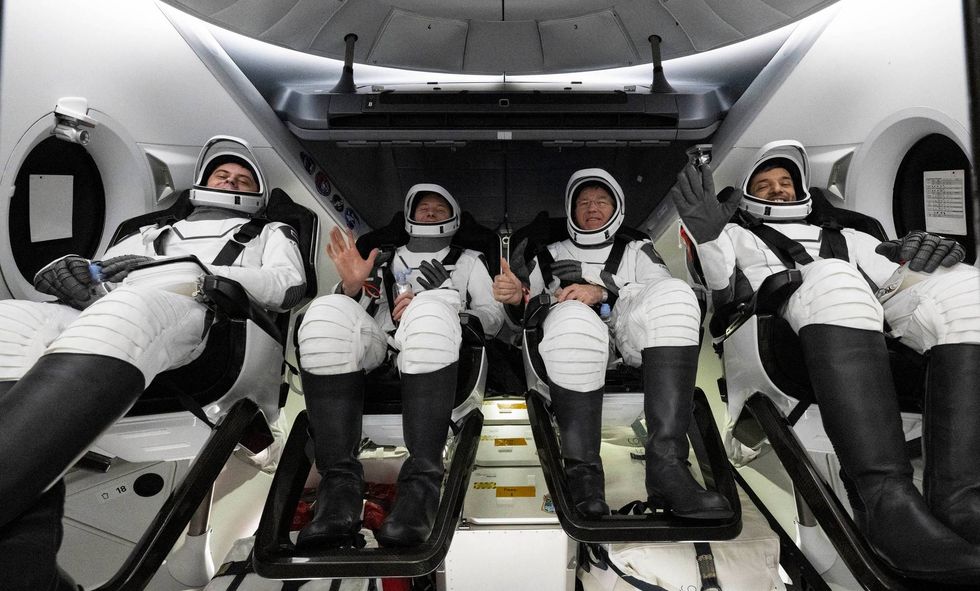 NASA/Joel Kowsky
"This international crew represented three nations, but together they demonstrated humanity's shared ambition to reach new cosmic shores. The contributions of Crew-6 will help prepare NASA to return to the Moon under Artemis, continue onward to Mars, and improve life here on Earth," said NASA administrator Bill Nelson.
In total, the crew traveled 78,875,292 miles in orbit, 184 days on the ISS, and completed a whopping 2,976 orbits around Earth.
The members of Crew-6 conducted a number of scientific experiments, technological demonstrations, and spacewalks during their mission.
According to NASA, some of their contributions included releasing Saskatchewan's first satellite, studying plant biology in space, and even assisting a student robotic challenge.
A release from the International Space Station National Laboratory provided more detailed insight into the studies conducted during the mission which covered an array of disciplines. Below are highlights from the ISS National-Lab sponsored studies.
• The crew worked on a joint project between the ISS National Lab and the National Institutes of Health National Center for Advancing Translational Sciences, studying heart muscle tissue in microgravity in an effort to learn more about heart disease and test new treatments.
• Multiple investigations were funded by the US National Science Foundation, including one study that tested if producing extremely lightweight solids called 'graphene aerogels' in space yields better results than on Earth.
According to the ISS National Laboratory, the results of this study could lead to advancements in technology ranging from space suit materials to battery storage.
• Another monumental study held on the ISS tested the capability of a 'bioprinter' used to print human cells and tissues in microgravity. The project produced the first print. of a live human meniscus. The sample returned to Earth with the crew and will be further studied.
The Crew-6 mission was part of NASA's Commercial Crew program. The SpaceX Crew-7 mission relieved the Crew-6 members, arriving at the ISS on August 27.
LISTEN on the Audacy App
Tell your Smart Speaker to "PLAY 1080 KRLD"
Sign Up to receive our KRLD Insider Newsletter for more news
Follow us on Facebook | Twitter | Instagram | YouTube