


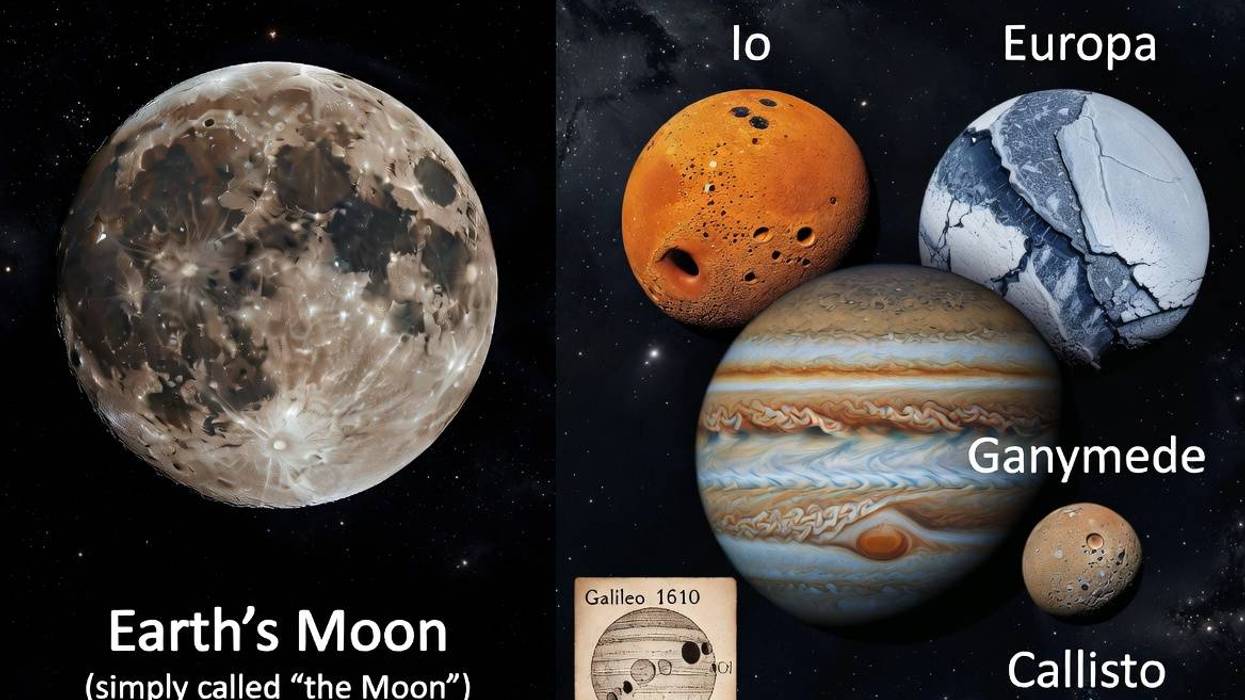

Scientists at NASA explain why our planet's only natural satellite is known simply as "the Moon" while dozens of moons orbiting other planets each have unique mythological names.
The reason traces back thousands of years to a time when humans had never seen or imagined any moon except the one orbiting Earth. The English word "moon" comes from ancient Proto-Germanic roots tied to measuring time — the lunar cycle gave us the concept of a "month." For most of human history, there was no need to give it a more distinctive label because it was the only one visible in the night sky from anywhere on the planet.
That changed in 1610 when Italian astronomer Galileo Galilei spotted four small objects circling Jupiter through his telescope. Astronomers realized these were natural satellites like Earth's Moon, so they borrowed the term "moons" to describe them and assigned each a specific name from mythology — Io, Europa, Ganymede and Callisto — to tell them apart. The same pattern followed as more moons were discovered around Saturn, Mars, Uranus and beyond.
 Artemis II sets distance record with wider path beyond the MoonArtemis II Crew
The International Astronomical Union, which standardizes names for celestial bodies, officially calls Earth's satellite "the Moon" with a capital M. In Latin it is Luna (the root of "lunar"), and in Greek it was Selene, but English speakers have used the simple, original name for centuries.
NASA notes on its science website that our Moon "shares a name with all moons simply because people didn't know other moons existed" until Galileo's discovery. The convention stuck because it was already deeply embedded in language and culture.
The distinction highlights how scientific naming often builds on what was known first. Earth's Moon remains unique in our solar system as the only one bright enough to dominate our night sky and influence tides, calendars and early human storytelling — no other moon needed a special name until we found company in the heavens.
LISTEN on the Audacy App
Tell your Smart Speaker to "PLAY 1080 KRLD"
Sign Up to receive our KRLD Insider Newsletter for more news
Follow us on Facebook | Twitter | Instagram | YouTube