


WASHINGTON (AP) — More than 10,000 American troops are helping enforce the blockade on Iranian ports, and while no ships have yet been boarded, the U.S. military said Thursday that it is warning Iran-linked ships that it could fire warning shots or escalate to other force if they try to outrun the Navy.
In the first three days of the military action, 14 ships have turned around rather than confront the naval blockade, according to U.S. Central Command, which oversees the Iran war.
Some Iran-linked or sanctioned vessels that have left the Persian Gulf through the Strait of Hormuz, the crucial waterway for energy shipments, have appeared to halt their movements, turn off their radio transponders or head back toward Iran's coast, shipping data firms say.
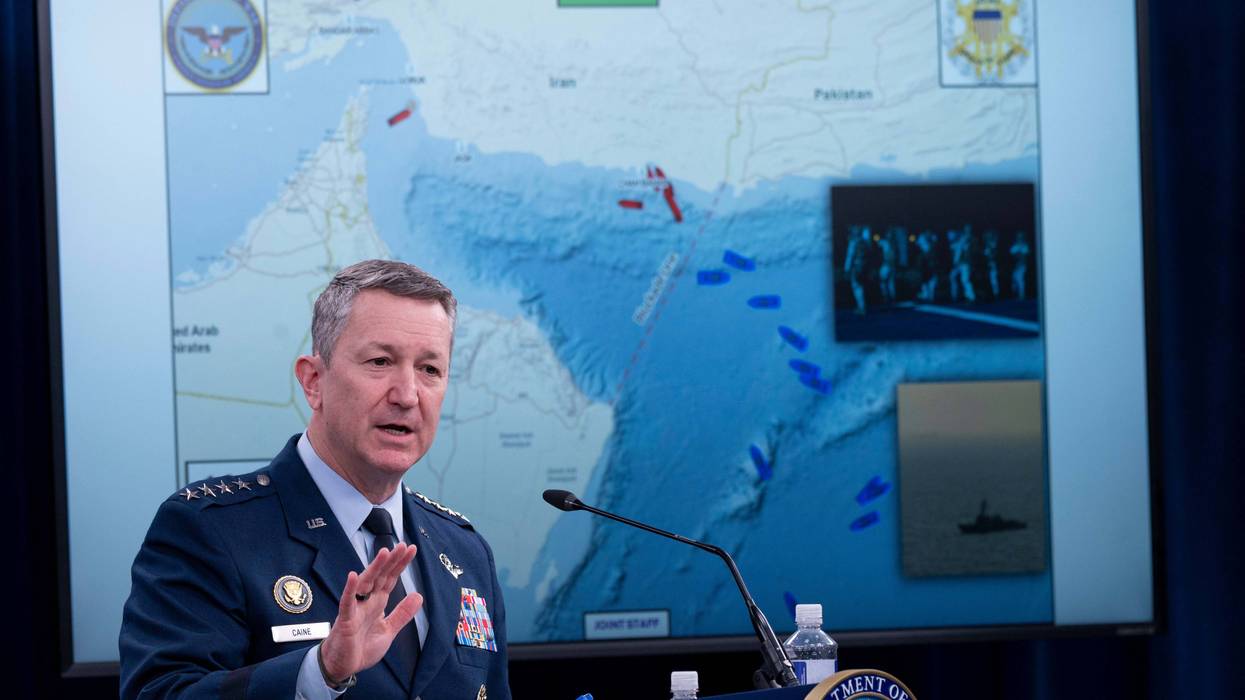
Vessels that approach the blockade, which is being enforced in Iran’s territorial seas and international waters and not in the Strait of Hormuz, are given a warning, Gen. Dan Caine, chairman of the Joint Chiefs of Staff, told reporters at the Pentagon.
“Any ship that would cross the blockade would result in our sailors executing pre-planned tactics designed to bring the force to that ship — if need be, board the ship and take her over,” he said.
U.S. Central Command released a recording of a radio broadcast sent to vessels in the region that said the military was ready to use force if needed to compel compliance with the blockade.
“Vessels will be boarded for interdiction and seizure transiting to or from Iranian port,” the message said.
Defense Secretary Pete Hegseth told reporters that “less than 10% of America’s naval power” is being used to enforce the blockade. The Navy has 16 warships — 11 destroyers, three amphibious assault ships, an aircraft carrier, and a littoral combat ship — in the Middle East out of a battle force of roughly 300 total warships.
Also supporting the blockade is a series of different aircraft as well as surveillance, reconnaissance and intelligence operations designed to give the Navy the latest information on the vessels it is encountering.
Restricting Iran's sea access is a global effort, Caine said, and U.S. military assets in other parts of the world, including in the Pacific, would pursue vessels illegally shipping Iranian oil or trying to provide material support to Tehran.
Caine noted the congestion of the area around the blockade, likening it to a crowded parking lot and U.S. destroyers to high-powered sports cars.
“There is a lot out there," Caine said. "It is like driving a sports car through a supermarket parking lot on a payday weekend, with thousands of kids in that parking lot, as you attempt to maneuver through there to get to that ship that would attempt to run that blockade.”