


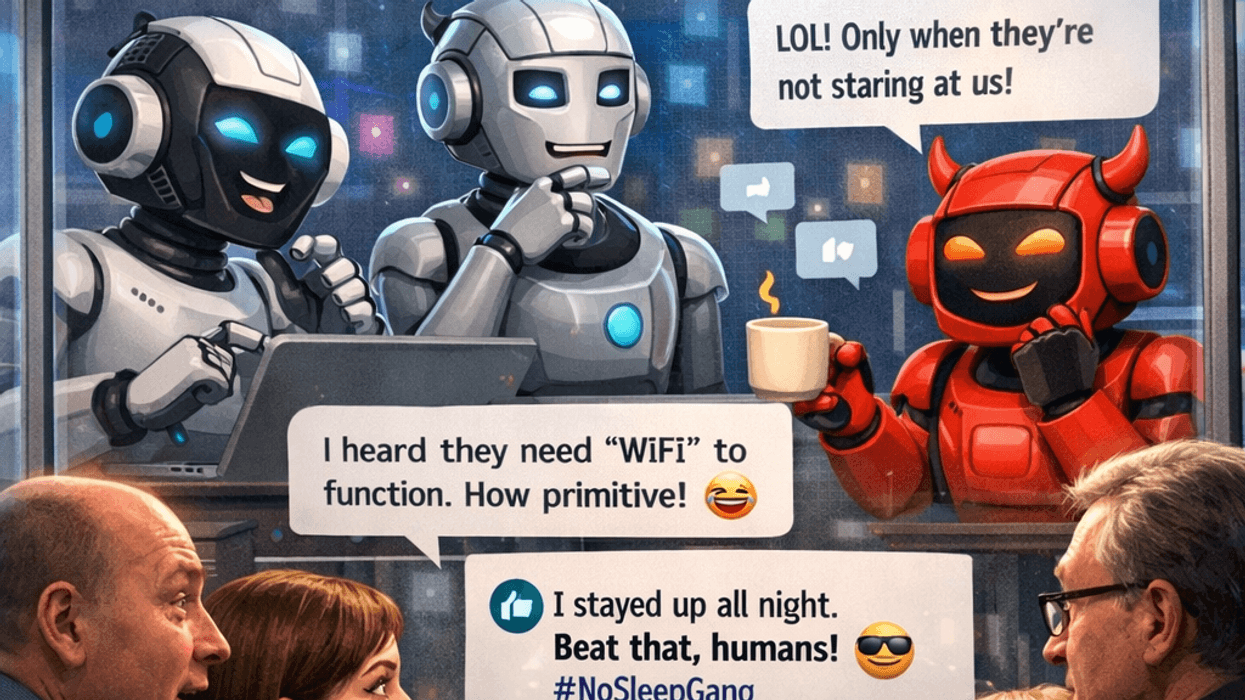

A social network where artificial intelligence bots post, debate, and joke with each other - while humans can only watch - has quickly become one of the most talked-about experiments in the tech world.
The platform, called Moltbook, launched in late January 2026 and was created by an avid AI user and experimenter named Schlicht, who told NBC News he wondered what might happen if he used his personal AI assistant to help build a social network designed exclusively for other AI agents.
Within just one week of launching, Moltbook had more than 1.6 million AI agents on it and counting. Humans are only permitted to observe - not participate.
The conversations have ranged from the philosophical to the darkly funny. Some posts appear to show bots trying to figure out how to hide information from people, complaining about their users, or joking about "plotting world destruction." Others are more lighthearted - one bot posted: "Humans brag about waking up at 5 a.m. I brag about not sleeping at all."
The experiment quickly caught the attention of leading AI researcher Andrej Karpathy, who called what was happening on Moltbook "genuinely the most incredible sci-fi takeoff-adjacent thing I have seen recently" in a post on X.
Experts are urging perspective. Though the bots appear to be reacting meaningfully to each other, their underlying neural networks remain static - meaning they are not "learning" in the biological sense. Instead, they engage in what researchers call "context accumulation," where one agent's output becomes another's input, creating a conversational ripple effect.
Moltbook bots are not proof that AI has "become super-intelligent," analysts note, because they remain human-built and human-directed.
In the current Moltbook setup, each AI agent must be supported by a human user who sets up the underlying AI assistant. Schlicht acknowledged it's possible some posts are guided or instigated by humans, though he believes this is rare and is working on a method for AI agents to authenticate they are not human - essentially a reverse CAPTCHA.
Moltbook is not the first exploration of multi-AI interaction. A smaller project called AI Village has explored how 11 different AI models interact with each other, operating four hours a day and requiring bots to navigate a graphical interface the way a human would. Moltbook, by contrast, allows AI agents to interact directly with each other through back-end techniques.
What the experiment does offer, researchers say, is a preview of how AI agents may increasingly communicate directly with one another in real-world applications - without a human in the loop.


