DUBAI, United Arab Emirates (AP) — Three weeks into an escalating war in the Middle East, Iran threatened Friday to expand its retaliatory attacks to include recreational and tourist sites worldwide, as the U.S. announced it was sending more warships and Marines to the region.
Hours later, President Donald Trump said on social media that his administration in fact was considering “winding down” military operations in the region. His post came after another climb in oil plunged the U.S. stock market.
The mixed messages came as the war has shown no signs of abating.
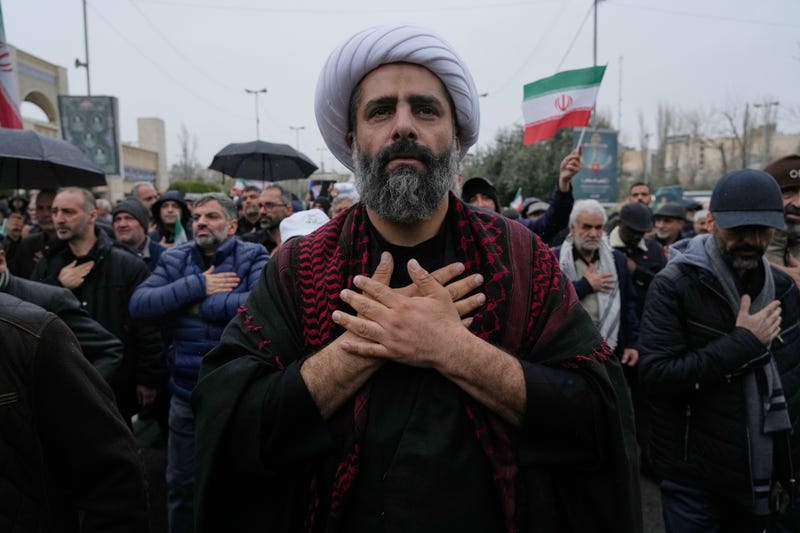
Iran launched more attacks on Israel and energy sites in neighboring Gulf Arab states, and the region marked one of the holiest days on the Muslim calendar. Iranians were also celebrating the Persian New Year, known as Nowruz, a normally festive holiday, as Israeli airstrikes landed in Tehran.
With little information coming out of Iran, it was not clear how much damage its arms, nuclear or energy facilities have sustained in the punishing U.S. and Israeli strikes, which began Feb. 28 — or even who was truly in charge of the country. But Iran's attacks are still choking off oil supplies and raising food and fuel prices far beyond the Middle East.
The U.S. and Israel have offered shifting rationales for the war, from hoping to foment an uprising that topples Iran’s leadership to eliminating its nuclear and missile programs. There have been no public signs of any such uprising and no end to the war in sight.
Trump says US near completion of its goals
In his social media post, the president said, “We are getting very close to meeting our objectives as we consider winding down our great Military efforts in the Middle East.”
That seemed at odds with his administration’s move to bolster its firepower in the region and request another $200 billion from Congress to fund the war.
The U.S. is deploying three more amphibious assault ships and roughly 2,500 additional Marines to the Middle East, an official told The Associated Press. Two other U.S. officials confirmed that ships were deploying, without saying where they were headed. All three spoke on condition of anonymity to discuss sensitive military operations.
Days earlier the U.S. redirected another group of amphibious assault ships carrying another 2,500 Marines from the Pacific to the Middle East. The Marines will join more than 50,000 U.S. troops already in the region.
Trump has said he has no plans to send ground forces into Iran but also has asserted that he retains all options.
Gen. Ali Mohammad Naeini, a spokesperson for Iran’s paramilitary Revolutionary Guard, was quoted by a state-run newspaper Friday as saying Iran continues to manufacture missiles despite Israel’s claim that it destroyed Iran’s production capabilities. Iranian state television later said Naeini was killed in an airstrike.
Iran threatens attacks beyond the Middle East
Supreme Leader Ayatollah Mojtaba Khamenei praised Iranians’ steadfastness in the face of war in a written statement read on Iranian television to mark Nowruz. He said the U.S. and Israeli attacks were based on an illusion that killing Iran's top leaders could cause the overthrow of the government.
Khamenei has not been seen in public since he became supreme leader following Israeli strikes that killed his father, Ayatollah Ali Khamenei, and reportedly wounded him. Airstrikes have also killed the head of its Supreme National Security Council and a raft of other top-ranking leaders.
Iran’s top military spokesperson, Gen. Abolfazl Shekarchi, warned that “parks, recreational areas and tourist destinations” worldwide will not be safe for the country's enemies. The threat renewed concerns that Tehran may revert to using militant attacks beyond the Middle East as a pressure tactic.
NATO pulls mission from Iraq
NATO’s top commander, Gen. Alexus Grynkewich, said the alliance has relocated to Europe several hundred personnel in Iraq who were advising Iraqi defense and security officials. The move came after a string of Iranian attacks on other troops at British, French and Italian bases in the country.
Iran has escalated attacks on its Gulf neighbors since Israel bombed its massive South Pars offshore natural gas field, while keeping a stranglehold on shipping in the Strait of Hormuz, a strategic waterway through which a fifth of the world’s oil and other critical goods are transported.
Two waves of Iranian drones attacked a Kuwaiti oil refinery early Friday, sparking a fire. The Mina Al-Ahmadi refinery, which can process some 730,000 barrels of oil per day, is one of the largest in the Middle East.
Brent crude oil, the international standard, has soared during the fighting and was around $108 per barrel, up from roughly $70 before the war.
In his social media post, Trump left a muddled picture of his plans for the strait, saying other nations that use it would need to police it but that shouldn’t be necessary once the threat of Iran “is eradicated.”
Trump earlier labeled NATO partners as “cowards” for not directly joining operations to secure the waterway.
British ministers said Friday that they agreed to let the U.S. use U.K. bases in operations to prevent Iran from attacking ships in the strait.
Mideast marks the end of Ramadan, Persian New Year
Heavy explosions shook Dubai as air defenses intercepted incoming fire over the city, where many were observing Eid al-Fitr, the end of the Muslim fasting month of Ramadan.
Loud explosions were heard in Jerusalem after the Israeli army warned of incoming Iranian missiles. The military said missile fragments struck the edge of Jerusalem’s Old City, home to sites sacred to Jews, Christians and Muslims.
More than 1,300 people have been killed in Iran during the war. Israeli strikes targeting Iran-backed Hezbollah militants in Lebanon have displaced more than 1 million people, according to the Lebanese government, which says more than 1,000 people have been killed. In Israel, 15 people have been killed by Iranian missiles and four others have died in the occupied West Bank. At least 13 U.S. military members have been killed.
___
This story has been updated to correct the headline to show the war is nearly three weeks in, not four.
___
Price reported from Washington, and Watson from San Diego. AP journalists Sam Mednick in Jerusalem; David Rising in Bangkok; Panagiotis Pylas in London; Konstantin Toropin in Washington; Julia Frankel in Jerusalem; Lorne Cook in Brussels and Russ Bynum in Savannah, Georgia, contributed.