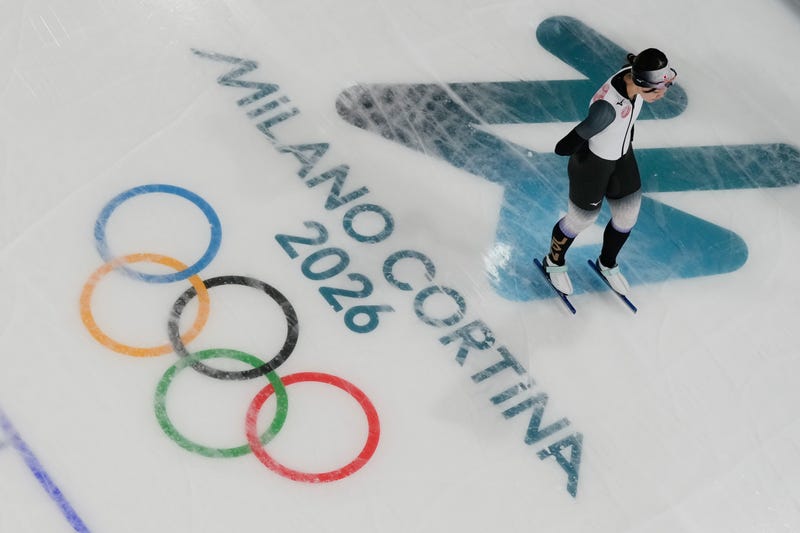
MILAN (AP) — Italy has ramped up security ahead of the opening ceremony of the Milan Cortina Winter Olympics Friday, with thousands of agents protecting athletes, spectators and global leaders at locations spanning from Milan to the Dolomites.
Prime Minister Giorgia Meloni's Cabinet on Thursday approved a security decree including stricter measures to counter violent protests, just ahead of fresh demonstrations planned around the opening ceremony. Opposition lawmakers criticized the measure, saying it muzzles freedom of expression.
While some preliminary hockey and curling events started on Wednesday, the Games officially kick off with the opening ceremony at Milan’s San Siro Stadium on Friday evening, featuring global music stars and high-profile guests.
Around 6,000 security personnel will be deployed across the Olympic sites during the Games, including bomb disposal experts, snipers and counter-terrorism units, Italian authorities said.
Coordinating security across multiple venues
Security at the Milan Games are particularly complicated because this is the most geographically dispersed in Olympics history, with events spread across Milan to three clusters in the mountains.
Italian police will rely on a network of operations centers to manage security and react to alerts quickly, and share information between them. The Associated Press on Thursday toured the main operations center in Milan, where dozens of police officers sat in front of computers and giant screens and kept eyes on various locations.
“The aim is to monitor in real time, in an absolutely timely and immediate manner, what is happening across the territory,” Sabrina Pane, Milan's deputy prefect, told the AP. “We can do this thanks to a very fast, constant flow of information.
Other centers are located in Bolzano, Trento, Venice, Verona, Belluno, Sondrio and Varese, where some Games venues are located.
Cross-border operations
Foreign police officers, as well as personnel from security agencies Interpol and Europol, will work with Italy’s public security department to quickly handle critical situations requiring international cooperation.
On Wednesday, Foreign Affairs Minister Antonio Tajani revealed that Italian police had already foiled a series of Russian-linked cyberattacks targeting several foreign ministry offices, as well as websites linked to the Winter Olympics and hotels in Cortina.
Interforce teams are operating around the clock to monitor both the territory and the internet in an effort to prevent further cyberattacks.
“We are committed to a dual approach,” said chief police commissioner Luisa Massaro. “The first is the protection of critical computerized infrastructure. The second is web monitoring."
Last week, news that a unit of U.S. Immigration and Customs Enforcement (ICE) would be present during the Winter Games set off concerns and protests across Italy, where people expressed outrage at the inclusion of an agency that has dominated headlines for leading the Trump administration’s immigration crackdown.
Homeland Security Investigations, a unit within ICE that focuses on cross-border crimes, frequently sends its officers to overseas events like the Olympics to assist with security. HSI officers are separate from the ICE arm at the forefront of the immigration crackdown known as Enforcement and Removal Operations, and there was no indication ERO officers were being sent to Italy.
Hundreds of protesters gathered on Saturday in Milan to voice opposition to the security force — both the entry of its agents to Italy and their deportation actions in the U.S. Italy's Interior Minister Matteo Piantedosi told parliament this week that ICE agents would only have an advisory role and would not operate on Italian territory. ICE’s unit will function solely within U.S. diplomatic missions, he said.
Protests against ICE unit
That hasn't completely quelled discontent. At least three rallies were set to take place in Milan on Friday before the opening ceremony, including two targeting ICE's deployment during the Games.
Dozens of students gathered Friday morning at Milan’s Leonardo da Vinci plaza to protest, blowing whistles and shouting “We don’t want ICE in our city!” as they marched under drifting clouds of pink smoke.
“It’s not only that I don’t like what they are doing to immigrants, I also don’t like what they are doing to protesters,” said Andrea Cucuzza, 18. “That’s why we are protesting. They don’t like manifestations, protests? Then we are doing one.”
Under the new security rules introduced by the government decree, police are allowed to detain people for up to 12 hours when there are reasonable grounds to believe they may act as agitators and disrupt peaceful protests. The decree takes immediate effect upon publication in the government’s official gazette.
Center-left opposition lawmakers strongly criticized the measure, saying they impose dangerous limitations to freedom of expression and exploit security worries around the Olympics to toughen state control over ordinary citizens. But the government holds a majority in parliament, ensuring the decree’s ratification before the 60-day deadline.
The move also comes several days after violent clashes between police and demonstrators erupted in the northern city of Turin. Tens of thousands of people gathered Saturday to protest the December eviction of a community center that had been occupied by leftist activists for three decades.
That peaceful demonstration turned violent when a small group of masked protesters started attacking police officers, pushing Meloni's conservative government to speed up approval of a security package that had been discussed for months.
___
Zampano reported from Rome. Associated Press writer María Teresa Hernández reported from Milan.
___
AP Olympics: https://apnews.com/hub/milan-cortina-2026-winter-olympics