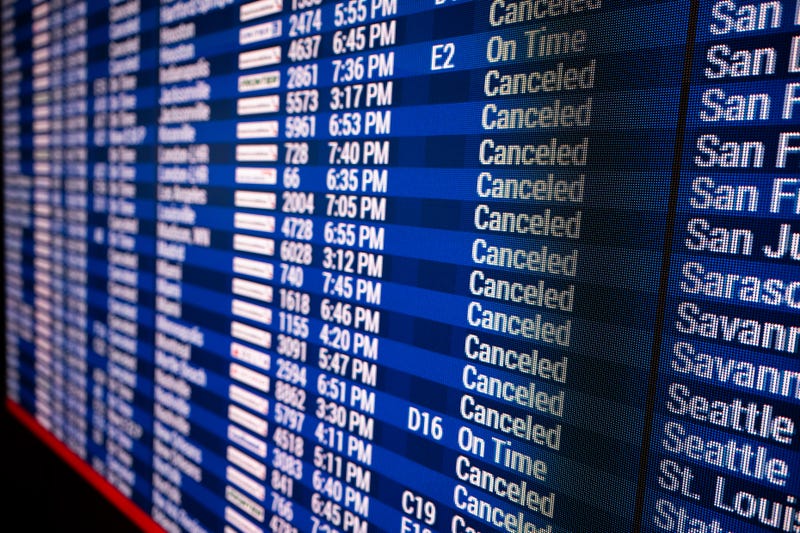
NEW YORK (AP) — Severe winter weather across the northeastern United States, a partial government shutdown and security concerns in parts of western Mexico converged to make Monday a challenging time for air travel.
Thousands of U.S. flights were canceled or delayed on the East Coast as a powerful snowstorm upended daily routines in Boston, New York, Philadelphia and other major cities. Airlines also suspended or adjusted service to destinations in and around Mexico’s Jalisco state as violence erupted in the aftermath of a senior cartel leader's killing.
Travelers with Global Entry memberships faced delays upon arriving in the U.S. as well after the Department of Homeland Security, which shut down on Feb. 14 because Congress did not reach an agreement on its continued funding, temporarily halted the program, which gives pre-approved individuals an expedited way to clear immigration and customs.
The overlapping disruptions created cascading delays across interconnected airline networks, stranding some travelers and complicating airport operations, especially on both sides of the U.S.-Mexico border.
Winter weather in the US
The winter storm that pounded the Northeast brought heavy snow, strong winds and blizzard warnings that slowed or halted transportation networks across the region.
Air traffic slowed dramatically. More than 5,600 flights into, out of or within the U.S. were canceled, according to flight-tracking service FlightAware. About 2,500 others were delayed.
New York's John F. Kennedy International Airport and LaGuardia Airport reported the highest numbers of cancellations Monday — followed by airports in Boston, Newark, New Jersey, Philadelphia and Washington, D.C. Smaller airports, including Rhode Island’s T.F. Green International Airport, temporarily suspended operations.
More than 1,700 flights already were canceled for Tuesday.
Even after a storm passes, it takes time for airlines to get their planes and flight crews back where they need to be to restore full schedules, according to Michael McCormick, an associate professor of air traffic management at Embry‑Riddle Aeronautical University.
“This storm is so wide-ranging, it’s impacted major hubs along the Northeast. And those airports are the most vulnerable airports in terms of getting aircraft and air crews positioned to be able to fly their schedule,” McCormick said. As a result, there will continue to be cancellations that “gradually decrease daily," he said.
Benjamin Lundell and Thomas Mehari were among the travelers who got stuck in New York on Monday. The two network consultants were on a business trip from Sweden and had their flight to Texas canceled.
“We're dressed for Houston currently,” said Lundell, as he trudged through knee-high snow in a thin jacket and jeans in search of a new hotel in Manhattan.
Ground travel
The National Weather Service called travel conditions “extremely treacherous” and “nearly impossible” in areas hit hardest by the storm.
Beyond air traffic, millions of people under blizzard warnings faced state or city-level bans on non-emergency ground transportation. Public transit systems were reduced or suspended in some areas. As of midday Monday, New York's Metropolitan Transportation Authority said that it had “removed articulated buses from service during the storm” and that there might be subway delays, especially along routes that run outdoors. The Long Island Rail Road temporarily suspended all services until further notice.
As for longer passenger train routes, Amtrak suspended all service between New York Moynihan Train Hall and Boston South Station through the end of the day Monday. Amtrack said its crews were working to restore service by Tuesday, but it still expected additional cancellations.
Mexico travel
While the winter storm accounted for the bulk of Monday's flight cancellations, it was not the only factor. After the killing Sunday of Mexico's most powerful cartel leader, Nemesio Oseguera Cervantes, in Jalisco state, local and foreign governments issued travel advisories and safety guidance.
A series of retaliatory attacks since the killing of of Oseguera Cervantes have put much of Mexico on edge. Jalisco Gov. Pablo Lemus suspended public transportation on Sunday and urged residents to stay in their homes. Meanwhile, the U.S. State Department advised American citizens in parts of Jalisco and other states to shelter in place and avoid non-essential travel until the situation stabilized. Canadian authorities issued similar guidance.
AeroMexico, Delta Air Lines, United Airlines, American Airlines and Air Canada canceled or scaled back flights to Puerto Vallarta and Guadalajara. Many offered customers flexible rebooking options. Some government agencies may implement more sweeping limitations on air travel if safety concerns persist or escalate further, aviation experts said.
Oklahoma resident Steve Perkins, 57, told The Associated Press in a video interview from Puerto Vallarta that he and his wife were stranded after their scheduled flight home Monday was canceled. Perkins said the couple was having coffee on their hotel's terrace Sunday morning when they heard an explosion and later saw plumes of black smoke surround the downtown.
“My wife called our kids to tell them goodbye if we were never gonna see them again, that kind of thing. It was fairly unsettling,” Perkins said.
He said the other guests at the hotel, who were from Canada and New York, were also very concerned but that the hotel staff “was oddly nonchalant about it. They said, ‘Don’t worry, it’s under control.’”
Perkins, who works as an IT consultant, said his vacation was only supposed to be for a week so he’ll have to resume working from Puerto Vallarta until he can go home.
Perkins and his wife have been taking annual trips to Puerto Vallarta since 2012 and always felt safe until now. He said they were told they can’t fly home until March 1 and once they do, they don't plan to return.
“If somebody knows Marco Rubio, maybe we could ask him to come get us somehow. There’s a bunch of people trapped,” Perkins said.
Global Entry
Adding to airport strain, the Department of Homeland Security said the suspension of its Global Entry program that started over the weekend would remain in place until the partial U.S. government shutdown ends.
Global Entry allows pre-approved travelers to use expedited kiosks when entering the U.S. from abroad. The suspension could mean longer wait times for some returning passengers at international airports.
Homeland Security initially planned to halt the Transportation Security Administration PreCheck program as well but ended up not doing so. The department indicated it still might suspend PreCheck, however, saying it would adjust operations on a “case-by-case basis” as staffing constraints arise.
TSA agents are working without pay during the lapse in funding, which could lead to staffing issues and security lines the longer the shutdown drags on.
Tips for travelers
U.S. airlines are required to provide refunds for canceled flights.
When they expect severe disruptions, they also often give travelers a chance to postpone their trips by a few days without having to pay a fee.
Many carriers are offering rebooking options for customers impacted by the storm and the security challenges in Mexico. They include JetBlue, Delta Air Lines, American Airlines, United Airlines, Southwest Airlines, Alaska Airlines, Air Canada and AeroMexico.
McCormick suggested that travelers subscribe to text or email alerts from their airlines to receive the latest updates. Going online to look at alternate routes is also helpful. Be sure to check if cancellations or delays are impacting a connecting airport as well as the departure airport and final destination.
___
Yamat reported from Las Vegas. Associated Press journalists Jake Offenhartz in New York and Juan Lozano in Houston contributed.