


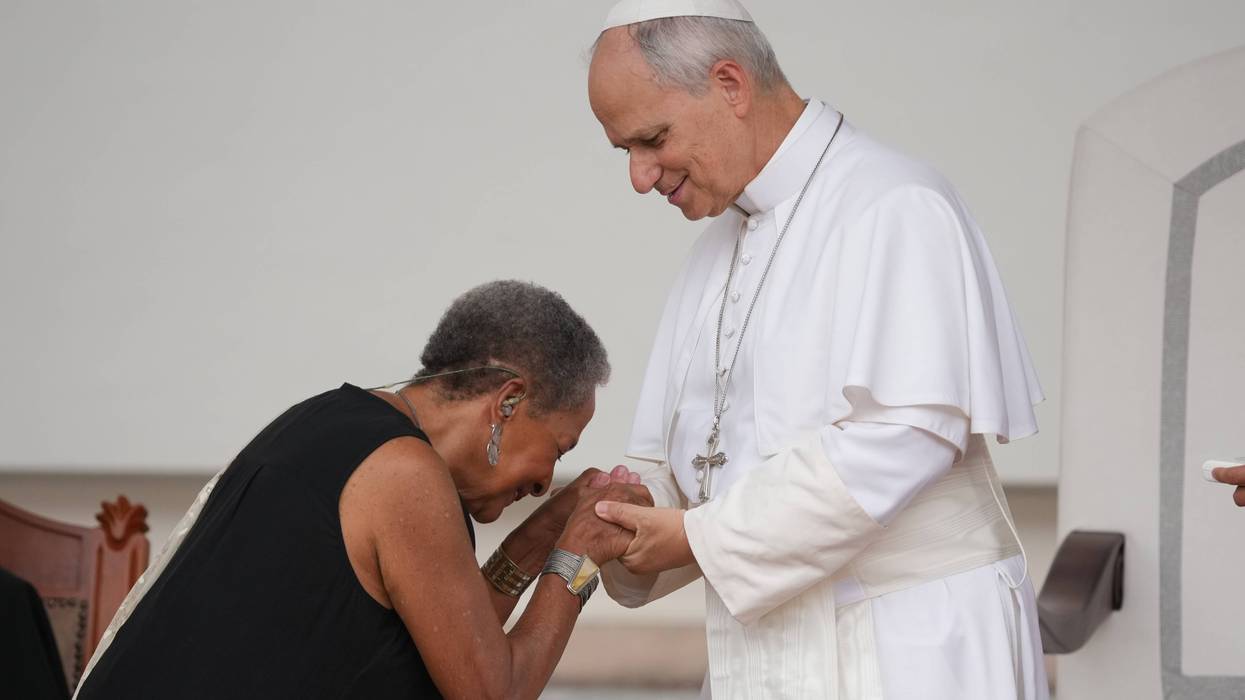

LIMA, Peru (AP) — When Latin Grammy-winning singer Susana Baca was asked to sing for Pope Leo XIV during his visit home to Peru, she vowed to let the music speak for itself and declined all interview requests.
Baca, the world’s best-known Afro-Peruvian musician, feared the moment could be trivialized when in fact it marked a watershed for her and Peru’s African-descended community. As Peru’s first Black culture minister, the 82-year-old Baca remains a leader in the campaign to end discrimination that has long made second-class citizens of Indigenous and Black Peruvians.
Breaking her silence in an exclusive written interview with The Associated Press, Baca reflected on Leo’s message, its meaning for Peruvians and the music she chose to sing him. She also reflected on the significance of Leo’s historic apology for the Catholic Church’s role in facilitating slavery and his visit to a UNESCO-recognized memorial for slavery in Peru, given Leo’s own family tree includes enslaved people and slave owners.
Answers have been edited for brevity and clarity.
AP: What was the pope’s visit itself like for you?
BACA: For me, the pope himself was a revelation. In his gaze of a good man, I was able to find a deeper meaning in his ecclesiastical commitment. He draws closer to his religious foundation where he grows, which is the people.
He conveys in his words the vision of a church renewed in its social dimension, to highlight Catholicism in its core principles: the struggle for, and the commitment to, the men and women who are most vulnerable.
AP: What can you tell us about the musical aspect of this visit?
BACA: The pope, through his humility, is the one who opens the door to music and to communicating with young people. In every culture, the return of the prodigal son is celebrated. In this visit, the pope is that son visiting, and we celebrate him with music, dance, and flavors for the palate. This can only happen when the bond between the people and the pope is that of a family.
AP: What can you tell us about the lyrics of “Canción de Fe” (“Song of Faith”)?
BACA: The poem and the song I performed before the pope are rooted in my heart. I believe and feel that singing for the pope is a way to accompany him in his message, in the preaching of faith that he expresses.
“Canción de Fe” is a song of hope at a difficult moment for Peru with politicians of low caliber and little moral quality.
As for “Si me quitaran totalmente todo” (“If they took absolutely everything from me”) — it’s a very intense poem and I sang it as an act of solidarity with those who suffer in a violent world. I sang it on my album “Espíritu Vivo” (“Living Spirit”), which I recorded in New York City on Sept. 11, 2001. ... I've managed to move people who were living through moments of great desperation and war, because this is a poem that brings life and death together. I feel that this is Gaza today … .It’s that same pain, which persists today in the Middle East and that can’t be silenced.
AP: How did you feel when the pope denounced the “suffering and humiliation” endured by African enslaved people at the Sanctuary of St. Turibius of Mogrovejo, who is revered for having denounced abuses against Indigenous and enslaved people by Spanish colonizers?
BACA: I felt very good and happy. For me, the pope’s act of asking forgiveness and reflecting on the history of St. Turibius of Mogrovejo, so long afterward but in such a meaningful way, was very important. It’s a gesture that the Afro-Peruvian community not only is grateful for, but also feels that this dark chapter of history is finally addressed with a clear vision – that’s the light, the forgiveness and the recognition that we can fail, but we can also heal our mistakes.
AP: How do you see the Afro-Peruvian community today?
BACA: I believe that one of the most important things in the history of Afro-Peruvians is that we did not remain submerged despite our history of suffering. We’re an Afro-Peruvian people who have learned to forgive; the injustice of many moments in history is less painful if we have the capacity to forgive.
And perhaps, this is what connects me in my conscience, to the pope. I feel that in all his homilies and teachings, the pope emphasizes the importance of asking for forgiveness and forgiving — that the injustice of many moments in history is less painful if we have the capacity to forgive and to be forgiven. Finally, it’s forgiveness. And that’s faith.
I feel that this identifies my singing, which seeks to be a reflective singing — the same notion of faith that the pope has, and a historical process that belongs to the Afro community. Peru’s people have a beautiful diversity, and that’s also something that the pope said in his speech, and this condenses his own rich human nature in the presence of the Afro-Peruvians, and in the presence of the Indigenous and Amazonian peoples.
AP: Finally, what message would you like to share with the world — especially with young people — following the pope’s visit?
BACA: The message is very clear. First, for the young people in the sense who understand the pope’s words as part of their own language of rebellion today, of speaking a truth that was covered under the pope before last.
Before Francis, the Church was distant from young people; the Church didn’t represent a sense of a future, and what this pope has done is put everything he says into a context that speaks to young people.
The pope moves beyond the conservative rhetoric of the old church and speaks in a context that is youthful, vital and grounded in day-to-day life. I feel that the pope’s words are an embrace for the young people.
___
Associated Press religion coverage receives support through the AP’s collaboration with The Conversation US, with funding from Lilly Endowment Inc. The AP is solely responsible for this content.