


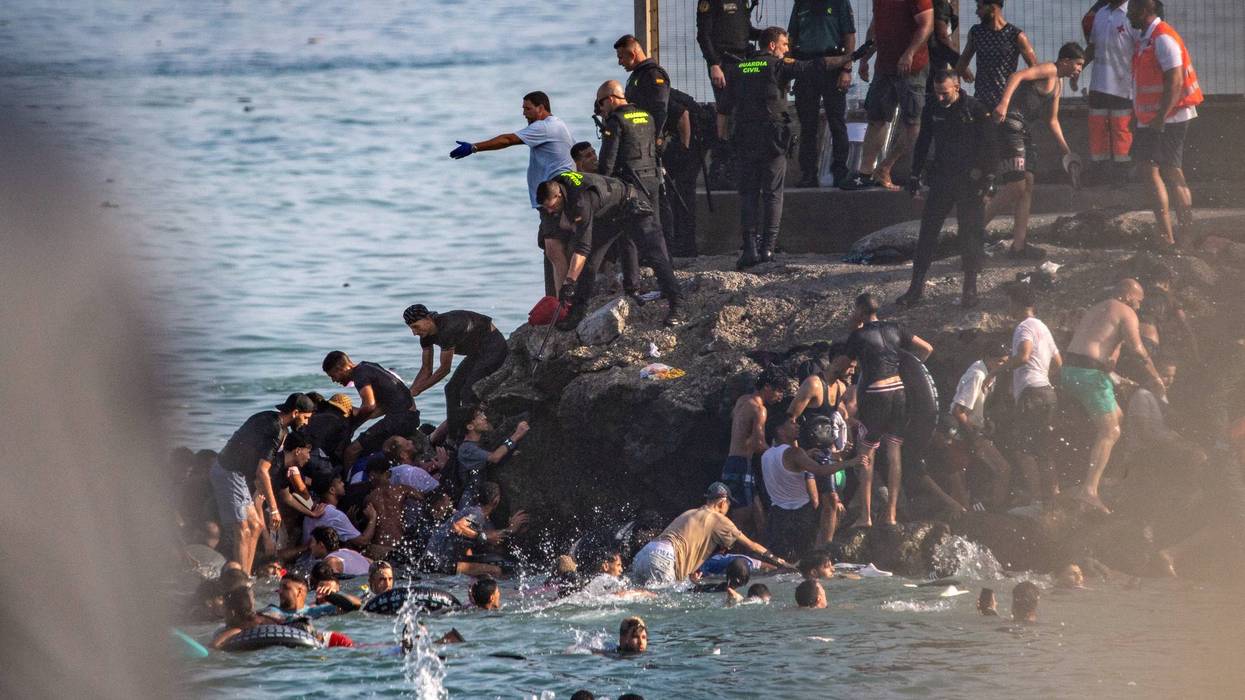

MADRID (AP) — Spain's national intelligence agency issued multiple warnings before the Ceuta border crisis about a potential mass crossing of migrants from Morocco into the Spanish exclave in late July, according to declassified documents released by the government on Wednesday.
The trove of 40 documents, which includes alerts, intelligence reports, charts and communications from multiple law enforcement and intelligence agencies, appears to undermine what Spanish Prime Minister Pedro Sánchez has said about the level of prior warning the government had before the sudden influx took place.
Major protests in Spain have taken place in response to the migrant arrivals, with critics blaming the Sánchez government for its handling of the crisis, and his political opponents accusing him of pandering to Morocco.
Spanish intelligence warned of calls on social media
On July 29, a day before more than 72,000 people began pouring into the Spanish city neighboring Morocco, Spain's spy agency, the National Intelligence Center (CNI), sent an alert via WhatsApp to the Spanish government's delegation in Ceuta about calls on social media "for an assault on the fence and by sea tomorrow at 8 p.m.”
“There are two different groups with a total of 180,000 followers," the declassified WhatsApp message from the intelligence agency said, “just to give you an idea of its scale."
A report from Spain's spy agency sent that day to Moroccan intelligence services warned of plans on social media for migrants to enter Ceuta on July 30 by climbing a border fence separating the exclave from Morocco, or by swimming around it, the documents show. It mentioned that migrants might take advantage of Morocco's national Throne Day, celebrated on July 30.
That same day, Spain's national intelligence agency issued similar warnings about “several groups on Facebook and WhatsApp encouraging these attempts” in messages to Spain's Civil Guard police force.
Once thousands of people were streaming across the border on July 30, a Defense Ministry intelligence report issued that day stated that Moroccan forces were passive and acted negligently to stop migrants.
“It cannot be ruled out that Morocco may attempt to exploit the situation that has arisen in Ceuta to further its strategic interests,” the report went on.
Morocco's foreign ministry did not immediately respond to a request for comment from The Associated Press on Wednesday about the documents.
Sánchez says documents did not explain scale
On Wednesday, Sánchez rejected the idea that the declassified documents revealed that there was prior warning about a border crisis of the scale that took place between July 30 and 31.
“The existence of this campaign was known ... and was being monitored, but in no way did it constitute or could it be interpreted as an indicator of the scale, nature, or probability of what happened afterward,” Sánchez wrote on X, referencing the spy agency’s July 29 warning about what was brewing on social media.
Sánchez has defended his government's handling of the crisis and said last week there was no evidence that Morocco's government orchestrated the incident. That sparked further criticism, particularly after a leaked police report alleged the involvement of Moroccan police in the episode.
Several weeks after the initial border rush, Ceuta is dealing with a prolonged humanitarian crisis because of some 5,000 migrants who remain in the small city, according to the national government. Local officials cite a higher figure of up to 10,000 people.
The Spanish leader pledged last week to release documents related to Spain's deadliest mass crossing, in which NGOs reported that more than 140 migrants died.
In the days immediately before the mass crossing, hundreds of migrants had swum from Morocco to reach Ceuta, which Spain’s Interior Minister Fernando Grande-Marlaska acknowledged at the time.
He said that authorities were facing “an extraordinary, exceptional situation," and that the Spanish government was “dealing with it with the means that we already have deployed there permanently.”
Wednesday’s document trove includes reports from multiple agencies that detailed the increasing number of arrivals, a surge that overwhelmed authorities beginning July 30.
___
Renata Brito contributed from Barcelona, Spain.


