



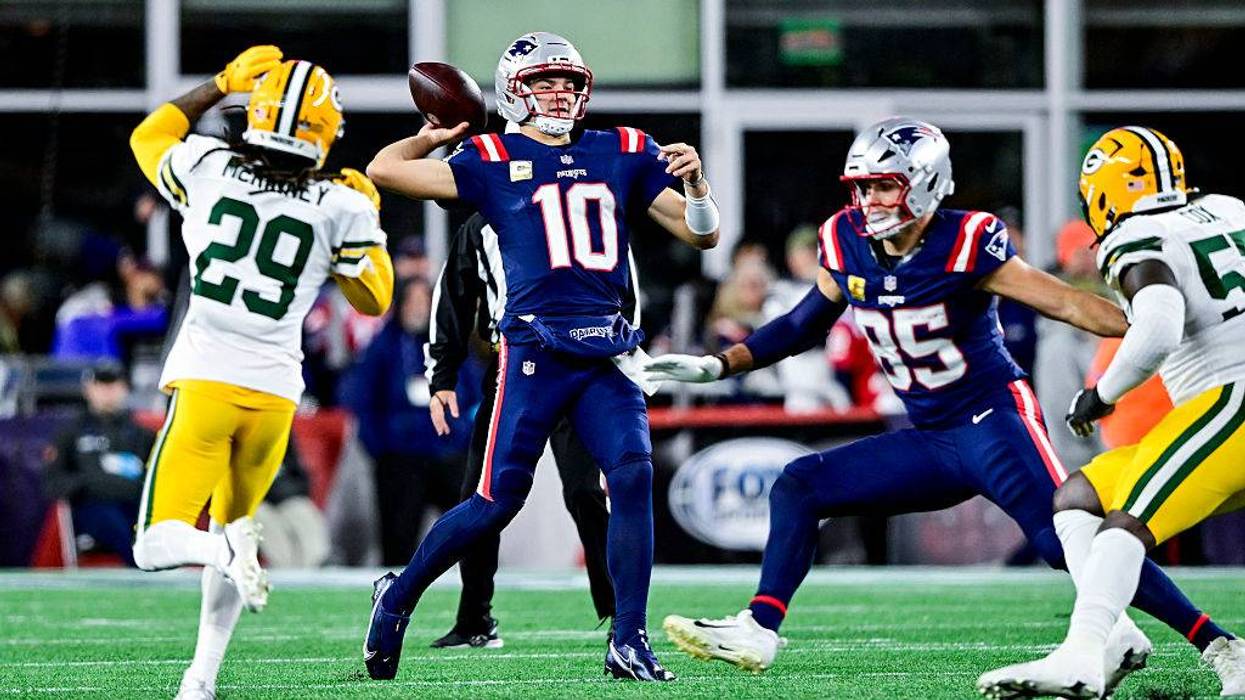

As the Patriots arrive in Munich, Germany, for the sixth international game in franchise history, they face a potentially season-defining moment.
With their bye week coming up, there’s a significant difference between heading into it at 6-4, with some much-needed rest and the potential return of injured players on the horizon, and entering at 5-5 after losing back-to-back games and three of their last four.
How will it shake out?
Let’s take a look at three things to watch as the Patriots look to earn their first win against an NFC opponent this season (0-3) and improve to 3-4 against teams with winning records.
Can the Patriots avoid a slow start?
The Patriots have fallen behind by double digits early in each of their last three games, making slow starts an increasingly concerning trend.
“As a team, we have to start faster,” team captain Kevin Byard said. “In all three phases, I don’t think we’ve started fast as much as we would like to in most of the games this year. So, we’ll continue to turn over every stone and try to figure out how we can do that.”
They trailed by 10 in the first quarter in Chicago.
They trailed by 10 in the first half against Miami.
They trailed by 14 points in the first quarter against Green Bay, a deficit that grew to 17 early in the second quarter.
Over their last three games, the Patriots have been outscored 27-3.
They managed to overcome the slow start in Miami against the one-win Dolphins, but weren’t as fortunate against Chicago and Green Bay. They never reclaimed the lead or even tied the game in either loss.
Sunday’s matchup with Detroit presents an opportunity to turn that worrisome trend around.
According to NextGen stats, the Lions’ offense has reached the red zone on just 20.0% of drives that began in the first quarter of games this season (4 of 20), the sixth-lowest rate in the NFL. Jared Goff has recorded an 18.8% sack rate and a 42.9% pressure-to-sack rate on first-quarter dropbacks, both of which rank as the highest marks in the NFL. In all other quarters, including overtime, Goff has recorded a 3.0% sack rate and a 10.9% pressure-to-sack rate, both ranking second-lowest in the NFL ahead of only Kirk Cousins (2.9% sack rate, 8.0% pressure-to-sack rate).
Detroit has averaged just 2.9 points per game in the first quarter, 28th in the league, and has scored only two first-quarter touchdowns this season, tied for 29th.
Defensively, Detroit has allowed five first-quarter touchdowns. Only the Browns, Raiders, Falcons, Bengals, and Cowboys have allowed more.
The long flights and six-hour time difference present added challenges for the Patriots, but if they can adjust quickly, they’ll have an opportunity to get off to a better start and put an end, at least temporarily, to this troubling trend.
A bounce-back game for the defense?
Last week, the Patriots’ defense found itself on the wrong side of history, surrendering 45 points to the Packers, the most an opposing team has ever scored at Gillette Stadium.
Now, they’ll face another difficult test as they look to bounce back against the Detroit Lions.
Believe it or not, the high-powered Lions offense has scored no more than 20 points in each of its last three games since returning from its bye week. They’ve still managed to win all three. According to Next Gen Stats, it’s the first time Detroit has won three consecutive games while scoring 20 points or fewer since Weeks 5-8 of the 1974 season.
The Lions have averaged 19.3 points per game over that three-game stretch, 20th in the NFL. That’s a significant drop from their first five games, when they averaged 32.8 points per game, tied with the Bills for the league lead. Their 164 total points through the first five weeks of the season are tied with Buffalo for the most over any five-game stretch this season.
“The offense is amazing,” Christian Gonzalez, who is looking for a bounce-back himself, said. “They’ve got a great quarterback — an elite quarterback — two elite receivers. An elite running back. Even a really good offensive line. So, they present a challenge.”
Despite their recent dip in scoring, the Lions’ offense remains one of the most productive in the NFL and presents a major challenge for New England.
Detroit ranks fifth in the NFL in yards per game (379.8) and is top 10 in both yards per pass play (6.9) and yards per rush (4.4). The Lions are also one of four teams, alongside the Patriots, Bears and Rams, with at least 2,000 passing yards and 1,000 rushing yards.
Running back Jahmyr Gibbs leads the NFL with 211 touches, including a league-high 177 carries and 34 receptions. His 1,132 yards from scrimmage also lead the NFL, while his 11 total touchdowns are tied with Kansas City’s Kenneth Walker. Gibbs’ 29 carries of 10 or more yards lead the league and will test a Patriots run defense that has been inconsistent at times.
In the passing game, wide receivers Amon-Ra St. Brown (61 receptions, 657 yards, five touchdowns) and Jameson Williams (28 receptions, 468 yards, five touchdowns) present another difficult matchup for a secondary coming off a rough performance against Green Bay. Packers wide receivers Christian Watson (seven receptions for 171 yards and a touchdown) and Matthew Golden (10 receptions for 164 yards and a touchdown) combined for 335 receiving yards against New England last week.
Add in tight end Sam LaPorta (35 receptions, 399 yards, three touchdowns), and the Patriots’ secondary will have its hands full against Jared Goff. The Lions quarterback has been highly efficient, completing 67.8% of his passes (185 of 273), the fourth-highest rate in the league. He’s thrown just two interceptions, tied with Houston’s C.J. Stroud and Washington’s Jayden Daniels for the fewest among quarterbacks with at least 200 pass attempts. As a team, Detroit has turned the ball over just five times this season, the second-fewest in the NFL behind Houston’s four.
“Very confident,” Marcus Jones said of his belief in a bounce-back from the secondary. “We’ve been there before. We had the situation of the game in Jacksonville earlier in the year. We understand what we can do.”
The NFC North, arguably the best division in football, has given the Patriots’ defense plenty of problems this season. It has handed New England losses in two of its last three games, with Chicago totaling 30 points and 405 yards and Green Bay putting up 45 points and 478 yards. Those are the only two games in which an opponent has surpassed 400 total yards against the Patriots during the Mike Vrabel era.
Don’t overlook the Lions’ defense
The Lions had arguably one of the worst defenses in the league through the first five weeks of the season, allowing 29.6 points and 404.4 (!) yards per game. They surrendered 148 total points, 2,022 total yards, and 20 touchdowns over that span.
But as Detroit’s offense has quieted down since returning from its bye week, the defense has played like a completely different unit.
Since the bye, Detroit has allowed just 41 points, tied for the second-fewest over any three-game stretch this season. The Lions have surrendered only four touchdowns over that span, tied for the fewest over any three-game stretch this year.
They still have their holes, no doubt. And they haven’t faced a murderers’ row of quarterbacks, with Kyler Murray and Malik Willis among their opponents. Jordan Love was the notable exception, and he put up more points against the Patriots than the Lions’ defense has allowed over its last three games. Still, Detroit’s recent defensive improvement presents some challenges.
It starts with the defensive front. Led by Alim McNeill (5.5 sacks), Aidan Hutchinson (5.0 sacks), and D.J. Wonnum (5.0 sacks), Detroit has totaled 27 sacks (third-most in the league) and 128 pressures (sixth-most). Ten different Lions have recorded a sack this season. They’ve recorded multiple sacks in all but one of their eight games, at least three in six games and five or more in three.
If the Patriots can give Drake Maye time to throw, however, there should be opportunities to attack the secondary. Detroit has allowed the most passing yards per game (260.9) and the third-most passing touchdowns (18). The Lions have also allowed 34 completions (fifth-most) and five touchdowns (second-most) on throws traveling 20 or more air yards.