(WWJ) A 30-million-year-old fossil tucked away in an Oregon museum has finally revealed its true identity: it’s one of the most complete ancient dog skeletons ever discovered in North America.
According to researchers at the University of Michigan, the fossil belongs to Mesocyon coryphaeus, an early wild dog species that lived long before the Ice Age.
For decades, paleontologists weren’t entirely sure what they were looking at. When the rock-encased skeleton was first pulled from Bureau of Land Management land in the late 1980s, scientists mistook it for an oreodont—an extinct mammal often nicknamed a "sheep-camel-pig."
It wasn’t until the 1990s that researchers separated the skull and realized it was actually a canid. Years later, in 2012, park paleontologists finished carefully chipping away the surrounding rock to reveal almost the entire body.
"This was the most magical, fun project to just be handed on a silver platter," said Anne Kort, the University of Michigan paleontologist who led the recent description of the fossil for the Journal of Paleontology.
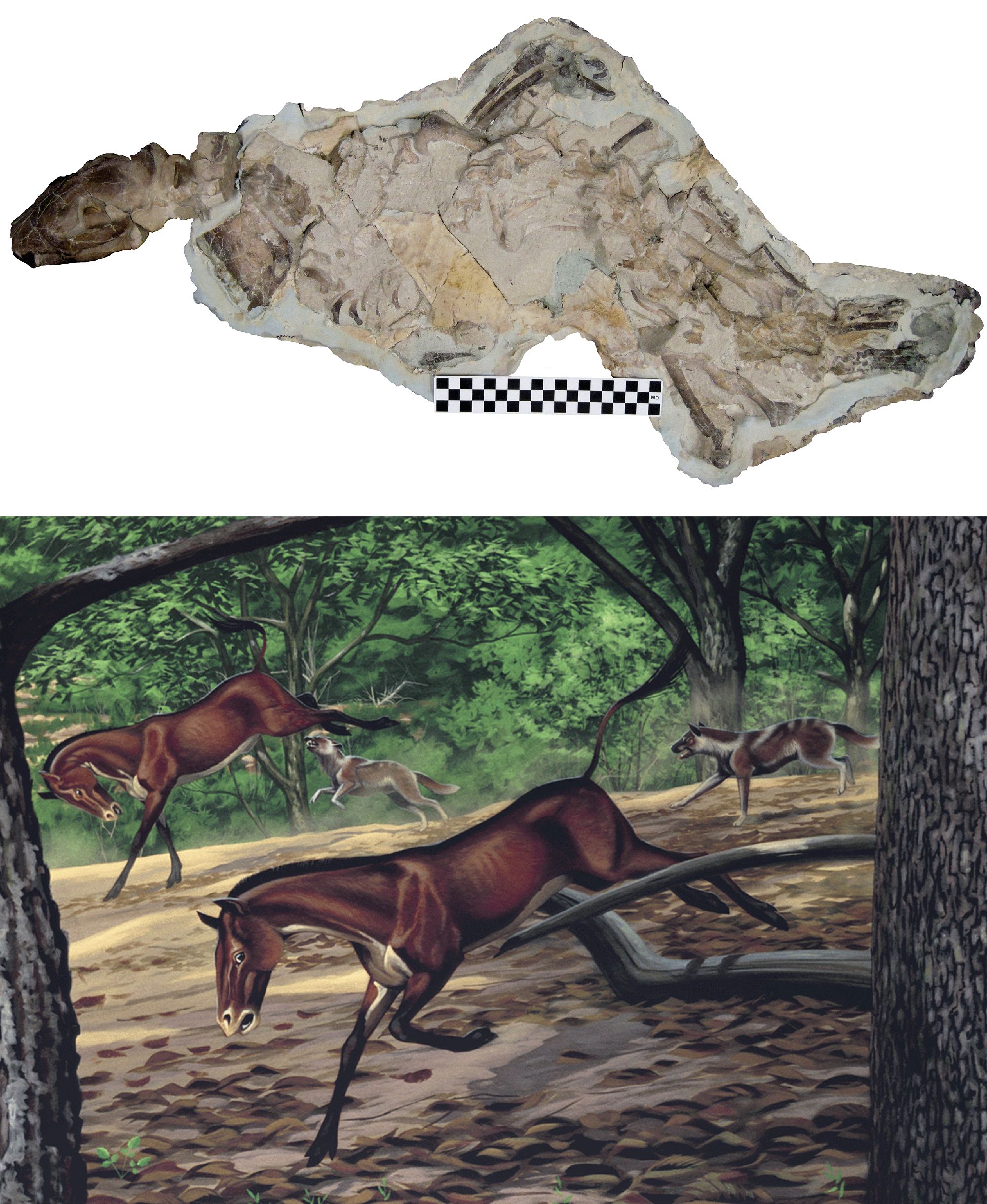
A fossil of Mesocyon coryphaeus was found on Bureau of Land Management land in the 1980s, near the John Day Fossil Beds National Monument.
Credit: Image courtesy of National Park Service; Mural created by Roger Witter.
A Remarkably Intact Discovery
While scientists previously knew about Mesocyon from isolated skulls found over the last century, this specimen is nearly whole, missing only its tail and small parts of its paws.
The extraordinary preservation left little to the imagination—including the animal's sex.
"The other fun thing is, it even had the baculum, so, the penis bone," Kort said. "That means we definitely know this was a male."
The skeleton also featured a unique genetic bone growth on its wrists called an osteochondroma, a trait found in about 60% of the earliest dog fossils, further cementing its place in the dog family tree.
Built Differently Than Today’s Dogs
Dogs first evolved in North America about 40 million years ago as tree-climbing forest dwellers. By the time Mesocyon arrived 10 million years later, the climate had cooled and dense jungles were giving way to open woodlands.
Kort wanted to find out if Mesocyon had started running like modern dogs, but its anatomy proved otherwise.
"The answer is pretty definitely no," Kort explained. "Mesocyon also just has more robust bones in general. It's shorter and stockier."
Instead of sprint-ready limbs, the fossil revealed:
- Flexible elbows: Its joints allowed forearms to rotate, meaning it could still wrestle prey or climb.
- Flat-footed tendencies: It still had a full big toe (what we now call a dewclaw) and occasionally walked heel-down rather than exclusively on its tiptoes like modern dogs.
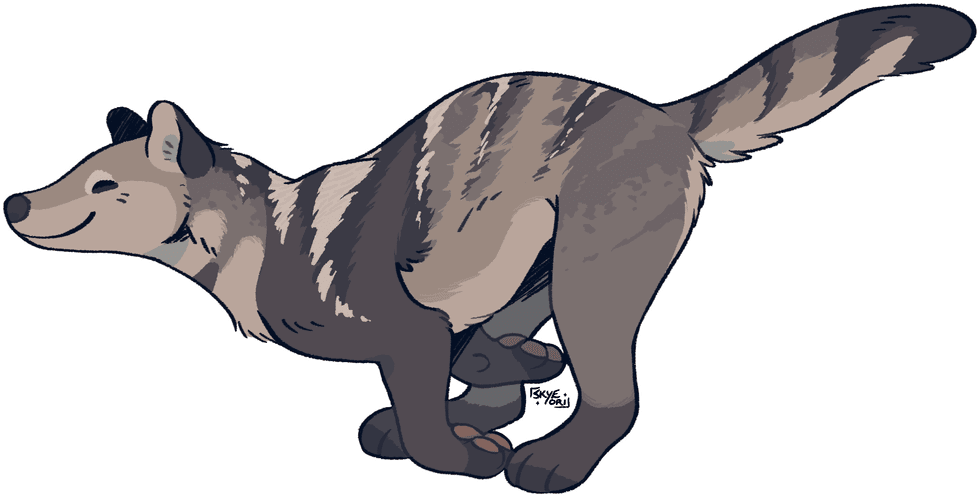
University of Michigan
A Lesson for Modern Times
While it looks and acts a bit like a modern dog's ancestor, Mesocyon belongs to an evolutionary branch that completely died out. Kort hopes the discovery serves as a reminder of what extinction actually means for the planet today.
"This fossil is not our current dogs' great-great-great uncle, because this whole line went fully extinct," Kort said. "I think sometimes there's an assumption that life finds a way... but when we lose things, they're gone forever. They're never going to be perfectly replaced, and I think that's an important lesson to take away when we're thinking about extinctions today."