
The U.S. reopened a border crossing in Arizona to cattle from Mexico on Monday as part of a broader effort by the Trump administration to reduce record-high beef prices, though economists doubt the move will mean much to grocery store shoppers.
"Cattle producers are extremely frustrated by this announcement, and I think it's important for us to take a step back and really remember that beef sales and demand have remained resilient even as price pressures force consumers to adjust their budget and spending," Kaitlyn Root, from Minnesota State Cattlemen’s Association, told WCCO's Adam and Jordana. "Consumers are seeing an increase in many different items at the grocery store, yet the administration seems to keep focusing all of the attention on beef, even though it is not the only item experiencing these price changes."
Root also says any price decreases would be manufactured, and not a solution. In fact, she calls it market manipulation.
"We feel this move is unlikely to have any significant long-term impact on the price of beef," Root explains. "If consumers see a decline in beef prices from this, it would be moderate and short lived, so that's on the consumer side. But on the producer side, cattle producers are already facing significant challenges."
The U.S. Department of Agriculture has said concerns about the New World screwworm's spread lessened enough to allow the movement of cattle from Mexico at a crossing in Douglas, Arizona, about 230 miles (370 kilometers) southeast of Phoenix. Over time, it hopes to reopen other crossings in New Mexico and Texas.
“Today, the border in Sonora is open for livestock,” Mexican President Claudia Sheinbaum said during a Monday morning news conference in Mexico City, referring to the Mexican state bordering Arizona.
Beef prices clearly are a concern for President Donald Trump, who announced Friday that he would allow up to 331,000 tons (300,000 metric tons) of imported ground beef into the U.S., tariff-free, to be sold at below-market prices over the next 90 days. In February, the White House said closing the border to livestock imports from Mexico more than a year ago was “essential” to containing the screwworm but it has exacerbated a shortage of cattle for slaughter in the U.S.
“The administration obviously has a lot of incentive to try to be able to say that they’re doing something about high beef prices in particular,” said Derrell Peel, a professor of agribusiness at Oklahoma State University. “Beef has been singled out because it is an expensive product and because it’s just high profile.”
The Trump administration closed the border to cattle imports in May 2025 as part of its response to the screwworm, a parasite with flesh-eating larvae that can infest and even kill cattle or other animals. The move came as the U.S. already was struggling to meet beef demand, thanks to a cattle herd that has been shrinking for five years and now is the smallest in decades.
Because the USDA plans a phased reopening of the border, it will take months for Mexican imports to return to their traditional levels, Peel said. Mexico has traditionally provided 1.1 million head, or about 3% of the U.S. cattle supply.
“I don’t expect to see any measurable impact on cattle prices or beef prices soon,” Peel said.
Root says that just trying to buy beef locally to support ranchers and farmers is not going to do much to help.
"So there is a trend toward consumers buying more beef locally, and we think that's great," Root explains. "However, local beef is not always available or accessible to every consumer. So, while this trend may create new opportunities for some producers, it is not a solution for all producers or all markets. That's why it remains important to maintain stable, competitive markets that allow U.S. cattle producers to succeed on a level playing field in these increasingly global marketplaces."
The smallest US herd in decades fueled record prices
The USDA reported that on Jan. 1, the U.S. cattle herd had dropped to 86.2 million head, the lowest figure in 75 years. Beef prices skyrocketed over the past five years, rising significantly faster than food prices as a whole, according to the U.S. Bureau of Labor Statistics.
Root adds that it has become increasingly difficult to be a cattle rancher in the U.S.
"This comes from years of drought conditions and rising input costs, so ranchers are making tough daily decisions about feed availability, forage conditions, herd retention, and long-term investments," says Root. "It's really difficult to maintain your herd at the typical size and levels that you would when you don't have as much feed for them. So, the number one reason is drought conditions, but we're also seeing an aging demographic in farming and ranching. There's truly just less farmers and ranchers around, because it's really an aging demographic."
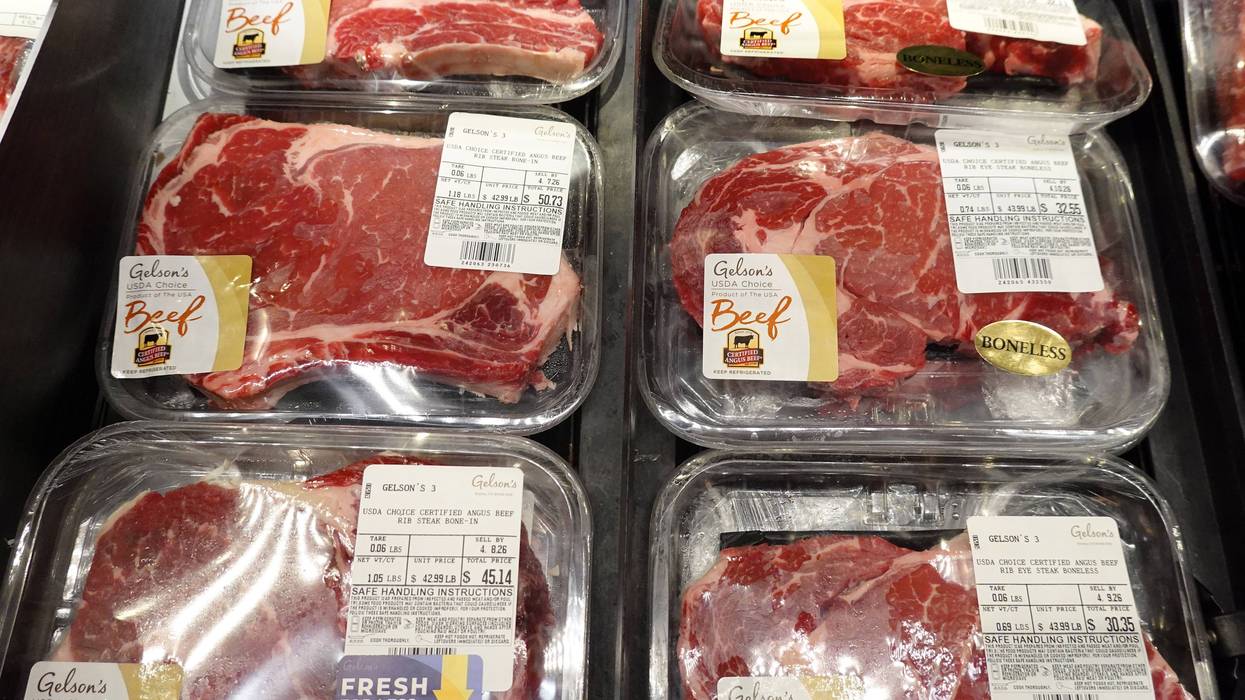
The average price of a pound (453 grams) of ground beef rose nearly 57% from July 2021 to July 2026, from $4.39 to $6.89 — hitting a peak of $6.90 in May — with a 10% increase over the previous year. Food prices have risen about 25% overall in those five years, according to the bureau's numbers.
The price for a pound of uncooked steak rose 35% over the past five years, reaching a record $13.06 per pound in July, also 10% higher than a year before.
But Glynn Tonsor, a professor of agricultural economics at Kansas State University, said the potential effect on beef prices from the smaller supply of cattle was lessened because the U.S. beef industry is more efficient and has been able to get more meat from each animal than in past years.
The USDA says the reopening starts at a safe spot
U.S. government and industry officials view the New World screwworm fly as a major threat to the nation's $113 billion cattle industry. It was an annual warm-weather scourge for U.S. ranchers from at least the 1930s through the 1960s, until the U.S. largely eradicated it. The fly was contained for years near the Panama Canal, but returned to southern Mexico in late 2024 and advanced toward the U.S., with the first case in Texas since 1966 reported June 3.
Since then, more than 40 cases have been confirmed in southern Texas and southeastern New Mexico, with infestations of cattle, sheep, goats and dogs.
In her July announcement of plans for a phased reopening of the border, U.S. Agriculture Secretary Brooke Rollins said it was possible to start with an Arizona crossing because the northern Mexican states of Sonora and Chihuahua had stronger animal health programs than other parts of Mexico. She also said each animal would be inspected and declared free of the parasite before crossing the border.
U.S. Senate Agriculture Committee Chair John Boozman said the USDA is taking a “careful, science-based” approach to reopening the border and imposing strong animal health protocols.
“This is an important step for America’s cattle producers, especially our feeders in the border states,” Boozman, an Arkansas Republican, said in a statement. “Restoring this long-standing trade is critical to strengthening our cattle supply and supporting a healthy, competitive beef industry.”
Drought, low prices led to the smallest US herd in 75 years
Drought in cattle-producing regions of the U.S. is a major reason the national herd is so small, said David Anderson, professor of agricultural economics at Texas A&M University. If grass doesn’t grow, cattle have nothing to graze upon, forcing ranchers to sell them off. Low cattle prices over the past two decades also are a factor.
“Where we are today is sort of the culmination of some 18, 19, 20 years of very low cattle prices,” he said. “That forces us to reduce our herds. Drought forces us to reduce them even further.”
The shortage of cattle also has left beef processing plants operating below capacity.
Tyson Foods, one of the nation's largest meat processors, announced in November that it was reorganizing its beef operations and closing a plant in Lexington, Nebraska, about 220 miles (354 kilometers) southwest of Omaha. Earlier this month, it announced plans to close a plant in Utah outside Salt Lake City and another in Illinois about 150 miles (241 kilometers) southeast of Chicago.
In June, another major U.S. processor, JBS USA, announced plans to close beef plants in Memphis and outside Philadelphia, though it later said it would keep some operations at the Pennsylvania plant to preserve 400 jobs there.
Rebuilding the U.S. herd — and ultimately lowering prices — likely will take years, largely because a cow typically has only one calf a year, Peel said. In addition, breeding a heifer keeps her out of the food supply, tightening it further as the herd is rebuilt.
Peel said prices will remain high for some time and for elected officials, “There’s nothing you can do.”