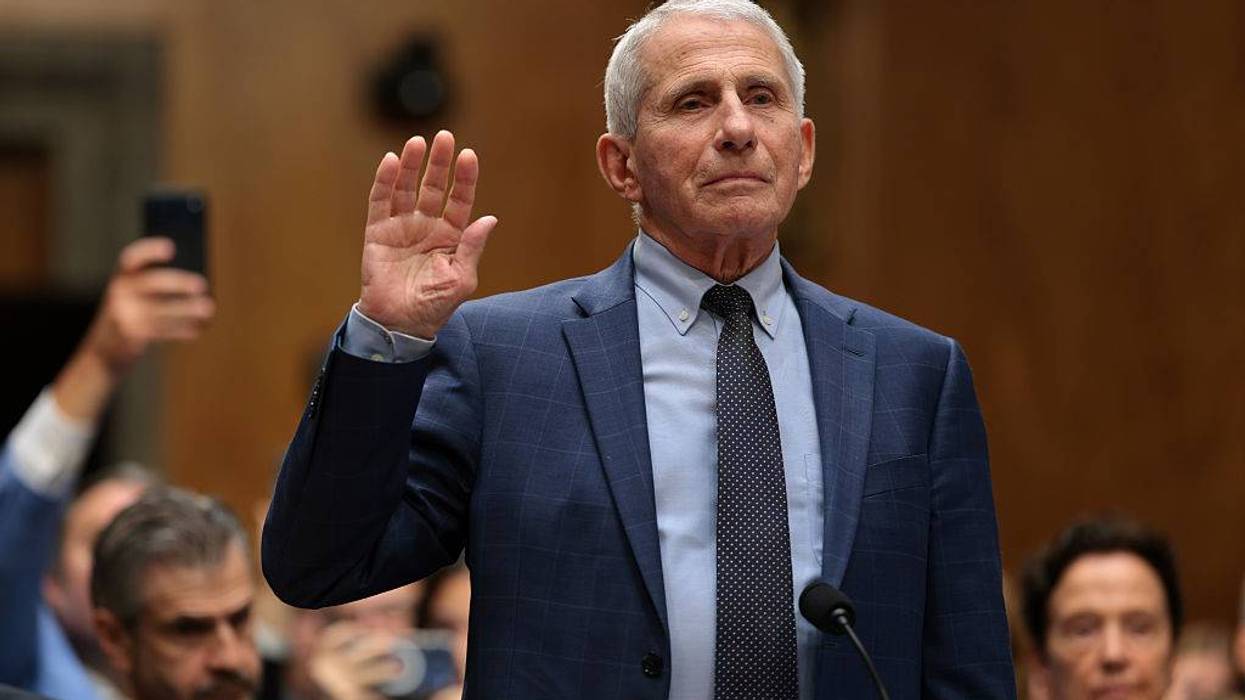

Days after Sen. Rand Paul (R-Ky.) released former National Institute of Allergy and Infectious Diseases (NIAID) Director Dr. Anthony Fauci’s “secret” unredacted diary entries, Fauci appeared in front of lawmakers Wednesday. In response to Paul’s questions, Fauci pleaded the Fifth again and again.
In opening statements, Fauci noted that he’s answered similar questions under oath many times. Even so, Paul has remained dedicated to his crusade against the former NIH director. His release of Fauci’s dairies, including “prequel” documents, were accompanied by cover letters that Paul stylized as hand-written diary entries on college ruled paper, including pink cursive script and heart doodles.
“Given Senator Paul’s obvious obsession with calling for my prosecution, his repeated slanderous comments about me and recently, his publicly releasing my unredacted personal diary aimed at embarrassing and intimating me, the only conclusion I can reach is that the sole reason he is calling me before this committee is to get me to say something, anything, that could vindicate his repeated public pledges that I end in his words, ‘behind bars,’” said Fauci in his opening statements Wednesday.
Fauci, now 85, served as the NIH’s AIDS Coordinator before his appointment as the first director of Office of Aids Research upon its establishment in 1988, according to the NIH. He held other positions in his decades long career before becoming head of the NIAID and retiring in 2022.
“Any reasonable person who has followed his unhinged obsession with me would readily come to the same conclusion, “Fauci continued in his Wednesday statement, referring to Paul. “Therefore, although it pains me to do so, because of the respect I have for the legislative branch of government, and my decades-long record of cooperating with Congress, under the advice of my attorneys, I will invoke my right under the Fifth Amendment of the Constitution to refrain from answering your questions.”
Paul’s stylized cover letter on the “secret diary” release notes that “Fauci took meticulous notes about his work.” Paul also alleged that Fauci “gloried in the positive attention he was receiving from legacy media and demonized those who questioned his official narrative – like me.”
Forbes said in an article this week that Fauci’s critics have accused him of “being consumed with his sudden fame while tasked with pandemic response efforts,” during the COVID-19 pandemic. However, it also noted that Fauci expressed discomfort with fame in his diaries.
“The ‘swag’ around me is getting really ridiculous,” Fauci wrote, of items like payer candles and jerseys adding, “Geeeez!! I do not like this one bit.”
Paul also claims that “many entries in Fauci’s daily historical account completely undermine the official narrative that Fauci and other public health officials espoused.”
In addition to Fauci’s diary, Paul released internal Slack messages exchanged among the authors of “The Proximal Origin of SARS-CoV-2” report: Kristian Andersen, Robert Garry, Eddie Holmes, and Andrew Rambaut. Paul’s office said in a press release that the messages “show that behind closed doors, the paper’s own authors were far less certain than their public conclusions suggested.”
Paul alleged in the diary cover letter that Fauci urged National Security Council officials to work closely with Andersen, Holmes, Garry and Rambaut. Specifically, he linked this to Fauci’s dismissal of the Federal Bureau of Investigation’s lab-leak investigation into whether COVID originated in a Wuhan, China, lab that received funding from the U.S.
Fauci has supported the theory of animal-to-human transmission of COVID in the Wuhan area that then led to human-to-human transmission of the virus. According to Paul, Fauci “was not just listening to the intelligence debate; he was actively arguing against the FBl’s position and directing officials toward the experts he trusted.”
“Fauci’s defense came down to allies and definitions,” said the cover letter.
Scientists in the virology community generally agree with Fauci’s version of how COVID developed, NPR said. Two of those scientists were quoted by the outlet.
Felicia Goodrum, a virologist at Dartmouth College who spoke to NPR from the American Society for Virology meeting in Minneapolis, said that genetic data about the virus “maps all initial cases to that market,” referring to a wet market in Wuhan where animal meat was sold – infected meat is the suspected origin of the virus. Goodrum said the genetic data does not point to the Wuhan Institute of Virology.
Robert Garry, a virologist at Tulane University, said there is “no actual evidence” for the lab-leak theory, even though Republican-led Select Subcommittee on the Coronavirus Pandemic published its final report that concluded a lab leak was the most likely explanation for the origins of SARS-CoV-2 back in 2024. He said the Wuhan Institute of Virology did not have a precursor virus similar enough to SARS-CoV-2 to create the pathogen that ultimately caused the pandemic.
Others figures on the right have also criticized how Fauci handled the pandemic and he was even preventively pardoned by former President Joe Biden at the end of his term. For example, current Health and Human Services Secretary Robert F. Kennedy, Jr.
“I think he was vulnerable, I think he had a lot of liability on creating… coronavirus,” Kennedy, who has faced his own share of criticism, said in a “The Tucker Carlson Show” interview.