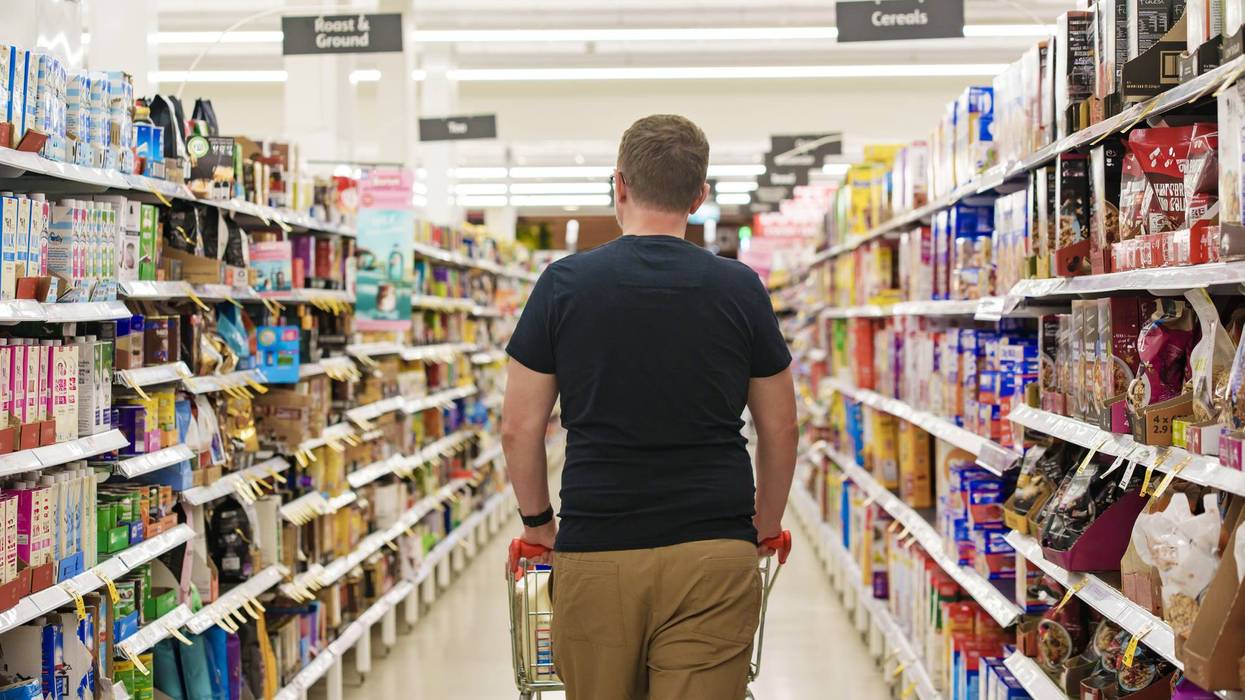

“So that’s not good. That could be a problem,” said X account FactPost on Tuesday, referring to Fox Business reporting this week on JPMorgan’s prediction that global food inflation will spike 5% in the first half of next year.
If that makes you feel like that “This is Fine” meme, you’re probably not alone. Here in the U.S., the Consumer Price Index for food has already increased by 3% over the last year, according to the Bureau of Labor Statistics. In July alone, it increased by 0.1%.
MoneyWise noted that the 5% figure comes from a recent JPMorgan report titled “Food Security is National Security: A Compounding Storm” and that the U.S. isn’t one of the countries that’s expected to be directly hit by food security threats. However, those threats are expected to disrupt the U.S. food system – and the prices we pay for groceries – anyway.
“America relies on imports for many of its staple foods, including coffee, cocoa and sugar. All of these goods are generally supplied to the U.S. by the countries that are most likely to be directly impacted,” MoneyWise said.
According to Newsweek, the reported was penned by JPMorgan senior global economist Nora Szentivanyi. She said that “successive shocks since COVID-19 have compounded, keeping food price pressures elevated into 2027,” the outlet noted. It also said the report “echoes previous warnings about the pressures on food supplies, with institutional desks, including Goldman and HSBC, warning of mounting food inflation risks.
One of the main factors leading to the inflation prediction is conflict in Iran. U.S. President Donald Trump announced in February that the U.S. had joined Israel to attack Iran, and fighting has gone on for months, resulting in blockades of the Strait of Hormuz, an important transportation route for oil and fertilizer.
In May, JPMorgan Global Head of Climate Advisory Dr. Sarah Kapnick wrote that the ongoing conflict in Iran could disrupt fertilizer supply. She said that “nitrogenous fertilizers shipped from the Persian Gulf,” were especially vulnerable and that disruption could raise farming costs and contribute to higher food prices over time.
“Fertilizer shortages can hurt harvests because the timing is unforgiving: farmers need nitrogenous fertilizers at planting, and they can’t be effectively applied once crops are already in the ground,” Kapnick explained. “Even if fertilizer shortages abate, there can be lingering effects because restoring fertilizer production can take time, while planting windows arrive on schedule.”
Kapnick also pointed out that “we’ve been here before,” when it comes to a convergence of global conflict impacting fertilizer and the El Niño weather pattern.
“In 2022, Russia invaded Ukraine, restricting access to and applications of potash and phosphorus fertilizers, lowering crop output and raising costs,” she wrote. “An El Niño later developed in mid-2023 with forecasts from central banks and commodity experts that production could decline for certain staple crops after El Niño peak in early 2024. These effects did play out, but there were mitigating global factors for certain crops.”
Nitrogen is the largest fertilizer consumed by mass, Kapnick said. She explained that synthetic nitrogen production converts natural gas into urea, “a nitrogen-rich fertilizer used globally,” and that more than 36% of global urea is imported from the Persian Gulf.
“Since the beginning of the Iranian conflict, the production of these materials has slowed, and the shutdown of the Strait of Hormuz has inhibited global trade – leading to rapid supply reductions and commodity price increases,” Kapnick said.
As of Aug. 13, the National Weather Service’s Climate Prediction Center said that El Niño conditions were strengthening, again just as they were in 2023 and 2024. MoneyWise called the fertilizer shortages a “ticking time bomb” and that is on track to coincide with what is expected to potentially by the strongest El Niño on record since 1950.